


Cornelia Poletto: Italian Cooking, Hamburg-Style
I personally love cookbooks and have probably around 600 of them—the Internet could never replace them!
They are an inexhaustible source of inspiration for me.
When I’m planning meal sequences for guests or a new menu, I enjoy sitting down in a relaxed way,
with a glass of wine, and flipping through cookbooks. They give me a great sense of calm.
It’s a ritual, like reading the newspaper. There are always a few lying next to my bed.
Cornelia Poletto, Moingiorno, p. 172
Why are there actually so few female chefs among the top “whatever-the-number” chefs? At least in Germany, the number is vanishingly small. Earlier this year, I read in the Süddeutsche Zeitung: “There are fourteen female Michelin-starred chefs in Germany. In a total of 341 Michelin-starred restaurants. That’s just four percent—4.09 percent, to be exact.” There are many reasons—care work at home, a male-dominated industry—but these are really just excuses for the long-standing status quo. One woman who has held her own in this culinary world for over 30 years is Cornelia Poletto. Although: it was a somewhat bumpy road before she could even use the word “held her own”…
Of course, the petite (159 cm) Cornelia also chose this rocky path for herself to some extent: Although she had already been accepted into an apprenticeship program at the renowned Hotel Vier Jahreszeiten in Hamburg after graduating from high school, she applied to work at Hein Winkler’s Residenz in Aschau. Dressed in her hotel management school uniform—“in the Hanseatic style: a dark blue double-breasted jacket with gold buttons and a silk scarf I’d inherited from my grandfather”—she had to wait for Heinz Winkler in the Residenz’s hot kitchen. “I was standing there more or less in the way, surrounded by steaming pots and pans, with everyone staring at me. My face turned bright red as time went on; I didn’t even know where to look except down the drain of the sink I was standing next to. I can still picture that drain today. I waited. And waited. Finally, Heinz Winkler came in with the message that he didn’t have any time at all. Well.” But Cornelia wouldn’t be fobbed off; there was a second appointment. “Heinz Winkler wasn’t exactly thrilled about having a woman in his kitchen, but I needed an answer. ‘Yeah, for heaven’s sake,’ Winkler finally exclaimed at some point, ‘then just start here!’”
That’s how it all began. I know this thanks to her latest book. It has the lovely title *Moingiorno!*—perfect for an Italophile from East Frisia—and brings together what has been Poletto’s culinary philosophy for more than 35 years: North German coolness and Italian culinary art. *Moingiorno* is more than a cookbook: it’s also a book to read, a biography. Amid the 78 recipes—which are surely why most people buy the book or receive it as a gift—you’ll discover “My Culinary Life” in five chapters. The quotes in the previous paragraph are from the period between 1992 and 1995. These are texts well worth reading, written (according to the colophon…) by Bettina Wündrich and Theresa Hallermann—the recipes were thus put together by Cornelia Poletto and Kathrin Heuser: teamwork isn’t just for the kitchen; it also works wonders when making a book.
After her apprenticeship with a three-star chef, there was a grounding interlude: As head chef at a golf club on Lake Chiemsee, Cornelia learned to prepare 20 schnitzels at once—along with other main courses. And she learned to prepare simple dishes. “That did me a world of good,” she says. Cornelia then got the finishing touches—and arguably the most important ingredients—for her culinary style in Hamburg. While working with Sicilian chef Anna Sgroi and her then-partner Sebastiano, she learned to cook at a Michelin-star level and met her future husband, sommelier Remigio Poletto. Oh, and a little side note: she didn’t land the job with Anna Sgroi until her second try. “In 1996, I traveled from southern Germany to the job interview with high hopes—and Anna (who is now a very good friend of mine) had absolutely no desire to deal with me. She told me to come back another time, but this time for a trial shift.” It worked out—she worked with Anna Sgroi until 1998 (when the restaurant closed).
Self-employed for 26 years
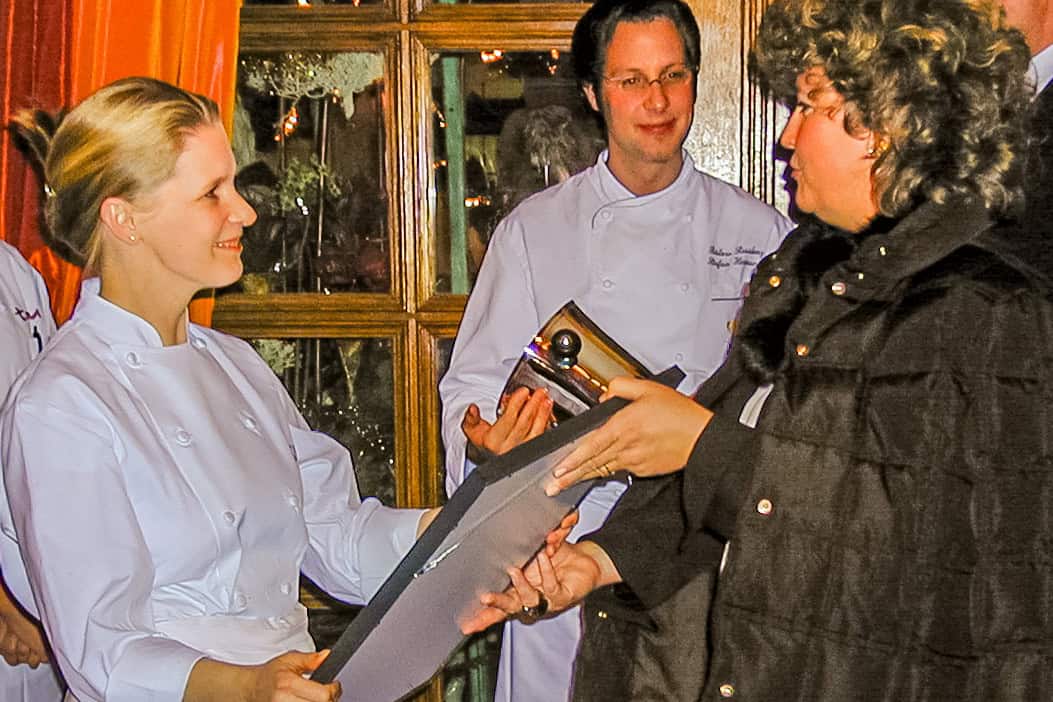
Italian cuisine and an Italian husband: it just had to be an Italian restaurant: In 2000—after yet another interlude; history really does repeat itself—first came the wedding, and then the restaurant “Poletto.” It was by no means a surefire success at first, but in 2002 it earned a Michelin star and was named “Rising Star of the Year” by Feinschmecker magazine. Incidentally, the male counterpart was Stefan Hermann. The certificates were presented in December of that year by Feinschmecker’s editor-in-chief Madeleine Jakits at the Caroussel (she is now the magazine’s publisher).
That’s all (in principle, despite the length: so little) about Cornelia Poletto’s career up to the point of opening her own restaurant, which still exists today at a different location under a only slightly altered name (Cornelia Poletto). But now, finally, on to the recipes! They’re divided into chapters familiar from the menus of fine Italian restaurants: Aperitivi – Antipasti – Primi – Secondi pesce – Secondi carne – Dolci. You can still find what you’re looking for quickly via the summary of all recipes and, above all, the detailed ingredient index. It’s no rocket science, but it’s always nice to have! Incidentally, while the recipes all have Italian names with German subtitles, the overview is in German, which will suit most readers.
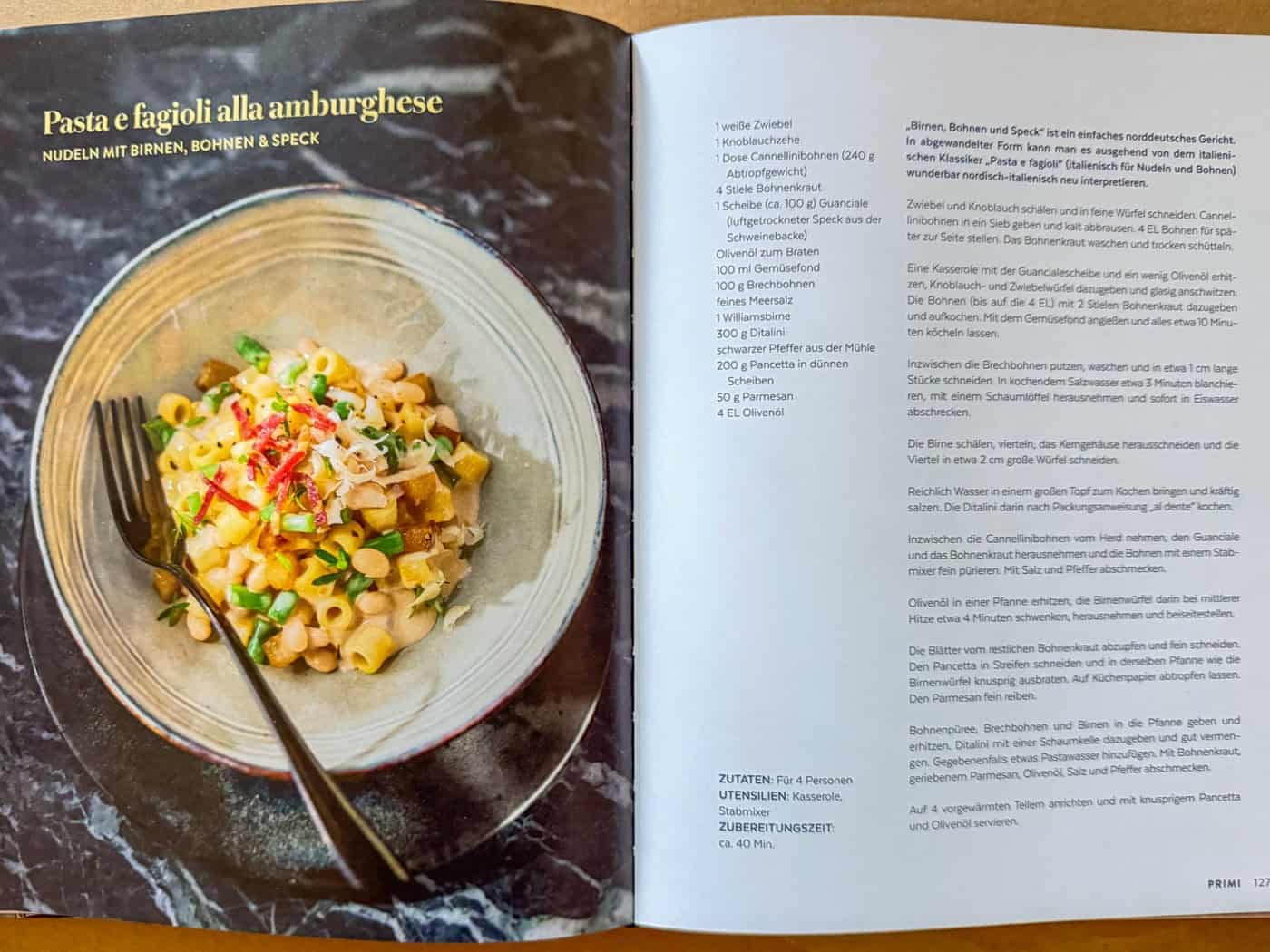
However, the Italian names of the dishes shouldn’t obscure Poletto’s unique approach: bringing together Italian and local Hamburg cuisine in the most delightful crossover on the plate. For example, the “Insalata con anguilla affumicata e salsa di patate” is nothing other than a version—not uncommon in northern Germany—of a lamb’s lettuce salad with potato dressing and smoked eel (my simple Westphalian variation, to which eel would also pair well: spinach leaf salad). I also really enjoyed the Italian twist on the typical Berlin veal liver dish, served as “Pasta alla Berlinese”—that is, pasta with veal liver, apple, and pearl onions—and the North German classic of pears, green beans, and bacon, also served with pasta as “Pasta e fagioli alla amburghese.” What these (and the other) recipes have in common: they aren’t overly complicated, but rather sophisticated and, in principle, easy to recreate. The fact that it’s usually not quite that easy at home is fine—after all, anyone who can cook tends to use a cookbook mainly for inspiration rather than as a strict, one-to-one copy, because the original is always better in at least two ways: no prep work, no dishes!
Cornelia Poletto, Moingiorno!
Publication date: October 7, 2026
Illustrated hardcover, 240 pages
ZS – a publisher of the Edel Publishing Group
ISBN 9783965846531
€29.90