

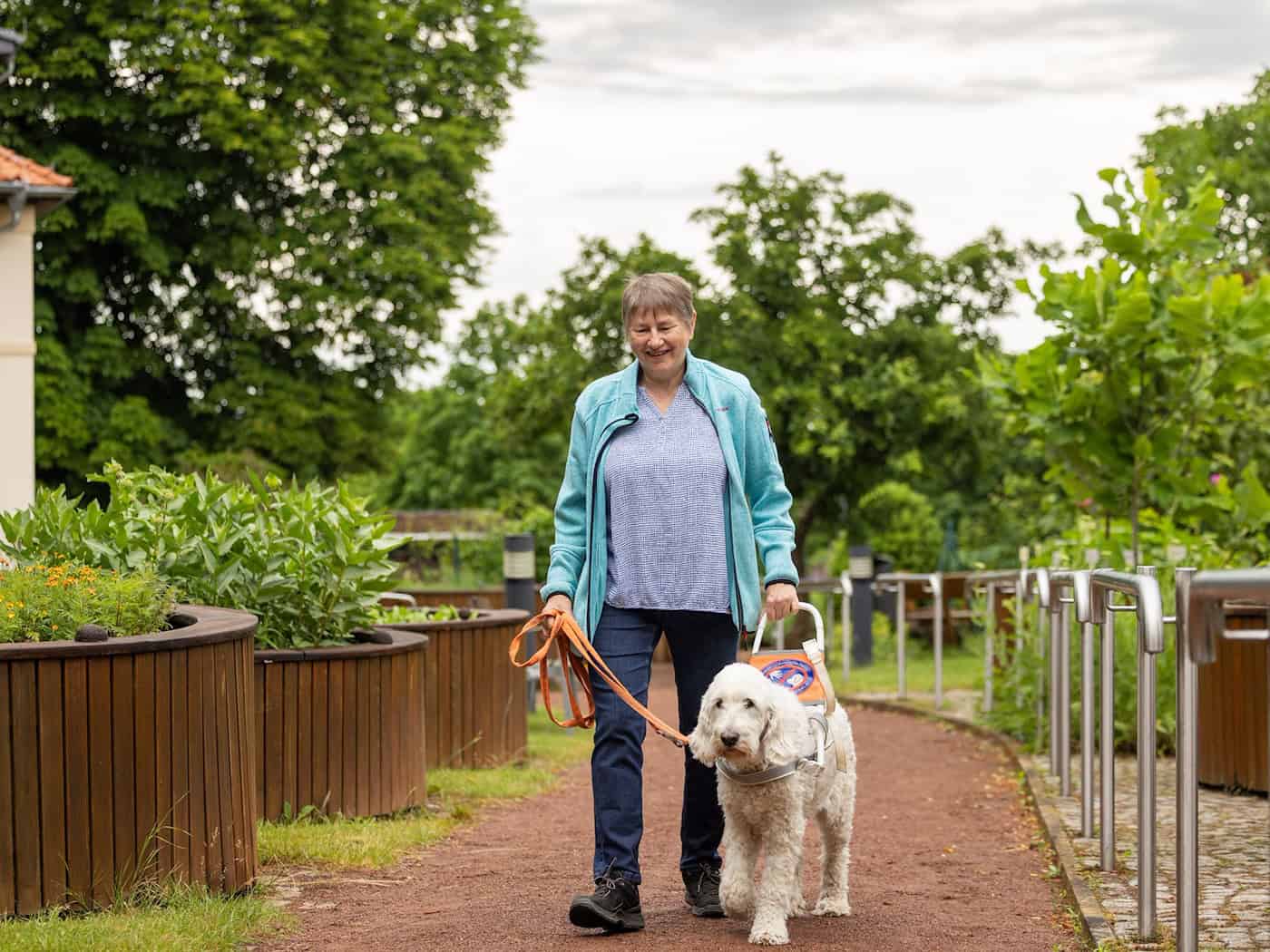
Marion Krause approaches the plants cautiously. She feels for the leaves and gently touches the flower. A spicy-sweet scent wafts up. “That’s the hedgehog carnation,” she says with a smile. Just a few steps further on, the scent of roses, flowering herbs, geraniums, and aromatic conifers fills the air. Even for sighted people, the Botanical Garden for the Visually Impaired in Radeberg, in the Bautzen district, is a natural wonder. But for people who are visually impaired or blind, it offers a rare opportunity to explore the plant world independently. Of the 1,300 plant species on site, about 700 can be experienced by them through their scent. Across the 22,000 square meters, many ideas that Marion Krause—as a visually impaired person—has helped initiate in recent years have now been brought to life. The former physical therapist and herbal educator is chair of the garden’s support association, which is part of the Deaf-Blind Service of the Evangelical Church in Germany. Deafblind people in particular, she says, often feel as if their bodies are “a kind of prison.” Quite a few struggle with depression and isolation. “Experiencing nature through the sense of smell and continuing to train this sense is a kind of refuge for them and can give them new courage to face life.” Some deaf-blind people regularly help with the gardening, reports garden director Almut Dietze. “Safety is important to us—something that people with these disabilities would also like to see more of in their everyday lives.” Twenty-five raised beds are set up at a height that’s easy to touch and smell. Along the 1.5-kilometer network of paths, the surface changes constantly: sand, wood chips, solid paving, or softer, meadow-like sections indicate the location. A continuous handrail runs along the main paths, supplemented by orientation markers in Braille and tactile cues at junctions. “Nothing leads into nowhere,” explains Dietze. “You always know where you are.” In Saxony, much has been achieved in recent years to make public spaces safer for visually impaired and blind people, says Andreas Schneider, chairman of the Saxony Association for the Blind and Visually Impaired. “The biggest challenge now is to maintain the standards we’ve achieved and to be involved in new projects from the very beginning.” A specialist group within the association supports a wide variety of construction projects. Schneider cites Leipzig Central Station with its wayfinding system, the redesign of the station forecourt in Meissen, and museums in Chemnitz as examples. “We’re constantly on the move.” This is because contrasts, tactile markings, and guide strips provide important orientation for those affected. However, planners and architects rarely encounter the needs of blind or visually impaired people during their training, says Schneider. “Accessible solutions aren’t always necessarily associated with higher construction costs.” He describes digital accessibility as a growing problem. Many forms, apps, or PDF documents are still difficult for screen readers to use. “We’re often not taken into account—or, it feels like, sometimes completely forgotten.” This also applies to government agencies and public institutions. At the Blindengarten Radeberg, on the other hand, many people with visual impairments experience a place that is consistently tailored to their needs, says Marion Krause. “Here, they can lose themselves in the scents and rediscover joy.” The landscaped scent trails are particularly well-suited for this purpose. One of them features around 55 species of sage, including dandelion-leaved sage, peach sage, Peruvian sage, and honeydew melon sage. Even the slightest touch of the leaves, flowers, and stems releases an intense fragrance—sometimes tart, sometimes more fruity or sweet. The Deafblind Service of the Evangelical Church in Germany is based in Radeberg, explains Pastor and Executive Director Ulrike Fourestier. In addition to the Botanical Garden for the Blind, the site also includes a counseling center, assisted living facilities, and a meeting and guest center for people who are deafblind. According to the service, it is in contact with approximately 250 people affected by deafblindness throughout Germany. One of the biggest challenges, says Fourestier, is ensuring they receive the correct diagnosis early on and gain access to support. “This requires specialized counseling centers.” However, there is a lack of secure funding for this nationwide. Furthermore, there are gaps in care for deafblind people who require nursing care in old age. The Radeberg Botanical Garden for the Blind is celebrating its 30th anniversary this year. It was conceived by Ruth Zacharias, a visually impaired pastor and chaplain for the deafblind. She wanted to create a place where plants could be experienced primarily through smell and touch. Only a small proportion of people who are blind or visually impaired have been so since birth, says Marion Krause. Most experience the loss of sight later in life. “It can happen to anyone.” This makes it all the more important not to view inclusion as a special solution. The garden is open to the public on Wednesdays and Saturdays during the summer months from 1:00 p.m. to 6:00 p.m. Copyright 2026, dpa (www.dpa.de). All rights reservedMany Obstacles for the Blind in Everyday Life
Resource Center for Deafblind People


