

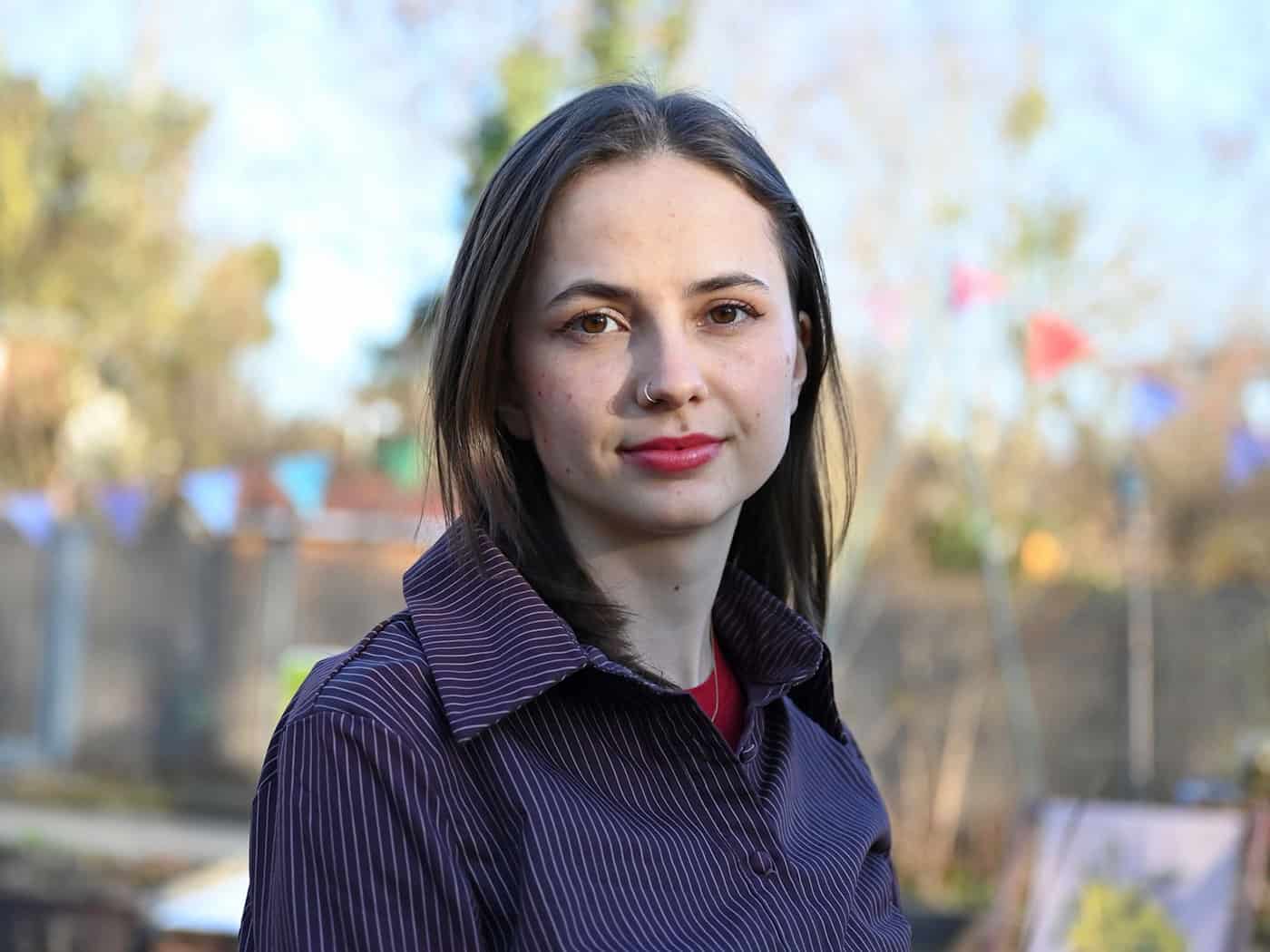
What is it like to grow up as a young woman in East Germany? Theresia Crone thinks for a moment. "I often had the feeling that I had to prove twice and three times over that I deserved a place at the table," says the Schwerin native. Even her mother always worked a lot and took on responsibility, says Crone. The 23-year-old was born and raised in the state capital of Mecklenburg-Vorpommern. Today, she is an activist for climate protection and the chronic disease endometriosis and lives in Berlin. She is not an isolated case - many young women emigrate. But what is it like to be a woman in an East German state? Where are they ahead of the West and where not? An overview on the occasion of International Women's Day on March 8. The wage level in eastern Germany is still significantly lower than in the west, says sociologist Jutta Allmendinger from the Social Science Research Center Berlin (WZB). The situation is similar for pensions. However, the difference to men is smaller. Last year, the expanded gender pay gap (labor market gender gap) of 22 percent was significantly lower than in the West (39 percent), according to figures released by the Federal Statistical Office in February. In addition to the gender pay gap, part-time and employment rates are also taken into account. The gender gap in the labor market was lowest in Mecklenburg-Western Pomerania (17 percent). This was followed by Saxony-Anhalt (20 percent), Saxony (21 percent), Brandenburg (22 percent), Berlin and Thuringia (23 percent each). In contrast, the gap was greater in the western federal states, with Baden-Württemberg and Bavaria leading the way (41% each). Women in the eastern German federal states are still more likely to work full-time. According to the Institute of Economic and Social Sciences (WSI) of the Hans Böckler Foundation, which is close to the trade unions, around six out of ten women work full-time, compared to around half in the west. Even in the GDR, this was a matter of course for women, says Allmendinger. There were no tax incentives to work less, as there are in the West with the spousal splitting system. "That was passed on to the children and grandchildren." Crone, however, would like to see a more differentiated view: "How are these women doing? Are they healthy? Are they happy? Are they financially secure?" Women with full-time jobs could also be overburdened if they were also looking after their families and taking on care work. It is also necessary to look at the differences between urban and rural areas. Research shows that more women are running companies in the eastern German states. The WSI assumes that the proportion of women at the top management level in private companies is around a third (32 percent), compared to 27 percent in the west. "When East German women become mothers, they are less reluctant to put their children in daycare," says Allmendinger. In many places in eastern Germany, the childcare rate for under 3-year-olds is over 60 percent, while in western Germany it is often only around 20 percent. "Of course, this has something to do with the fact that daycare centers have existed longer in the east and there is still a higher density." However, many young and, above all, well-educated women are migrating to the west, says Allmendinger. In some rural areas in eastern Germany, there is a clear surplus of men, as the Federal Institute for Population Research (BiB) also notes: There are fewer than 70 women among 18 to 30-year-olds for every 100 men. Crone also no longer lives in her home town of Schwerin. There are many reasons for this, including her political commitment. People who are committed to democratic structures are particularly needed in the eastern German states. For her, however, there is also the question of at what price; she herself does not always feel safe. Despite this, Crone appreciates the freedom she had as a teenager. She founded several clubs. This was not necessarily possible in the West, where the club structures were often better developed. "I think it's incredibly important that we also talk about East German biographies," says Crone. "At the same time, I think the prevailing narrative is counterproductive." If we only talk about the badly treated "Ossis" and the "better-Wessis", then the East is quickly cast in the role of victim and declared incapable of acting. People in the West often know little about the realities of life in East Germany. Crone wants to change that. "I call myself an Ossi, especially in the presence of Wessis," she says. That's how you get into conversation. Copyright 2026, dpa (www.dpa.de). All rights reservedLower wages, less inequality
More daycare, more full-time
More women in management positions
Young women are migrating
Crone: East is quickly cast in the role of victim


