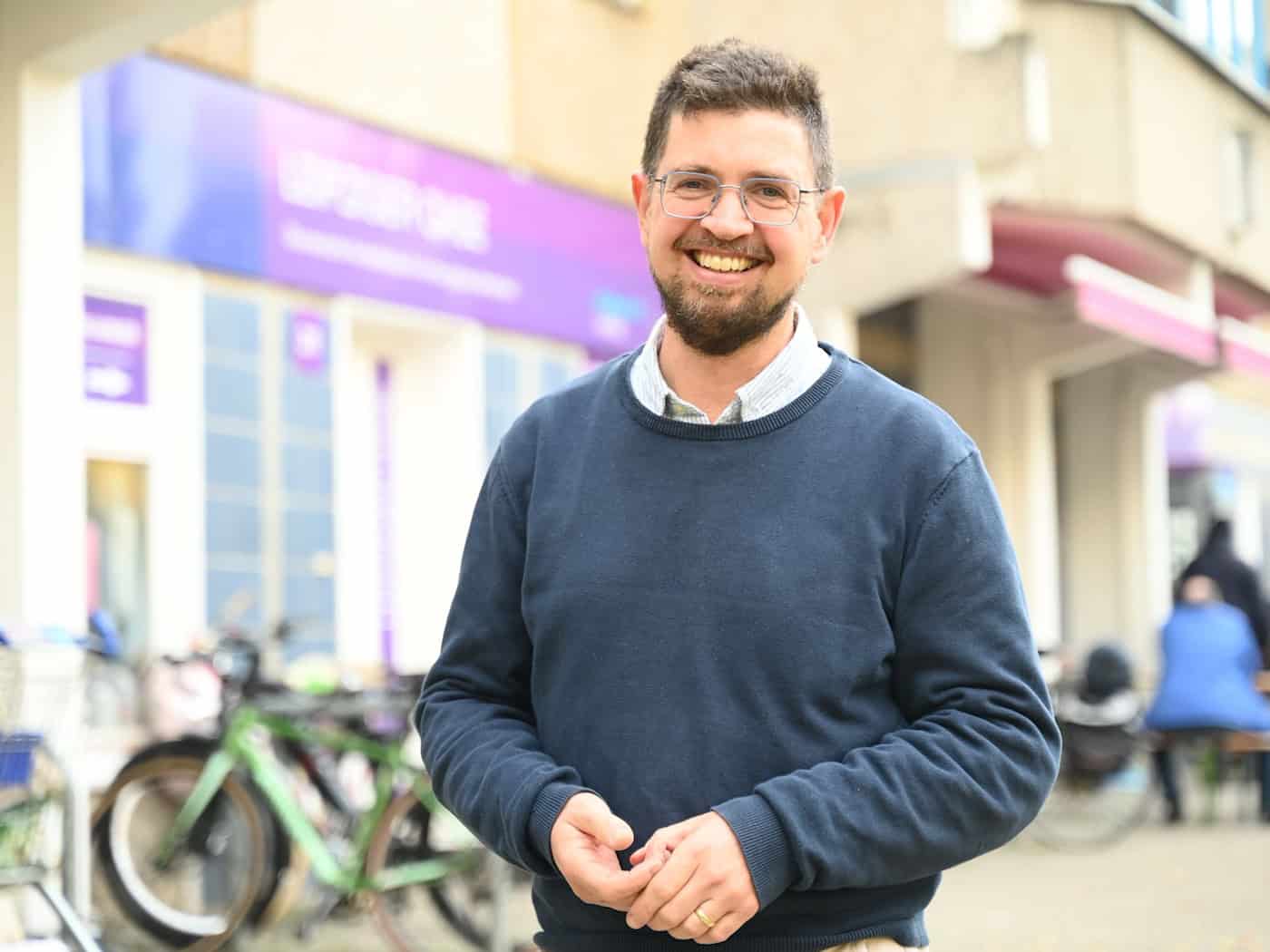
Several tents are set up on the lawn in front of the building that houses the Diakonie Leipzig Oasis. In between them, on the sidewalk and next to benches, there are about half a dozen people—middle-aged men and women. The Diakonie’s door opens practically every minute; more people come out of the building, while others step inside. This is where homeless people receive support. But the place wasn’t always as peaceful as it seems on this autumn Wednesday morning. At the end of last year, the city of Leipzig cleared the area—in part despite resistance from the homeless. When asked, city officials describe such clearances as a “last resort.” They argue that this merely displaces homelessness rather than ending it. The Social Services Office states that the primary focus is therefore on street outreach. According to the city, however, none of the “people camping out in front of the Oase” have yet been referred to overnight shelters. According to Benjamin Müller, it is impossible to put an exact number on the homeless population. However, the director of Oase Leipzig believes that the problem has likely grown due to rising rents in Leipzig. How a society deals with this issue is a “sign of its maturity,” Müller said. “Maintaining and financing safe housing could become one of the biggest issues in the near future and is a highly volatile social issue.” As of January 31, 2026, a total of 5,590 people in Saxony were housed due to homelessness. More than three-quarters of them were not German citizens, according to a publication by the State Statistical Office. However, these statistics only include people who were housed in a shelter as of the reporting date. This includes, for example, emergency and communal shelters, as the office stated upon request. Homeless people who are only temporarily seeking help at a day center are therefore not included. The actual number of people in need is therefore likely to be higher. Support services for the homeless are not limited to Leipzig. In Dresden, churches offer overnight shelter every year from early November through late March. This year, the demand for overnight stays was higher than a year ago, said Gerd Grabowski, coordinator of the night cafés. However, this does not necessarily indicate an increase in homelessness. After all, it has already been cold in recent days, Grabowski explained. Like Müller from Oase Leipzig, Grabowski also believes that the actual number of homeless people is virtually impossible to determine. The night cafés see about 2,800 overnight stays per season. However, this figure also includes people who come multiple times, Grabowski said. With up to 270 volunteers, they are well-prepared. For a 36-year-old lanky woman, the Oase in Leipzig is a place of refuge—once again. She is a trained office clerk and is now facing her third winter without a home, she said. She was fired from her job because she “isn’t really an early riser,” and she lost her rental apartment because she didn’t clear her trash from the common hallway. She now plans to take down her tent again and move on. Where to? She doesn’t know. She just didn’t want to go to the main train station. There, she said, there’s sometimes trouble with other homeless people. However, a single story like this isn’t representative of the lives of homeless people. After all, according to its own figures, the Diakonie assists nearly 100 people daily, and 1,600 people have registered their mailing addresses there. This is required to obtain a housing eligibility certificate. During the day, the Oase offers lunch for 2.50 euros, as well as breakfast; the building on Nürnberger Straße also provides free showers, laundry facilities, and social counseling. According to expert Müller, Leipzig is, alongside Berlin, the city that has experienced the largest influx of new residents in recent years. This has had an impact on rent prices. The median total rent burden for Leipzig households stood at 30 percent in 2024, according to the city’s social report. However, there are differences among households. According to a municipal citizen survey, the lowest-income 20 percent of households spent 43 percent of their net income on rent, while for the highest-income fifth, the figure was only 20 percent. In general, a rent burden of more than 30 percent is considered problematic because it often leaves people without enough money to live on. According to the City of Leipzig, 965 people were housed in the city’s emergency shelters last year, about one-third of whom were women. The men and women who receive support from the Oase during the day are not automatically included in the city’s statistics. In addition, quite a few of those affected—especially women—hide their homelessness, as Müller explained. However, not all homeless people can take advantage of the city’s services. Obstacles include, for example, pets, and there are very few shared overnight accommodations for couples, Müller said. Furthermore, the shelters are often located on the outskirts of the city and are not always easily accessible. In Leipzig, there has been an increase in the collection of sheltersuits in recent weeks. These are weatherproof jackets that can be converted into sleeping bags and are distributed to homeless people. While Müller considers this a sensible idea in the short term, he does not believe sheltersuits are a long-term solution. “In a wealthy society, it cannot be our goal to simply provide for the homeless outdoors. We must make these people part of our society again.” The Federal Ministry of Housing’s National Action Plan Against Homelessness aims to end homelessness by 2030. Müller doubts that this goal will be achieved. These are merely “moral declarations of intent,” and there is no budget for them in the federal budget, he said. The Diakonie’s “Oase,” run by volunteers and staff, is funded, according to its own statements, by the City of Leipzig, the church, and donations. To provide short-term shelter for homeless people, Müller suggests using gyms as overnight accommodations. The next morning, after the facilities are cleaned, school sports could resume, he said. In addition, more must be invested in education. Although those in need at the Leipzig Oase come from a “diverse background,” there is a link between a lack of a high school diploma and homelessness, Müller explained. He reported that two formerly homeless individuals are now employed at the Oase itself. They have found their way back to a stable life. Copyright 2026, dpa (www.dpa.de). All rights reservedNo one knows how many homeless people there are
In Dresden, there are night cafés to provide shelter from the cold
The Third Winter Out in the Cold
Rent Burden in Leipzig Has Reached a Critical Threshold
Sheltersuits Are Not a Long-Term Solution
Gyms as Overnight Shelter