

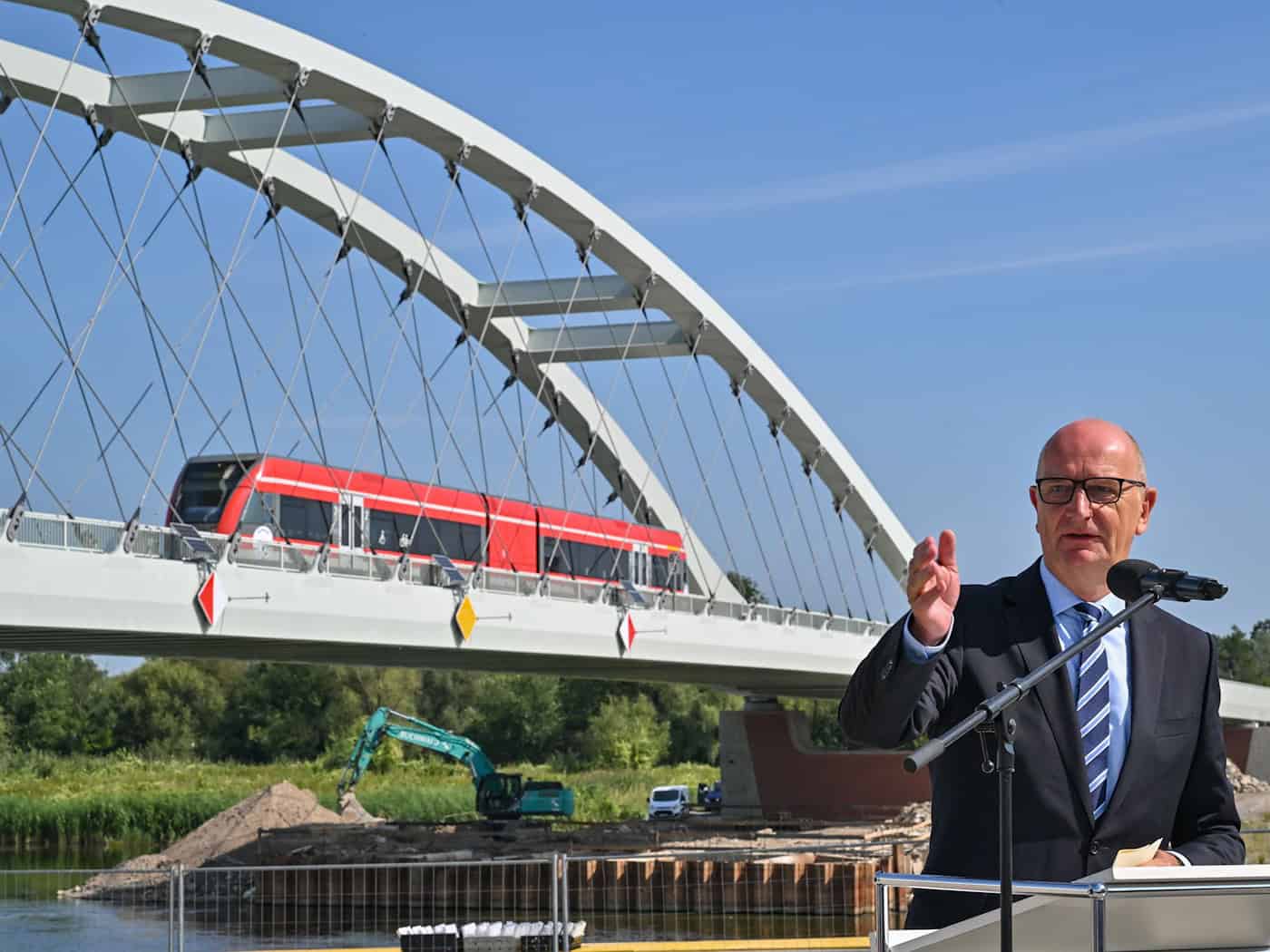
Brandenburg's Minister President Dietmar Woidke (SPD) sees a lot of catching up to do in terms of infrastructure in the eastern German states. "There are still huge differences between East and West," Woidke told RBB at the start of the conference of Eastern German heads of government. "We don't want special treatment for the East, we want fairness for the East, for example in the expansion of infrastructure towards Poland." The head of government is campaigning for the expansion of the Eastern Railway. If you look at the infrastructure on the Franco-German border and the train connections, there is a huge difference, said Woidke. The bridge over the Oder, for example, has been built, but the Federal Ministry of Transport refuses to build a second track. The route Berlin - Küstrin and further towards Poland is not electrified and is partly single-track on the German side. "This different treatment of things in the East and West leaves its mark on the people in the East," said Woidke. This is why the eastern states are particularly challenged to raise their voices together because they are relatively weak individually. "Incidentally, this affects Berlin just as much as Brandenburg, it affects Mecklenburg-Western Pomerania just as much as Thuringia." Copyright 2026, dpa (www.dpa.de). All rights reserved


