

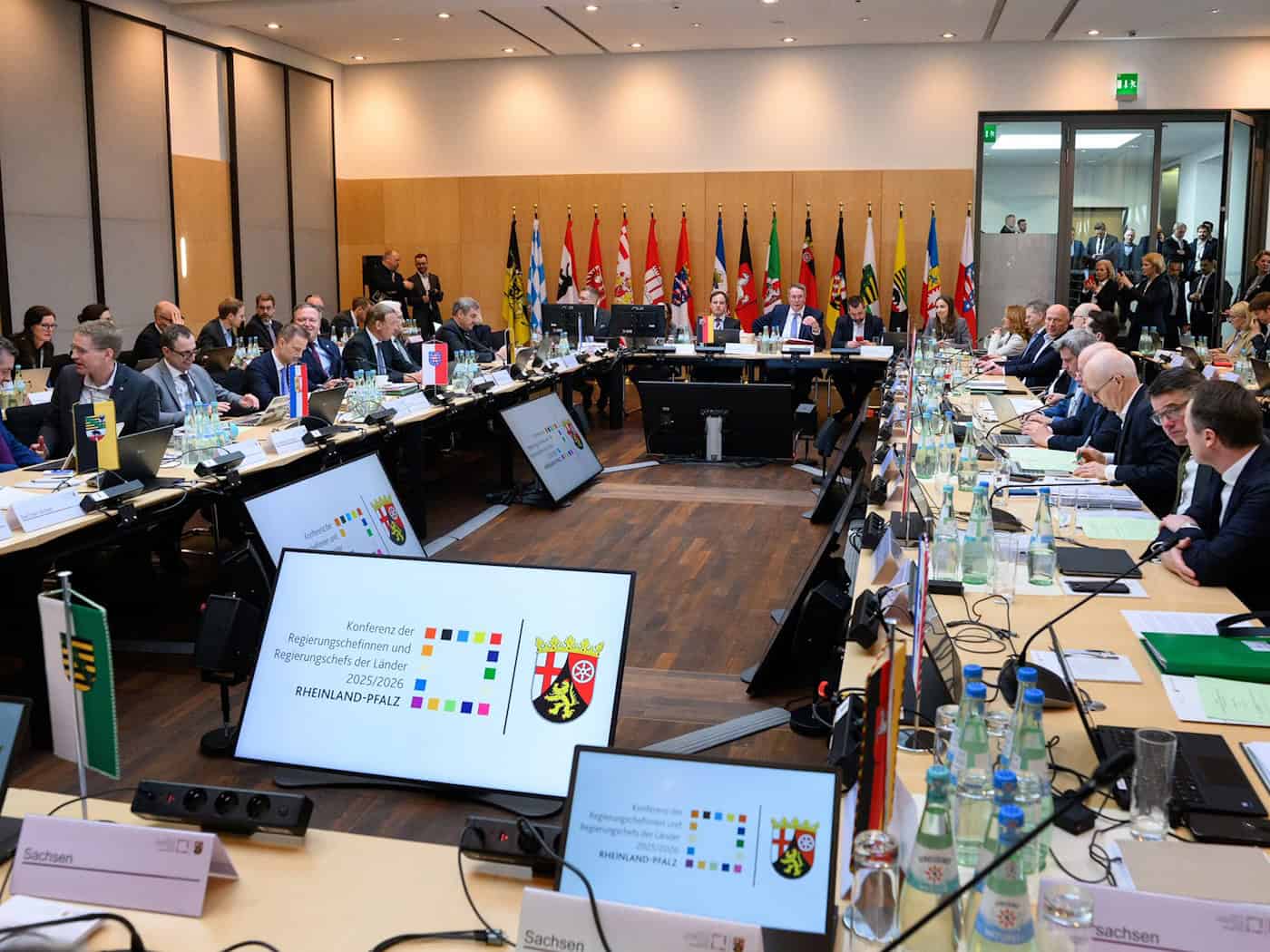
The federal states are demanding billions in emergency aid from the federal government for their financially ailing municipalities, some of which are on the verge of collapse. "The municipalities are not supplicants," emphasized Saxony's head of government Michael Kretschmer (CDU) at the Minister Presidents' Conference (MPK) in Berlin. "It is quite clear that the current situation has arisen and is being exacerbated by federal laws, by federal benefit laws." It is therefore not about "handouts" for the municipalities, but about clarifying this situation for which the federal government is responsible. The heads of the state governments spoke with the representatives of the municipal umbrella organizations before their actual consultations. MPK Chairman Alexander Schweitzer (SPD) warned that if a municipality could no longer guarantee services of general interest, this would have a negative impact on its citizens. "What is at stake is nothing less than the future of our democracy, which will or will not take place for the people on the ground," said the Minister President of Rhineland-Palatinate. The Chairman of the German County Association, Achim Brötel, called the financial situation of cities, municipalities and counties in Germany "truly dramatic". Last year, they presumably recorded a record deficit of more than 30 billion euros. "This will very quickly be reflected in the reality of people's lives." For example, if local authorities have to close hospitals or restrict local public transport. In addition to immediate financial aid for the old debts, the federal states and local authorities are also demanding that the federal government assumes all costs for tasks that it transfers to them in future. "The principle of 'he who orders, pays' must finally become reality," said Schweitzer. The President of the German Association of Towns and Municipalities, Ralph Spiegler, pointed out that the municipalities had proposed a one-third split of costs between the federal, state and local governments for the large block of social assistance at the beginning of the year. Spiegler called it incomprehensible that this proposal had been wiped away by the federal government as unfeasible without examination. "It has to stay that way: Whoever orders the party must at least participate, at least with this third." The municipalities are particularly groaning under the high social expenditure. Lower Saxony's Minister President Olaf Lies (SPD) emphasized: "We must also look at the expenditure side to see where the system is too expensive." It is also about reducing bureaucracy. "We can't get by if we just say we need more money. That's not there." Copyright 2026, dpa (www.dpa.de). All rights reservedMunicipalities record deficit of 30 billion euros in 2025 alone
He who orders the party must share in the costs


