

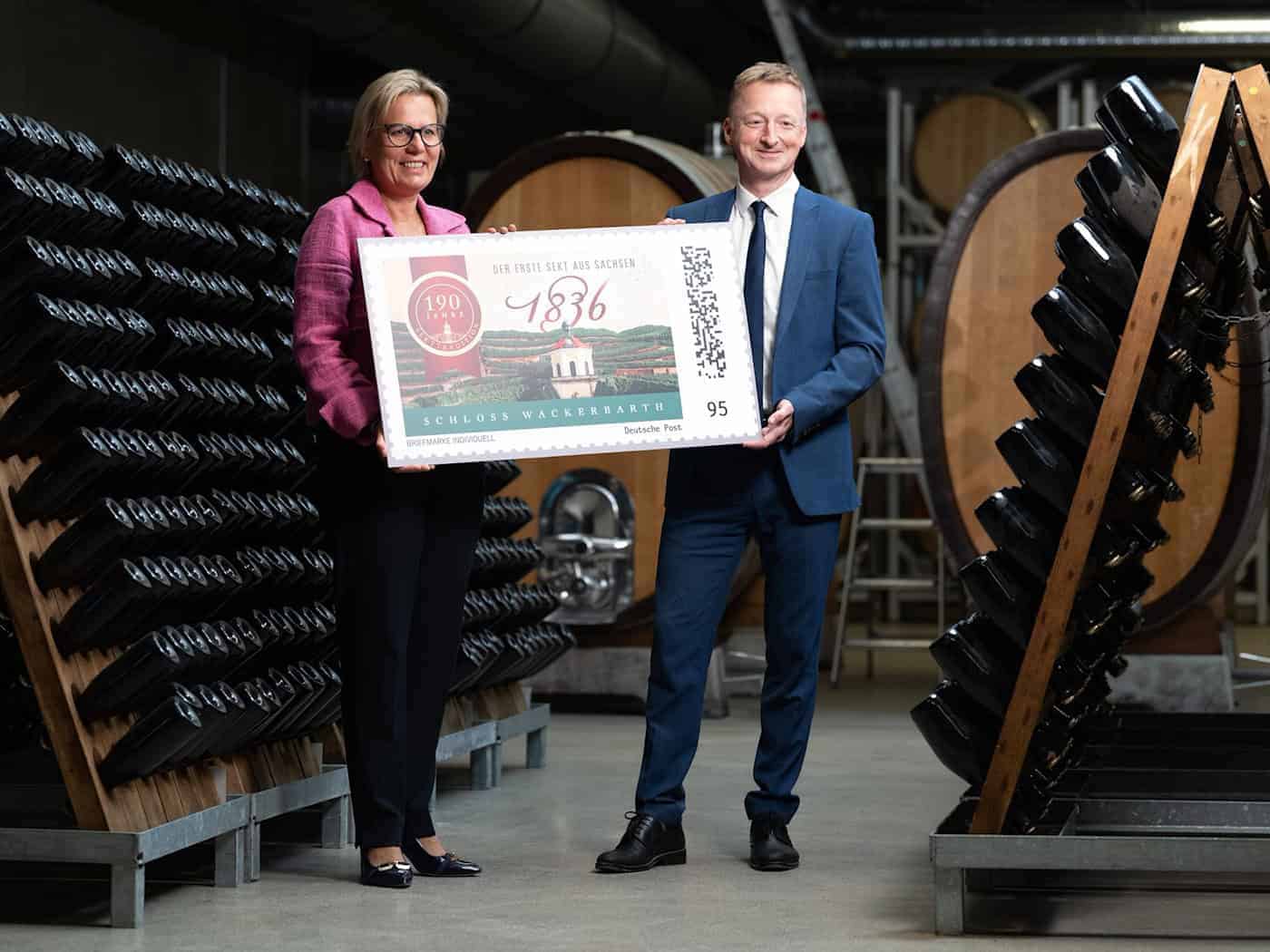
Saxony is popping the corks. This sparkling message can now be sent by mail all over the world. A special stamp commemorates the anniversary “190 Years of Sparkling Wine Tradition in Saxony.” Minister of Culture and Tourism Barbara Klepsch (CDU) unveiled the stamp, with a face value of 0.95 euros, together with cellar masters from the Schloss Wackerbarth State Winery. On this occasion, Klepsch was also allowed to rotate the sparkling wine bottles in the cellar. Rotating or shaking the bottles serves to move the yeast used during fermentation up into the neck of the bottle. The ministry used figures to illustrate just how important viticulture has become for tourism in the Free State. According to the data, it generates 3.1 million overnight stays per year. “During their stay in the Saxon wine region, wine tourists spend just under 300 million euros,” the report stated. This target group is particularly attractive to the Saxon tourism industry, as these guests’ spending is 11 percent (for overnight stays) and 55 percent (for day visitors) above the average for all travelers. At the event, Klepsch referred to the Tourism Master Plan, which is intended to generate creative ideas and competitive products. “In line with our ‘So schmeckt Sachsen’ initiative, the topic of cuisine is of great importance to us, as it ideally combines cultural and nature tourism. We see a great deal of potential in this area in Saxony.” According to the minister, the goal is to more closely integrate gastronomy, culinary arts, and tourism and to provide guests with unique experiences. “As an experiential winery, Wackerbarth Castle is one of our flagship attractions in this area and has significance that extends far beyond the Free State.” With more than 240,000 guests annually, the state-owned winery in Radebeul ranks among the world’s most-visited wineries, according to the “Global Wine Tourism Report 2025” by Geisenheim University. For this international analysis of global wine tourism, the authors surveyed more than 1,310 wineries from 47 countries, according to the report. In fact, viticulture can trace its roots back to an 850-year-old tradition. Sparkling wine was added later. In 1836, three winemakers in Radebeul founded a “Joint-Stock Association for the Production of Sparkling Wines.” “In doing so, they laid the foundation in the Elbe Valley not only for Saxony’s first sparkling wine winery but also for one of Europe’s oldest sparkling wine producers,” the State Winery announced. The Saxon founders obtained their expertise in bottle-fermented sparkling wine production directly from the heart of France’s sparkling wine region: Reims. Their first cellar master, Johann Joseph Mouzon, was an experienced expert who brought the classic bottle-fermentation method from his French homeland to Radebeul. Following his example, select Saxon grapes are still transformed into sparkling delights here today. Anyone wishing to purchase the limited-edition special stamp commemorating sparkling wine production should not delay a trip to Radebeul: It is available exclusively at the winery’s shop. The edition is limited to 1,836 stamps. Copyright 2026, dpa (www.dpa.de). All rights reservedWine tourists spend more than the average vacationer
“So schmeckt Sachsen” Tourism Initiative
A feast for the eyes and the palate
Wackerbarth is one of the most visited wineries in the world
“Production of sparkling wines” began in 1836


