


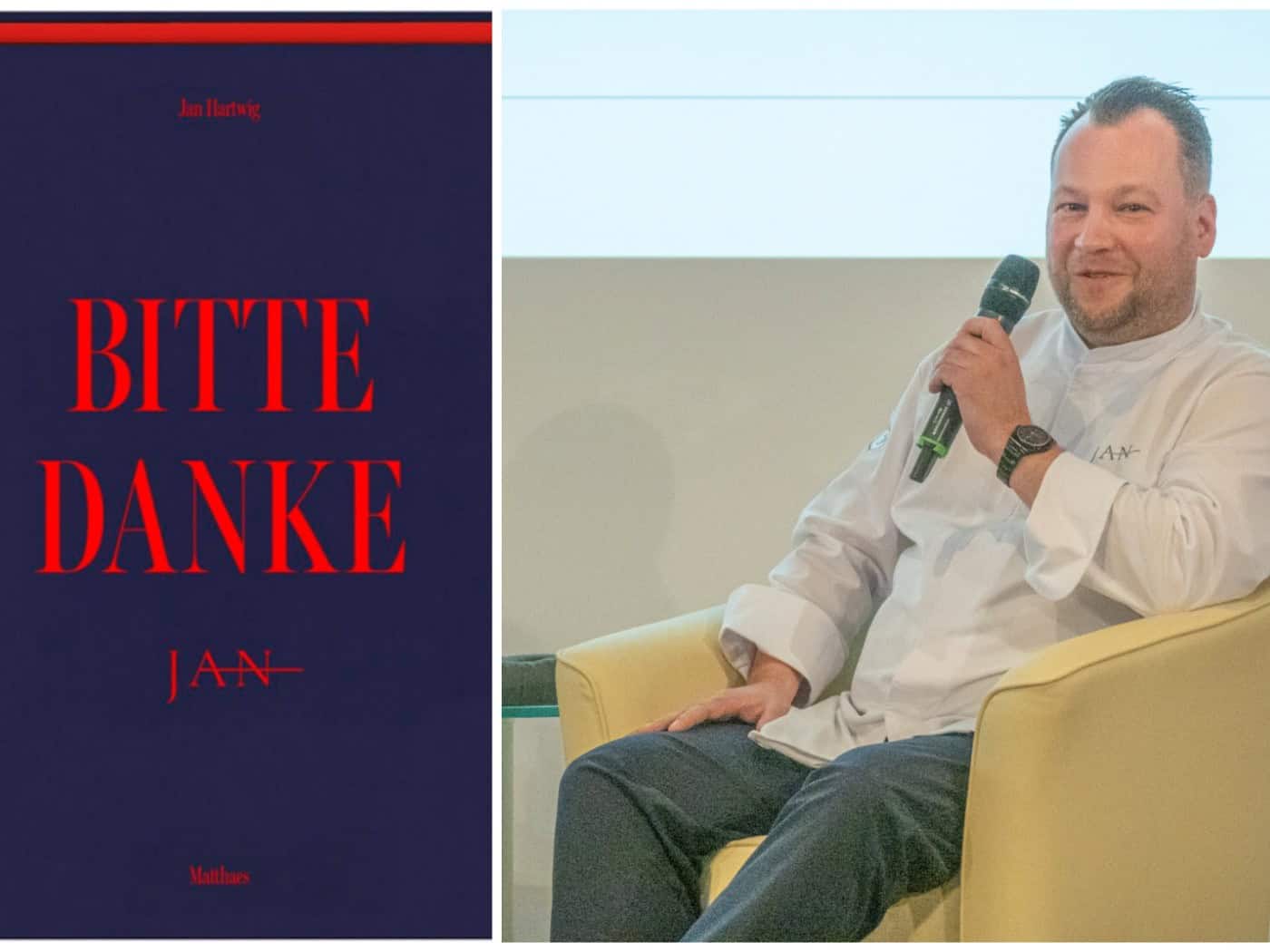
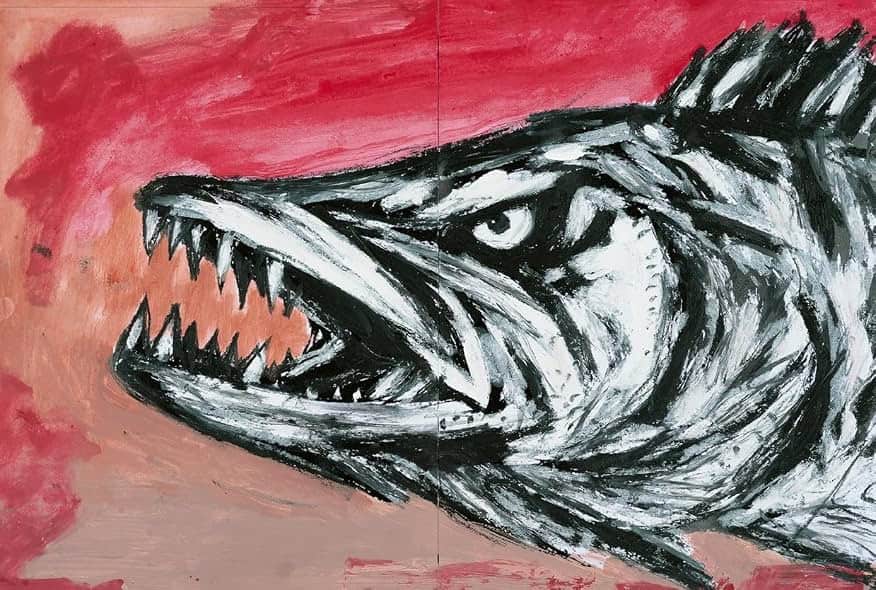
Jan Hartwig has followed up. After his debut novel "Labor der Liebe" (see my review), he has now released the large-format, hefty “Bitte Danke.” According to the 3-star chef, it is his “personal catalog of works showcasing what I, as a craftsman, am currently capable of.” It’s a lavish collection in which the more than 60 (new) recipes certainly take up a lot of space, but are accompanied by clever accompanying texts, wonderful photos by Thomas von Aagh, and art by Stefan Strumbel.
Its format (closer to calendar-sized A3 than to the standard A4 printer sheet), its weight (2,422 g), and its sophisticated content make it neither light bedtime reading nor a practical cookbook to keep by the stove. For me, it’s a book to read, one you can flip through again and again and enjoy learning from on a variety of levels—whether by reading or simply looking at the photos and the interspersed Strumbel illustrations. The feel of the book and the red edge-painting fit this approach quite well! The texts were contributed by the chefs Eckart Witzigmann and Tim Raue (both wrote a foreword) as well as Jürgen Dollase, Lorraine Haist, Otto Geisel, Anja Wasserbäch,Christoph Teuner and Hannes Finkbeiner. What the book lacks are short biographies of the authors—you don’t have to know (all) of them, of course, but a page or two would certainly have been nice. I’ve linked to all the authors (to Wikipedia, where possible) for further reading, if needed. You’re welcome. Thank you.
Who has rabbit blood in their house anyway?
Jan Hartwig writes in his (definitely worth reading) “Thoughts on the Book” that it is “a cookbook with recipes you can try if you’re ambitious—without tearing your hair out in despair after a quarter of an hour because it’s just too complicated.” To ensure success, the recipes are described in great detail. That’s true—but ultimately, it’s just a well-meaning gesture. I tend to side with Wilhelm Busch on this: “If someone who, with great effort, / has barely climbed a tree, / already thinks / that he’s a little bird, / he’s mistaken.” And let’s be honest: not many people can even manage to climb the tree in the first place. Jan Hartwig isn’t just creative—he’s also a master craftsman with numerous helpful assistants. And he has access to more equipment than we have at home or can find at your average electronics store: a Thermomix, a vacuum sealer, a dehydrator, a convection oven, a Pacojet, or even just a pretzel-shaped pastry mold.
Well, if you have the money and space, you can buy all of that. Of course, things get more interesting when the arrangements for the already tiny cubes of fish, meat, vegetables, and all the other ingredients need to be cut to edge lengths of 2, 3, 4, or 5 mm. That’s when you really have to be very ambitious and have a good eye for detail. Of course, the many surfaces contribute to the flavor profile—and to the visual appeal, of course. But the variety of flavor components in a dish is also what gives it depth. For “Royal-Style Wild Hare” (pp. 214–217, including illustrations through p. 219), in addition to about 80 other ingredients, you’ll also need hare’s blood and gold leaf—and who always has hare’s blood on hand?
A Lot of Craftsmanship Behind Every Plate
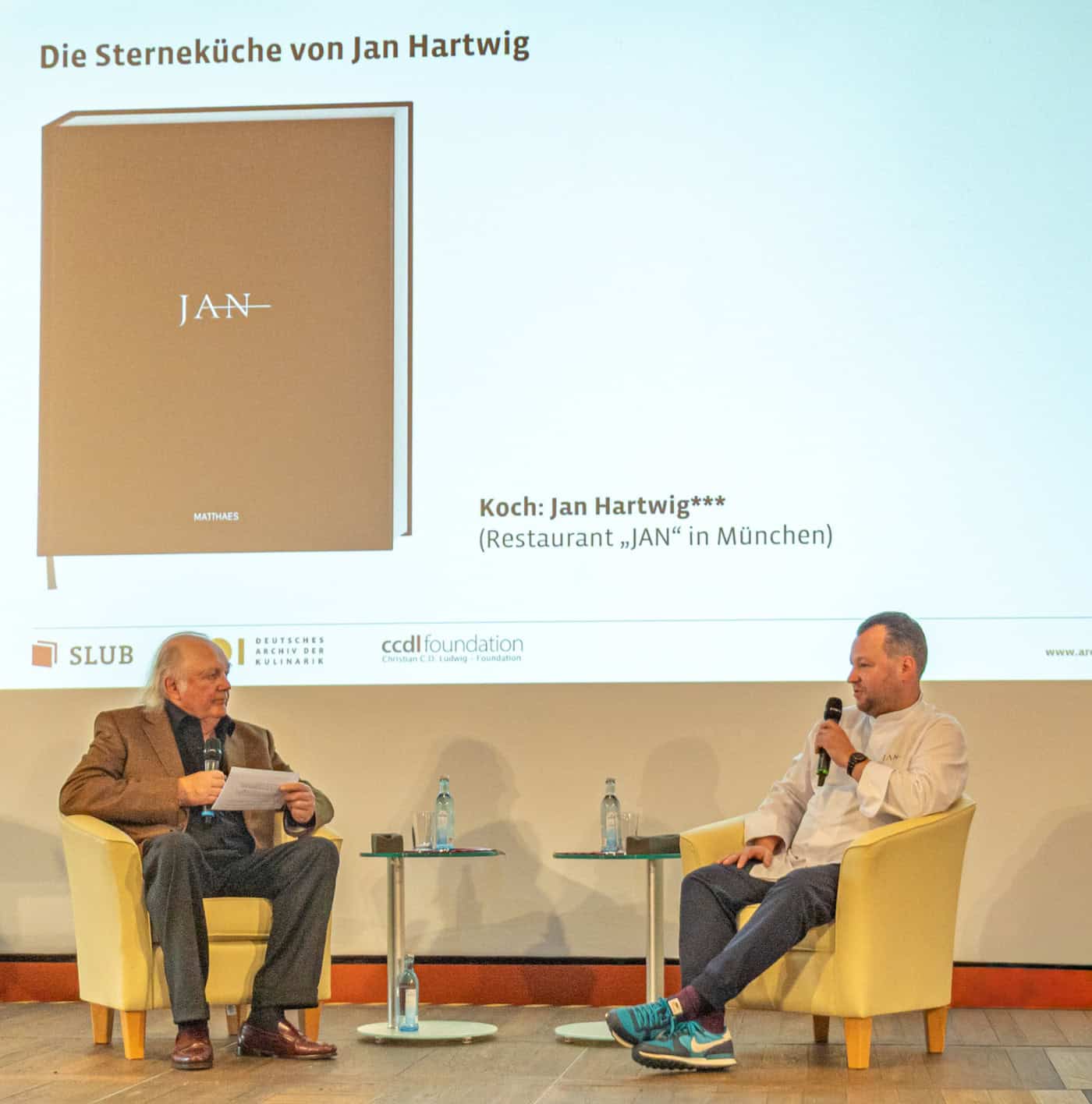
Examples like this show just how much craftsmanship goes into a single plate—respect! Nothing is left to chance, and of course the result is different when you omit, substitute, or alter ingredients. Nevertheless, the master is generous: “You are, of course, free to omit or substitute one or two ingredients when recreating or experimenting with my dishes,” he writes in his foreword to the book. This rings true, because when Jan Hartwig conducted interviews with critic Jürgen Dollase about the individual dishes prior to the publication of his first book, he said something similar: “I think you also have to maintain a sense of lightheartedness—you just have to dive right in and start cooking!” You can read more about this in the culinary documentary, which is available for free as part of a series (since 2023) in the German Culinary Archive.
Encouraged in this way, you can then read one or two recipes with a fresh perspective and pick up helpful tips for your own cooking. Naturally, this is more feasible with dishes that sound simple (though “sounding simple” doesn’t necessarily mean “easy to make”...) —and since Jan Hartwig is dedicated to the DNA of German cuisine and translates it into new worlds of flavor (self-description on his website), I’ll stick with the chicken salad (“back to the ’80s”) , grab some of the Mettbrötchen, and can definitely see myself finally making even better housewife-style matjes myself—despite the use of the term “housewife sauce,” which, for me, brings to mind the creepiest mental images. There are plenty of practical tips in there—and for all three recipes, it’s not a problem that Jan Hartwig generally designs his recipes to serve eight to ten people. That’s very practical in a restaurant setting, but in a two-person household, you quickly run into limits (1.2 g of this or that amounts to very, very little when scaled down). In my case—since my “no-stars” restaurant won’t be serving small appetizers before a multi-course meal anyway—I’d rather multiply the quantities—and that works. With a bit of ambition, you might even be able to tackle complicated courses: the Mularde would be a good local organic duck for me; as for the single dot of anchovy mayonnaise from a squeeze bottle, I’d definitely simplify the preparation, and I’d probably skip the foie gras. It would still make for a lovely Christmas or holiday roast—well worth the effort.
JAN – Please & Thank You
Publisher: Matthaes
Jan Hartwig (Author), Thomas von Aagh (Photographer), Stefan Strumbel (Art)
Publication Date: November 27, 2026
368 pages, ISBN 978-3985410859
Dimensions: 25.2 x 4 x 33.7 cm