


Protest for the energy transition: Fridays for Future demonstrates throughout Germany on April 24
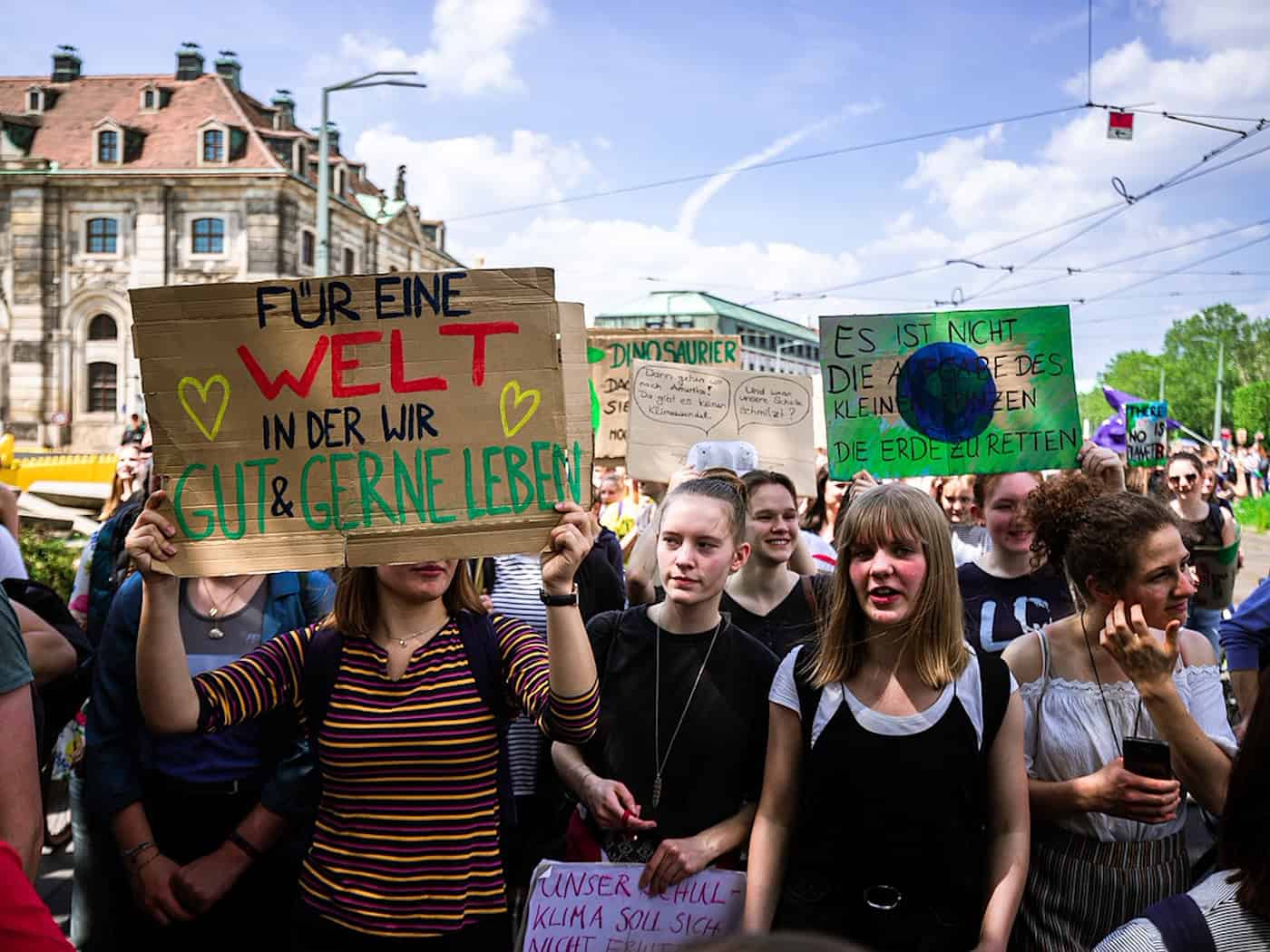
Motivation: 80,000 people on the streets - and now more than ever
Last Saturday, April 18, 2026, people took to the streets simultaneously in four major German cities under the slogan "Defend renewable energies! According to the organizers" - a broad alliance of Campact, Deutsche Umwelthilfe, Fridays for Future, Greenpeace, Germanwatch, GermanZero and WWF Germany - around 80,000 people took part in the protests across Germany. According to the organizers, 24,000 demonstrators gathered in Berlin alone and around 12,000 in Munich.
The reason for the protests was the energy policy of the German government, specifically the course taken by Economics Minister Katherina Reiche (CDU), who, according to the organizers, is actively slowing down the expansion of renewable energies. At the same time, the ongoing war in Iran is driving up oil and gas prices and making dependence on fossil fuels tangible for many people - at the pump, on their heating bills and in the supermarket. The alliance sees this as one more argument for a consistent energy transition: Those who rely on renewable energies are making themselves independent of wars and autocrats.
A week later, Fridays for Future wants to take this momentum to a wider area. On 24 April, the protest is to be taken from the major cities to all regions of the country - with the declared aim of organizing a visible action in as many constituencies as possible.
The demonstrations on April 24 in Saxony
Three events have already been planned in Saxony:
- Dresden - 14:00, Schlossplatz (walking demo; more information: fffdd.de)
- Freiberg - 17:00, Petriplatz
- Leipzig - 16:00, Kleiner Wilhelm-Leuschner-Platz (rally with energy bill and petrol cocktails; more info: fffleipzig.de)
Actions are planned in over 50 cities across Germany, from Aachen to Würzburg. The format ranges from classic walking demonstrations and rallies to creative forms of action such as chalk painting or symbolic mourning rallies.
What Fridays for Future demands
Fridays for Future raises both long-term fundamental demands and concrete demands on the current federal government. At its core, it is about climate neutrality by 2035, a coal phase-out by 2030 and a fully renewable energy supply by 2035. In addition, the movement is calling for an end to subsidies for fossil fuels and a carbon tax of 180 euros per tonne - a figure that, according to the Federal Environment Agency, corresponds to the actual social damage caused by greenhouse gas emissions.
In its current demands for the current legislative period - the so-called 100-day demands 2025 - FFF is specifically calling on the CDU/SPD federal government to reintroduce binding sector targets in the Climate Protection Act, a clear plan for the gas phase-out by 2035 and immediate programs for a socially just heating transition, the expansion of the rail network and an affordable Germany ticket. Fossil fuel subsidies should be abolished immediately.
FFF spokesperson Yasin Hinz clearly states the reason for this: the climate crisis is no longer a distant forecast, but a reality that can be experienced every day. Every new investment in fossil infrastructure prolongs this crisis - and contradicts what is scientifically necessary.
What the science says: PIK study sets standards for Europe
The demands of the climate protection movement are backed up by research. On April 16, 2026, the Potsdam Institute for Climate Impact Research (PIK) published a comprehensive model study in the scientific journal Nature Communications, which sets out concrete interim targets on the path to European climate neutrality by 2050.
The result: in order to achieve the 2050 target cost-effectively, the EU would have to reduce its net greenhouse gas emissions by around 86 percent by 2040 compared to 1990 levels. The EU Climate Council had even recommended 90 to 95 percent, also for reasons of global climate justice; the EU Commission then proposed a reduction target of 90 percent. According to PIK, the EU-internal reduction of 85 percent compatible with this target is in line with an economically viable transformation.
In concrete terms, according to the study, this means that electricity generation from wind and solar power must increase sevenfold by 2040 compared to the level of 2018 to 2022 (range: four to eight times). The share of electricity in total final energy consumption must increase from around 20 percent to around 49 percent. At the same time, demand for natural gas and crude oil would fall by 60 percent in the reference scenario - which would make Europe strategically less dependent on fossil fuel exporting countries.
PIK researcher Renato Rodrigues, lead author of the study, emphasizes that consistent decarbonization would not only strengthen Europe in terms of climate, but also economically and geopolitically. At the same time, his colleague Robert Pietzcker points out that the 86% mark represents a purely techno-economic lower limit - issues of global burden sharing and climate justice could justify higher levels of ambition.
The research team is encouraged by the fact that the necessary annual growth in wind and solar power has already been achieved once in the period from 2021 to 2025 - largely driven by political reactions to the energy price crisis. This shows that The pace is feasible if the political will is there.
Broad social support, political headwind
The current climate protests are taking place in a politically tense climate. While the scientific community is charting a clear course of action and a broad civil society - from environmental associations and social organizations to business representatives - is calling for more speed in the energy transition, many observers believe that the German government is sending contradictory signals. Economics Minister Reiche has publicly spoken out in favor of new gas investments and presented plans which, according to the protest movement, would structurally slow down the expansion of renewable energies.
The figures from the demo on April 18 show: The issue is mobilizing far beyond the traditional climate protection community. Solar roof owners, tradespeople, tenants, charities - they all feel directly affected by rising energy prices and dependence on fossil fuels. April 24 is an attempt to make this broad support visible outside of the big cities as well.
Sources
- Fridays for Future Germany - Demands: fridaysforfuture.de/demands
- Fridays for Future Germany - Day of action 24.4.2026: fridaysforfuture.de/aktionstag-24-4-2026
- Fridays for Future Germany - strike dates: fridaysforfuture.de/streiktermine
- Potsdam Institute for Climate Impact Research (PIK) - "What Europe should achieve by 2040 to be climate neutral ten years later", 16.4.2026: pik-potsdam.de
- Rodrigues et al (2026): "2040 greenhouse gas reduction targets and energy transitions in line with the EU Green Deal." Nature Communications. DOI: 10.1038/s41467-026-71159-8
- ZDFheute - "Tens of thousands protest against energy policy", 18.4.2026: zdfheute.de
- Campact - Press release on the demonstration on 18.4.2026: campact.de
- WWF Germany - "Defending renewable energies": wwf.de/energiewende-demo

