

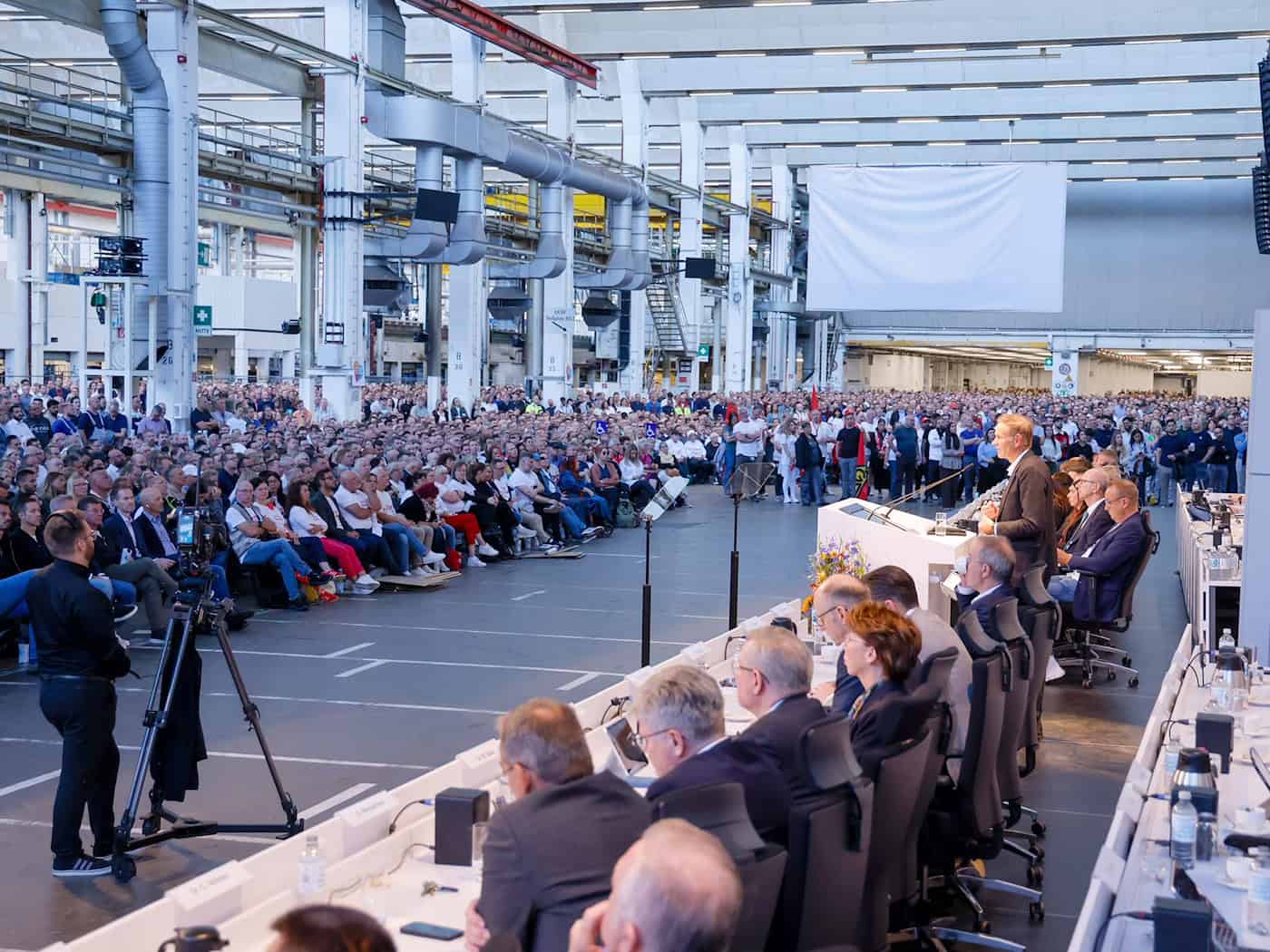
Tens of thousands of jobs are at risk, entire plants are under scrutiny—there is a tremendous need for dialogue at VW: Following a series of extraordinary town hall meetings, Volkswagen is set to hold what is, for now, the final such meeting between the executive board and the workforce in Hanover today, ahead of potential new decisions. At stake is nothing less than the future of the group, which also includes Porsche and Audi—VW is one of Germany’s largest employers. Management wants to cut costs and improve competitiveness, while employees, unions, and politicians fear for jobs and plant locations. The cost-cutting measures could take on a more concrete form as early as this week at a supervisory board meeting. An interim update: From the perspective of the Executive Board led by CEO Oliver Blume, the ongoing job cuts—50,000 positions by 2030—are not enough. Management is working on a “2030 Vision.” Since then, there have been fears about tens of thousands of additional job cuts and the closure of four entire sites: Emden, Zwickau, the Audi plant in Neckarsulm, and Hanover, where commercial vehicles are built. Chief Financial Officer Arno Antlitz is meeting with employees there today. He will emphasize the need for further cost-cutting measures—as Blume did previously. “We must reduce complexity, consistently streamline our structures, and cut costs,” Blume said at the town hall meeting at the Wolfsburg plant. “Tariffs, new competitors, and geopolitical risks: The entire auto industry is under enormous pressure.” The VW Group, he said, had “taken early countermeasures” and begun to realign the group and its brands. “Our market shares are growing. But that’s not enough yet.” With regard to the impending job cuts, the VW boss said that the next step would focus in particular on costs outside of direct vehicle production—that is: corporate positions, central functions, development, or sales. In light of the pressure to cut costs, there will also be noticeable cuts in management. We’re taking a close look there and cutting a quarter of the positions, said Group CEO Blume at the Emden plant. “All divisions must do their part; this is a major effort that can only succeed if we work together,” he said. Quite a lot, since—according to media reports—the supervisory board initially rejected Blume’s plan in July. As the CEO has already made clear and reiterated to employees: The figure of 50,000 additional jobs mentioned in the “2030 Vision” is not a “target,” but a “theoretical calculation” derived from costs. “Labor costs today are more than double those at comparable European locations. And when it comes to factory costs, other plants are still significantly cheaper,” Blume said in Zwickau. He estimates that about half of the necessary adjustments will take place in Germany. It is also unclear whether any plants will close—and if so, how many. Blume calls closures a last resort that he would prefer to avoid. For Emden, Zwickau, Neckarsulm, and Hanover, there is still no “competitive utilization plan” for the 2030s. “Our goal is to create solid prospects for all locations over the next six to twelve months,” says Blume. Ideas under discussion include temporarily using some locations for defense production and also manufacturing Chinese VW models in Germany. The ball is in the Supervisory Board’s court, which, according to media reports, is set to meet this Friday. It is unlikely that the board will make any final decisions at that time. Blume himself had said he wanted to finalize his cost-cutting plan by the end of the year. According to media reports, at least one additional proposal is likely on the supervisory board’s agenda—one put forward by the employees’ representatives. There is also resistance from the state of Lower Saxony, a major VW shareholder. Minister President Olaf Lies (SPD) is demanding “a viable plan for the future.” “Plant closures and mass layoffs cannot be the solution,” says the head of government. The state of Lower Saxony is also considering acquiring a stake in the Osnabrück plant, where passenger car production is set to end next year. Blume emphasizes: “The situation is more than critical.” Although VW is making a profit, the company isn’t earning enough to finance its future. Cost-cutting measures taken so far have not been sufficient. “We are too big. That often makes us too slow and too complicated.” The company is struggling with high costs and a challenging business environment. “This is not a VW crisis, but a crisis affecting the entire automotive industry,” says Blume. Mercedes-Benz has also already cut thousands of jobs. BMW has announced the elimination of about 8,000 jobs worldwide. Blume cites U.S. tariffs, the slump in the Chinese market with sharp price declines, geopolitical conflicts such as those in the Persian Gulf, tougher competition in Europe, and heavy regulation as major challenges. The result: Jobs in the German auto industry are disappearing faster than in any other industrial sector. At the end of the first half of 2026, 691,500 people were still employed in this key German sector—42,300 fewer than a year earlier and the lowest number since the Federal Statistical Office began compiling comparable data in 2005. Job cuts were particularly severe among suppliers. Bosch plans to cut up to 22,000 jobs worldwide in its supplier division, while ZF is cutting 14,000 jobs in Germany. Companies are increasingly having to turn away from Germany as a business location for economic reasons, says Hildegard Müller, president of the German Association of the Automotive Industry (VDA). She cites high labor and energy costs, lengthy procedures, bureaucracy, and dilapidated infrastructure as barriers to investment. IG Metall places the blame for the crisis on management, which it says has operated for decades without a plan or vision. The union is planning a nationwide day of action at automotive sites on September 21. Copyright 2026, dpa (www.dpa.de). All rights reservedWhat are the results so far?
What remains to be decided?
What’s next?
Why is the situation so tense?


