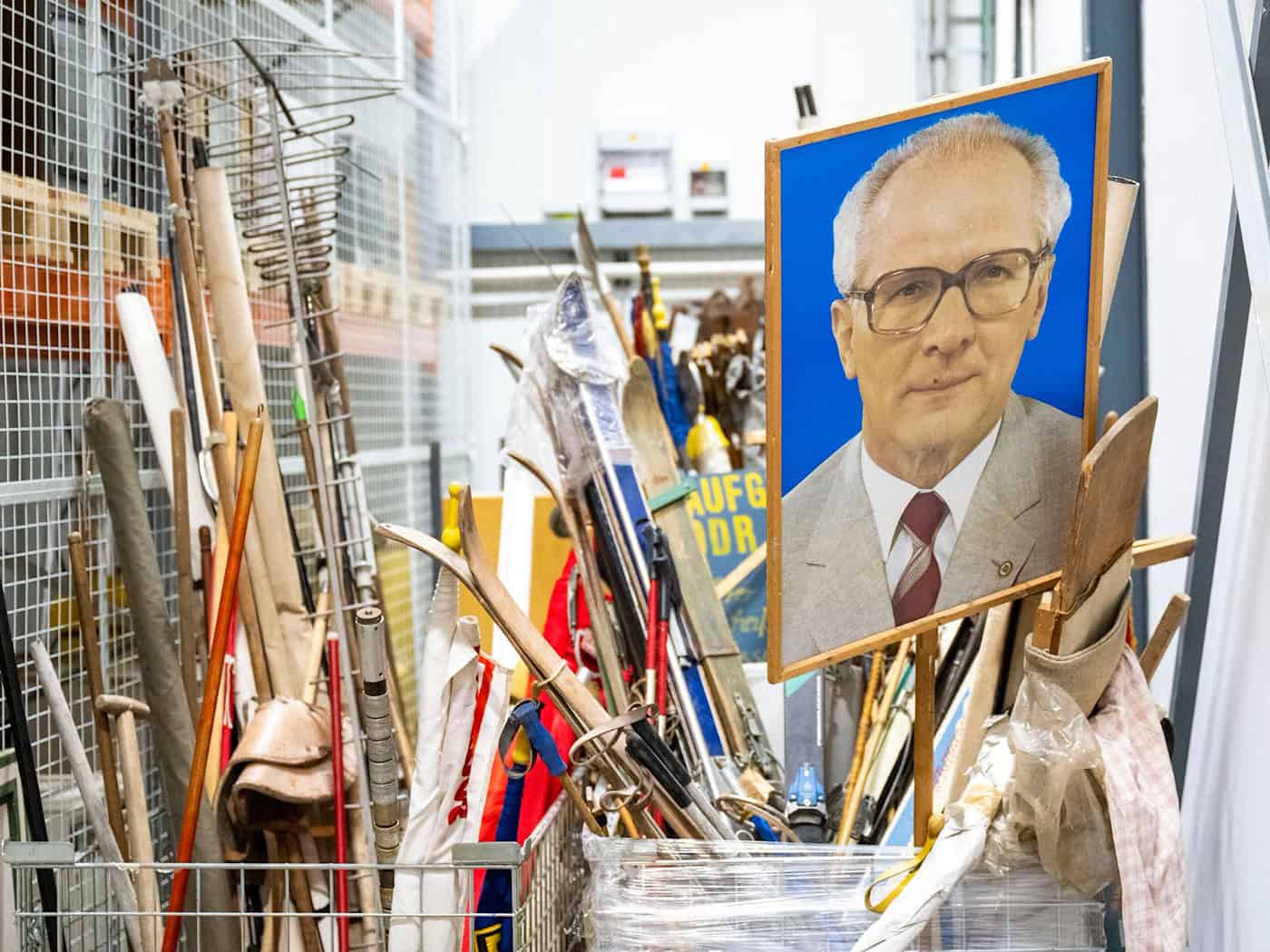
Shelves several meters high filled with televisions, furniture, and household appliances: The GDR Museum’s storage facility in Berlin-Marzahn houses around 360,000 objects. Anyone walking through the halls encounters not only a piece of history, but also people’s memories of life in East Germany up until 1989. “Most of the items you see here are actually donations from the public,” says historian Eric Denis Strohmeier-Wimmer of the GDR Museum. Since last year, visitors have been able to tour the storage facility on guided tours. On a tour through the halls, one comes across objects from many areas of everyday life in the GDR. Flags hang from the shelves, portraits of prominent socialists lean against the walls. And among the thousands of objects, even Erich Honecker’s television has found a place. Many visitors recognize things from their own past, says Strohmeier-Wimmer. “For most people, this is truly a place of remembrance.” It’s not always predictable which objects trigger memories. An old washing machine, the WM 66, has become a favorite over the years, the historian explains as he walks through the halls. Many visitors immediately recognize the model and share their own stories about it. “We really thrive on the fact that the people who come here then tell us details.” For example, one visitor reported that the machine used to be used not only for washing, but also for cooking Thuringian dumplings. However, not all memories revolve around everyday life in the kitchen or living room. In an air-conditioned storage area, letters, photos, and travel documents are stored in pull-out cabinets. Among the documents are also traces of a ship that, according to the historian, was something special for many GDR citizens: the MS “Völkerfreundschaft.” The ship was originally built in Gothenburg, Sweden, and was initially named “Stockholm.” In 1959, the GDR purchased the “Stockholm” for approximately 20 million Swedish kronor. In 1960, the ship finally set sail as the MS “Völkerfreundschaft.” For 25 years, the “GDR’s dream ship” was operated by the Free German Trade Union Federation (FDGB). According to the Rostock Seamen’s Association, the ship was decommissioned on July 5, 1985, at the Warnemünde passenger pier. Travel documents and photos serve as reminders of voyages on the cruise ship to the Black Sea, Egypt, or even Athens. Many of the documents have been well preserved and carefully kept by their former owners. “They kept these; for them, they were little treasures,” says Strohmeier-Wimmer. Yet the “Völkerfreundschaft” was far more than just a vacation ship. Places on board were often a reward for workers or party veterans and, at the same time, an expression of the GDR’s ability to stand up to the West. “They were actually trying to demonstrate, in the competition between systems, that the socialist state had the same capabilities as the capitalist state,” explains Strohmeier-Wimmer. Cruises were therefore also politically charged. The Federal Republic of Germany had always been the immediate point of comparison for the GDR. This put pressure on the regime to make certain offers—or at least to believe it had to make them. “Much of what the state does, it does intrinsically, of its own accord. Because it feels that the population demands it. We don’t even know if the population actually demanded it. I think they had other problems than going on vacation on a cruise ship,” explains Strohmeier-Wimmer. For the historian, “people’s friendship” cannot therefore be viewed in isolation from the GDR’s social policy. While many of these offerings did bring real benefits to people, they were also part of a system designed to secure public approval. At the same time, the preserved documents and travel diaries of former passengers describe the individual crossings, the ship’s layout, and the onboard program, sometimes in great detail. For Strohmeier-Wimmer, they demonstrate the significance these voyages held for many travelers. “It was simply a life-changing event,” he says. Brochures and menus from that era still offer a glimpse into what these voyages might have been like. Although the “Völkerfreundschaft” was a single-class ship, it did not lack in comfort. On board, there was an outdoor and an indoor swimming pool, a hair salon, a smoking lounge, a veranda café with a large dance floor, and a movie theater seating 180 people. In addition to everyday dishes, the menus also featured items such as turtle soup. Today, the mementos from the "Völkerfreundschaft" lie among thousands of other objects in storage. They bear witness to the diverse experiences that shaped everyday life in the GDR: from vacations, political aspirations, and personal experiences, to both beautiful and difficult moments. Anyone who would like to see for themselves can visit the repository on guided tours, which are offered Monday through Friday as well as on the first Sunday of every month. Copyright 2026, dpa (www.dpa.de). All rights reservedDepot evokes memories
The GDR’s first cruise ship
Standing up to capitalism
A life event