

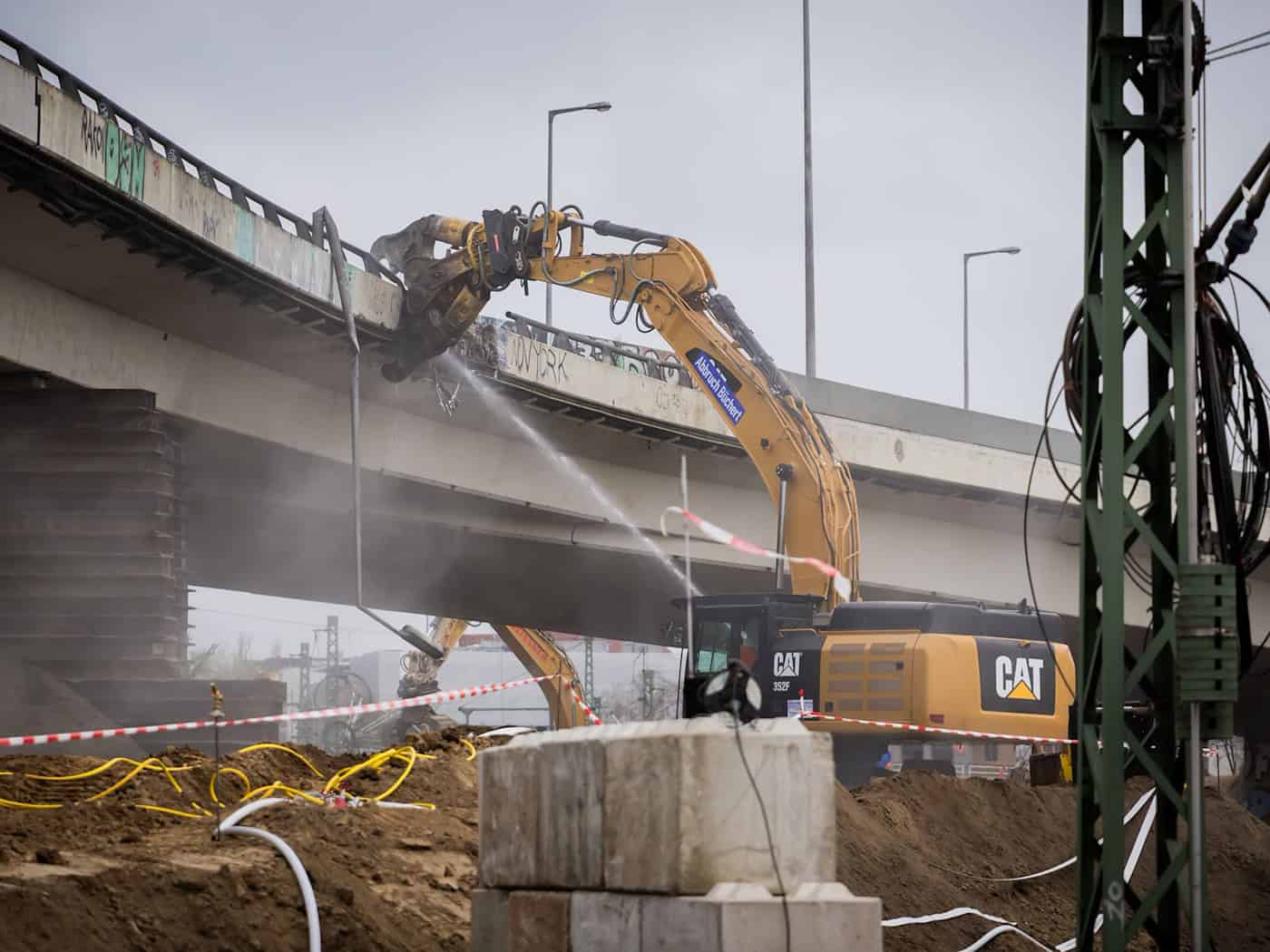
Whether it’s the Bonn North Bridge, the Rahmede Viaduct on the A45, or the Ringbahn Bridge in Berlin: Time and again recently, major transportation bridges have been suddenly closed—or, in the case of the Carola Bridge in Dresden, have even collapsed. Germany isn’t doing enough to maintain its bridges, criticized Steffen Marx of the Technical University of Dresden. “Maintaining bridges is like brushing your teeth: If I don’t brush my teeth for a day, it’s not that bad.” A bridge can withstand a year without maintenance. “But if I neglect maintenance for 30 years—as has happened in Germany—then the damage progresses more rapidly.” The Ringbahn Bridge on Berlin’s urban highway, for example, caused quite a stir. Due to damage to its supporting structure, it was closed on short notice in the spring of 2025 and subsequently demolished. The new bridge, costing millions, is scheduled to be completed in the first half of 2027. Steel superstructures are currently being hoisted into place for this project. Compared to the costs of maintenance, one would have to invest many times more to repair or rebuild a bridge, said Marx, director of the Institute for Structural Engineering at the Technical University. A faulty drain, for example, is easy to fix. But if this isn’t done, moisture seeps into the bridge, the steel rusts, and it becomes much more time-consuming and expensive to repair the damage. In most cases, a complete closure occurs suddenly because significant damage is discovered and experts certify that there is a risk of collapse. The roadway, sidewalks, and bike paths of Bonn’s Nordbrücke have been closed to traffic since early June. In 2025, it was the Ringbahn Bridge in Berlin; in 2024, the Elbe Bridge in Bad Schandau; and in 2021, the Rahmede Valley Bridge in the Sauerland region. About two years ago, the Carola Bridge even collapsed while still in use. “The condition of many heavily trafficked bridges in Germany is critical,” said Martin Claßen of RWTH Aachen University. This is particularly true of the highway network. “The current situation is not a sudden problem, but the result of a long-term trend.” Many bridges were built after World War II and designed for a service life of 80 years, Marx said. Often, they had been designed for a different load. “We have much more heavy-duty traffic and traffic overall today than we did at the time when many bridges were designed and built.” Afterward, a maintenance strategy was adopted that Marx said could be called “build and forget” (“build it and forget it”), Marx noted. “The bridges are built, but then not maintained.” Only the legally required inspections take place every six years. “That’s why we’re now facing a huge wave of bridges in poor condition.” With so many bridges in very poor condition, he added, there are inevitably some that are in even worse shape than previously assumed—collapses are virtually inevitable at some point. However, the Carola Bridge is the first bridge since World War II to have collapsed while in use. The cause was hidden wire breaks inside the structure—they could not be detected during inspections. Under the “traffic light” coalition government of the SPD, Greens, and FDP, the Ministry of Transportation had identified 4,000 highway bridges that are particularly important for traffic but in need of modernization. They are to be renovated or replaced within a few years—a goal that the current federal government is also committed to. However, Marx noted that the government largely interprets “modernization” to mean demolition and new construction. Yet about half of the bridges that are demolished could be renovated—which would save significant costs. “The relevant parts need to be repaired, but the bridge doesn’t have to look brand-new.” Claßen, too, is convinced that not every bridge needs to be replaced immediately. “For many structures, an intelligent condition assessment can help schedule measures efficiently.” When it comes to replacing bridges, however, the biggest challenge often lies in planning, permitting, and contracting. So-called functional tenders are an important lever: “Instead of defining projects down to the last detail, there should be a greater focus on describing the function a structure must fulfill. This creates room for innovative and more efficient solutions.” In addition, more standardization and modularization are needed. “Many bridges are still treated as individual projects,” said Claßen. Yet there are technically mature rapid-construction approaches that could drastically reduce construction times—and thus also closure periods. It is also important to improve existing bridge monitoring strategies, Claßen said. And despite all the shortcomings and opportunities for improvement: “The risk of an unexpected collapse remains low overall in Germany.” Copyright 2026, dpa (www.dpa.de). All rights reservedRepairs Much More Expensive Than Maintenance
“Build and forget” strategy
New construction would often not be necessary at all


