

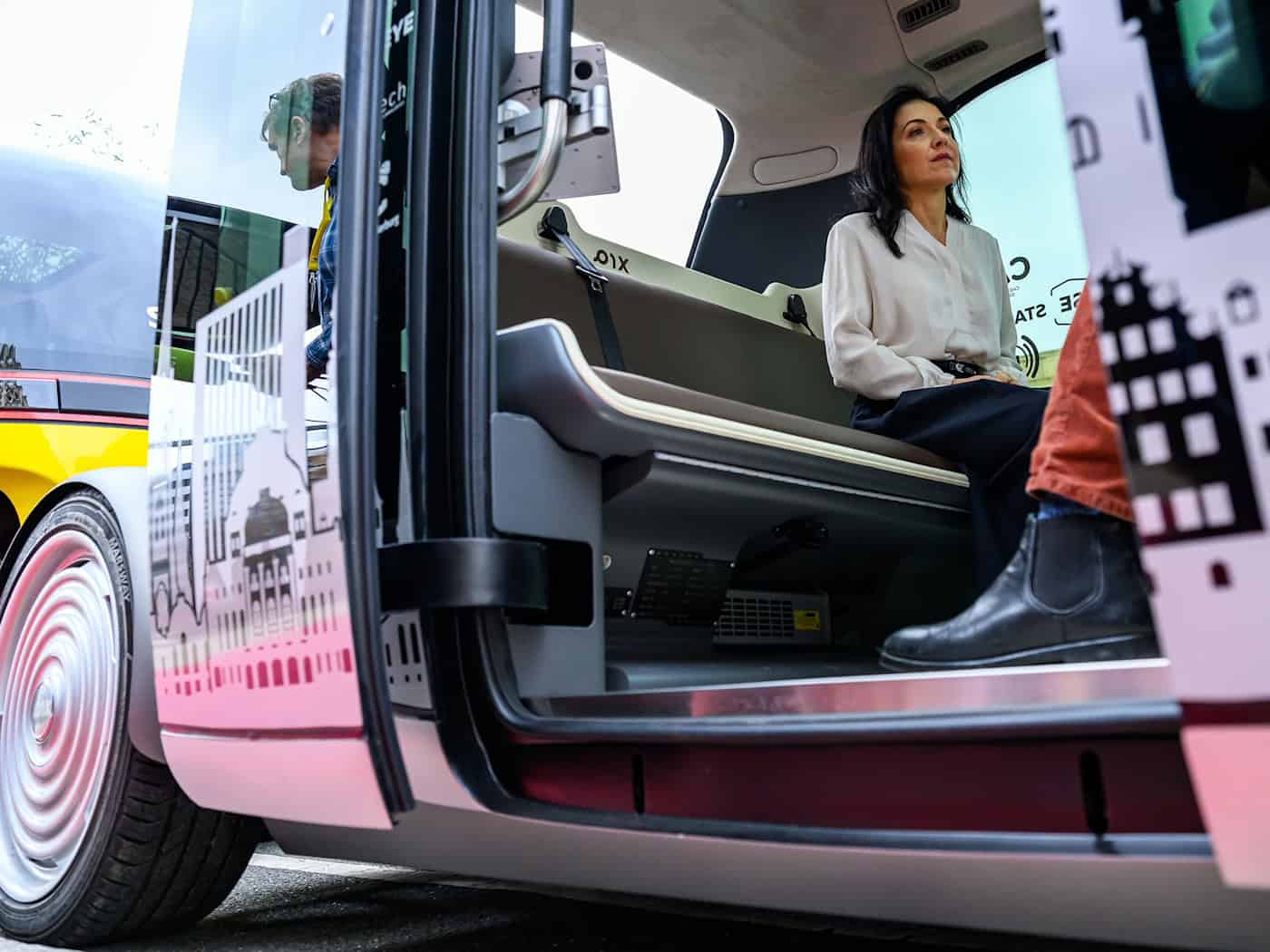
The transformation of the automotive industry has long been a reality in Saxony. While manufacturers and suppliers are grappling with the shift to electric mobility—and locations such as the Volkswagen plant in Zwickau are coming under pressure—the focus is already shifting to the next key technology: autonomous driving. Politicians, researchers, and businesses hope that this will not only help them navigate structural change but also create new value in the Free State of Saxony. The technology is by no means new. In Hamburg, selected passengers can already ride in self-driving minibuses, and other projects are underway in Berlin, Hesse, and Bavaria, among other places. Saxony, too, has been working on these technologies for years and aims to integrate autonomous vehicles into regular public transit service by 2030. To this end, 19 partners from business, academia, local governments, and politics signed a joint memorandum of understanding this spring. The Association of German Transport Companies (VDV) believes Germany is under pressure to act in the face of international competition. “There is tremendous momentum worldwide in autonomous driving, driven primarily by countries such as the U.S. and China,” says VDV President Ingo Wortmann. The association is therefore calling for a national strategy, more investment, and better framework conditions. From the industry’s perspective as well, autonomous driving opens up new opportunities for Saxony and eastern Germany. Karsten Schulze, managing director of the Chemnitz-based technology company FDTech, points to the region’s particular strength. Around Chemnitz, he notes, there is a concentration of specialized companies unique in Germany that collectively cover the entire value chain—from algorithm development and sensor technology to functional validation. These capabilities extend far beyond automotive manufacturing and could also be applied in public transit, logistics, agriculture, or construction. “We’re still competitive with all our strengths—but we’re no longer pioneers, because the framework conditions are significantly more favorable elsewhere,” says Schulze. Now, he says, the political and social framework must be established in such a way that the technology can also be put to use in Germany. “Otherwise, we’ll end up merely integrating foreign technology instead of being technology developers ourselves.” The state government is not relying solely on traditional vehicle manufacturing. It sees the future primarily where the automotive industry, semiconductors, software, and research converge. Autonomous driving combines robotics, artificial intelligence, sensor technology, and data management into a new key technology. This, in particular, could give rise to new industrial value creation and jobs. According to the Ministry of Economic Affairs, Saxony is well-positioned for this. In addition to a strong automotive and mechanical engineering industry, the Free State is home to Europe’s largest microelectronics cluster, Silicon Saxony, as well as high-performing universities and research institutions. Software development, system validation, and digital services could complement traditional vehicle manufacturing in the future, officials said. According to the state, it has been funding research and pilot projects for years. At the Technical University of Dresden, a test facility for autonomous systems is being built at the Smart Mobility Lab in Schwarzkollm. In Leipzig, the joint project “Saxon Initiative for Automated Shuttles in Public Transportation” (SIAS-ÖV) aims to pave the way for driverless shuttle buses. At the same time, Saxony is supporting municipalities and transportation companies with feasibility studies and preparations for the future deployment of autonomous vehicles. Initial projects are already demonstrating that the technology is increasingly making the leap out of the lab. For example, the automated shuttle bus “Flash” has been operating on a trial basis in the district of Northern Saxony since 2023. An operator still rides along for safety reasons, but in the future, the bus is to be monitored remotely from a control center. With its “Vision 2030: Autonomous Driving in Saxony’s Public Transit System,” the Free State of Saxony aims to gradually integrate autonomous vehicles into regular service. This is expected to create new mobility options, particularly in suburban and rural areas. The first concrete projects are already underway: In Dorfhain, in the northwest of the Saxon Switzerland-Osterzgebirge district, an autonomous shuttle bus is set to connect the community with the Edle Krone train station, thereby making public transit more attractive. According to the Ministry of Infrastructure, Germany now has extensive experience from research and pilot projects, as well as a legal framework for autonomous vehicles. The key now is to provide sufficient vehicles, infrastructure, and qualified personnel. This requires, in particular, reliable federal funding and support for model regions. It remains to be seen whether autonomous driving will actually become the next growth engine for Saxony’s key industries. The fact that the technology is now far more than just a research topic was most recently demonstrated at the Saxon Industry Dialogue in Chemnitz. There, representatives from business, academia, and politics were already discussing autonomous driving as a building block for structural change in industry. While Germany has struggled in many places to manage the transition to electric mobility, the next round of international competition is already beginning with autonomous driving. Copyright 2026, dpa (www.dpa.de). All rights reservedGermany Under Pressure to Act
Saxony is focusing on future technologies
From the Lab to the Road
Between Research and Regular Operation


