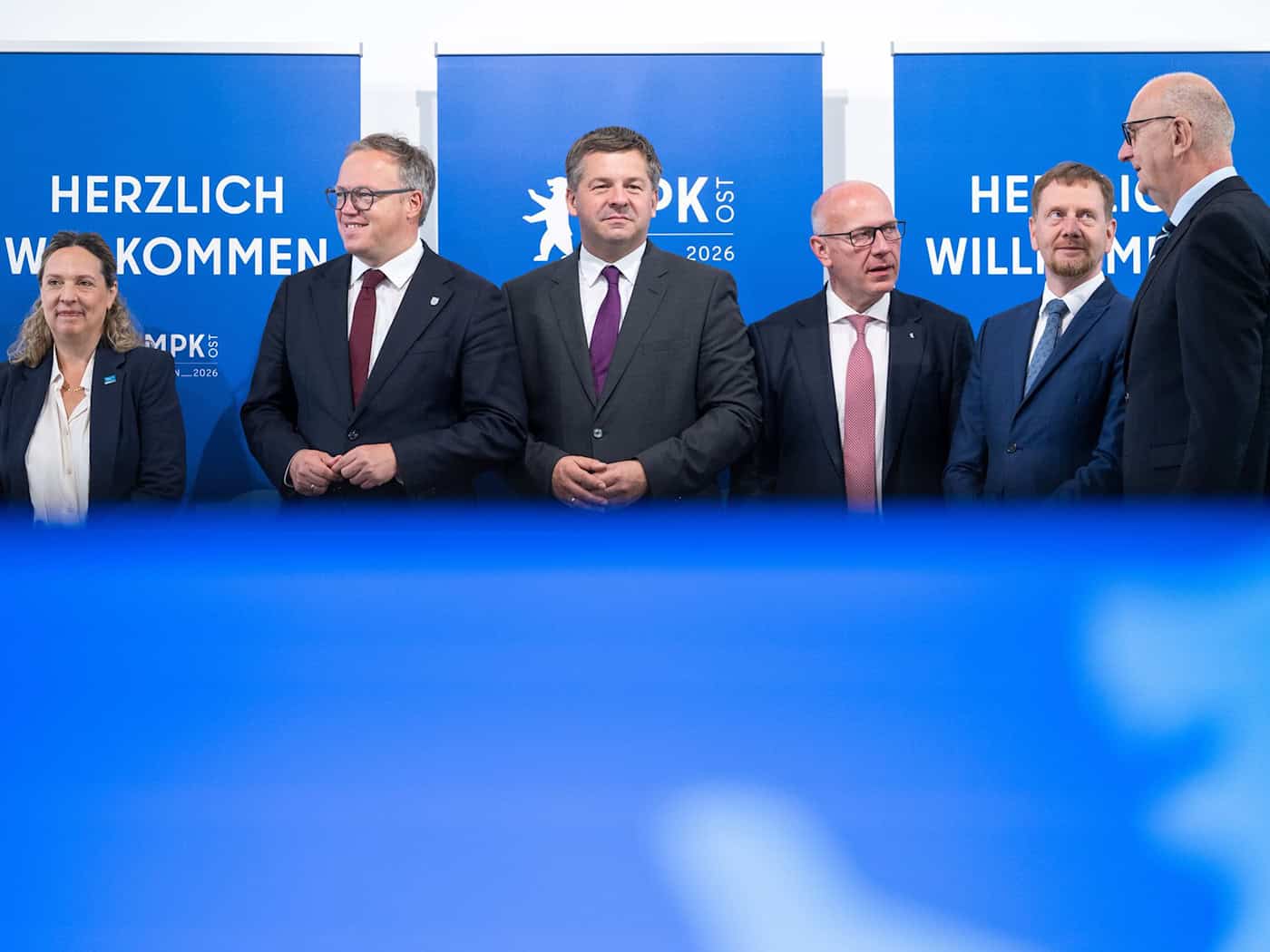
Discontent is growing in the eastern states: The heads of government in Berlin, Brandenburg, Mecklenburg-Western Pomerania, Saxony, Saxony-Anhalt, and Thuringia feel left behind when it comes to transportation. They are pushing for faster infrastructure development and warning against being left at a disadvantage. “The federal government started with the realization that, particularly in the direction of Eastern Europe, Poland, and the Czech Republic, rail transport connections are absolutely lagging behind those to France and Western European countries,” Saxony’s Minister-President Michael Kretschmer (CDU) told the German Press Agency. “The fact that nothing is happening there, that progress is so slow, is a truly major disappointment.” Brandenburg’s Minister-President Dietmar Woidke (SPD) vented his frustration at the meeting of eastern state leaders at BER Airport last Thursday. “Eastern Germany has undergone rapid development,” he said. Now, he added, there must be an open discussion about “discrimination and protectionism.” Woidke likes to illustrate this using the example of the Ostbahn. The RB 26 route is not electrified on the German side and is single-track in sections, even though a new bridge over the Oder went into service two years ago. It is embarrassing that Poland regularly accuses Germany of lagging behind in expansion, said Woidke. Kretschmer sees it similarly. “Not a single meeting with Poland or the Czech Republic goes by without them saying over and over again: We have international treaties, we’ve committed to this, we’ve built it,” he said. When it comes to infrastructure, “you Germans can’t really be relied upon anymore.” The coalition agreement between the CDU/CSU and the SPD states that key parts of the transportation infrastructure to Poland and the Czech Republic would be rapidly expanded. The Ministry of Transport, led by Patrick Schnieder (CDU), rejected the accusation of discrimination. A spokesperson pointed to projects such as the Dresden-Prague line and the Central Germany connection between North Rhine-Westphalia and Saxony, but also to a lack of funding for new construction and expansion. Woidke does not accept this and cites the federal government’s billion-euro package. The ministry explains that the special fund can “only” be used to pay for the renovation of tracks and bridges. And: “In general, there is no preferential treatment or discrimination against individual federal states or regions.” And the Ostbahn? According to the ministry, it is listed as a “potential need” in the requirements plan for federal railways. “To date, insufficient demand in long-distance passenger and freight rail transport has been demonstrated to justify upgrading it to the ‘urgent need’ category.” Copyright 2026, dpa (www.dpa.de). All rights reservedNo second track all the way to Poland
Kretschmer: Criticism from Neighboring Countries
Federal Ministry of Transport: No Discrimination