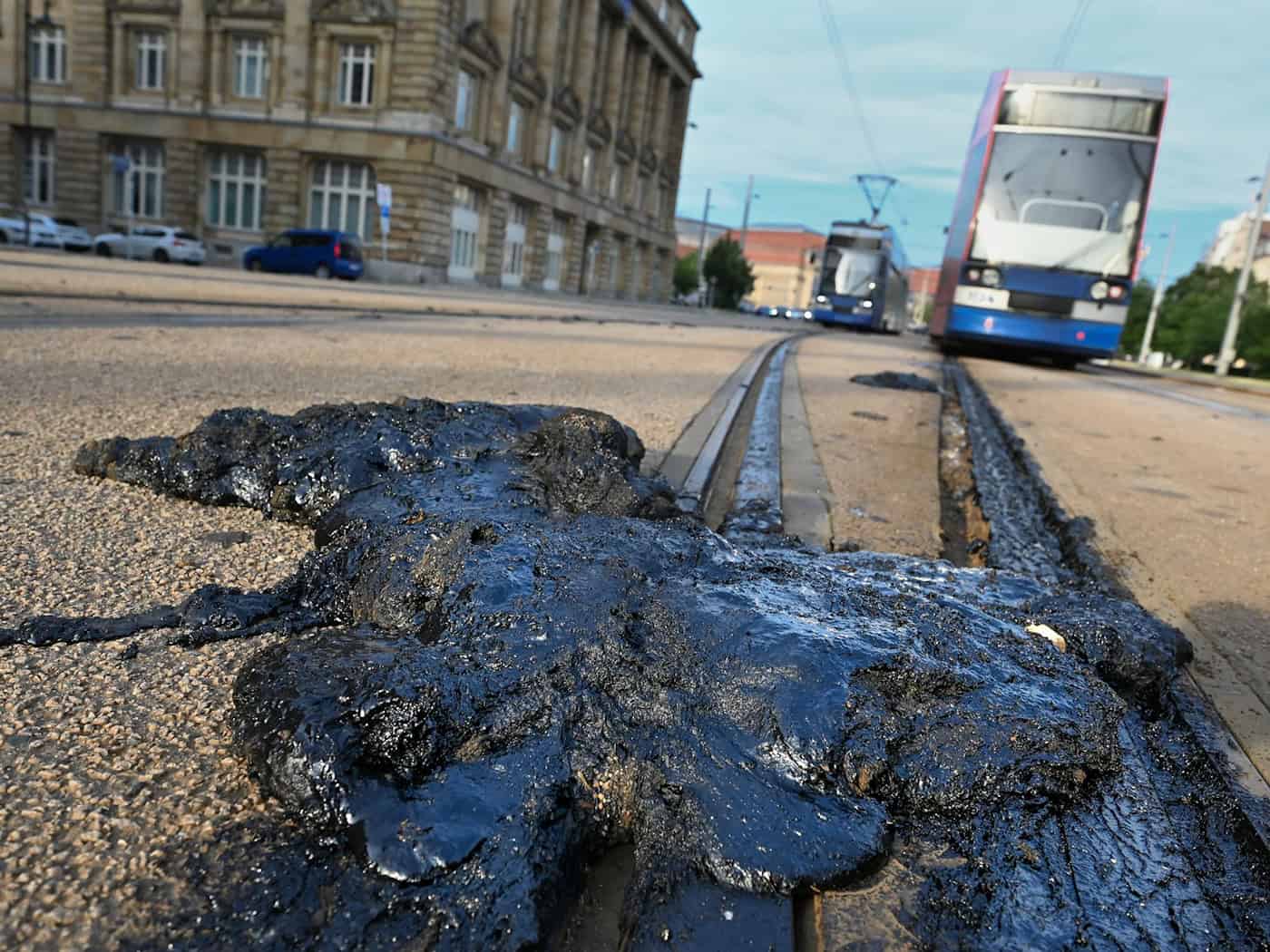
The severe heat damage that led to the suspension of tram service in Leipzig for several days can be attributed to several factors. This is according to the report now released by TÜV Süd Rail. According to the report, the damage was caused by the record-breaking heat—with temperatures hovering around 40 degrees for days—combined with the heavy strain on the tracks from cars, trucks, and buses. At the end of June, after several days of extreme heat, tram service in Saxony’s largest city was completely suspended. According to the Leipzig Public Transportation Authority (LVB), the joint compound had softened in many places along the tracks. The trams had pushed the joint compound out and spread it across the tracks and switches with their wheels—up to five millimeters thick. The compound hardened again, causing the tracks to stick together and also soiling about 100 vehicles. According to the LVB, the damage amounts to approximately 4.5 million euros. The 14 kilometers of damaged joints are expected to be repaired by the end of the year. The joints will be refilled with bitumen, but this time to a depth of about five to eight millimeters. The material will also be modified with plastic granules, which are intended to prevent the joint sealant from sticking to tires and wheels. The LVB is currently testing this granulate on a specific stretch of road. In addition, the TÜV expert recommends quality assurance through closer monitoring during the application of the sealant and an adaptation to climate-resilient infrastructure. The LVB’s internal heat plan envisages a two-stage approach for the future. “Starting at 33 degrees, intensive measurements are taken along the tracks, and at 38 degrees, measures such as cooling—and, if necessary, closures of individual bus routes—take effect,” explained Stefan Röll, Head of Infrastructure at LVB. These measures had already helped during the recent heat wave in August. “We are open to all options and are in communication with many municipalities. But we must also acknowledge that we have never experienced an event like this before,” said Toralf Müller, Managing Director of Operations at LVB. After all, extreme heat waves are expected to occur in the future as well due to climate change. The LVB had even asked the public for help over the summer. “Leipzig sticks together. Now we need you,” read the appeal. About 550 men and women had come to scrape the material that had seeped out of the joints off the tracks using shovels, painters’ putty knives, and knee pads. As a thank-you for the public’s help and understanding, the LVB had provided free tickets. Anyone with a valid ticket was allowed to bring one additional person along for free on trains and buses in early July. Copyright 2026, dpa (www.dpa.de). All rights reservedJoints softened and forced out—no regular service
Granules to be added to the joint sealant
LVB Heat Plan: Measurements and Traffic Restrictions Possible
550 Leipzig residents volunteered to help clear the tracks