


How AI Is Expected to Improve Stroke Treatment
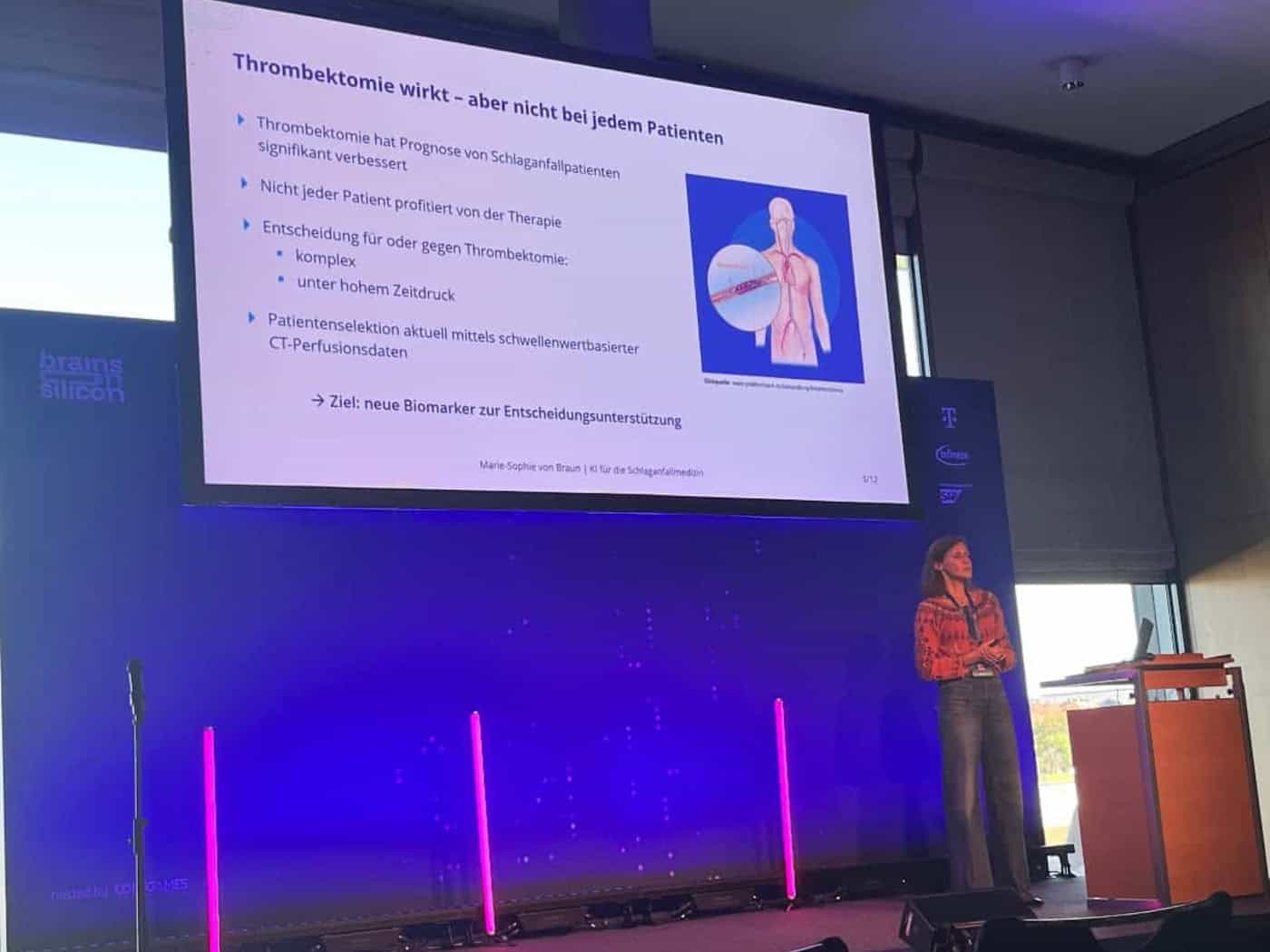
Dresden. When it comes to a stroke, time is of the essence. Researchers at the Center for Scalable Data Analytics and Artificial Intelligence (ScaDS.AI) are therefore investigating how artificial intelligence can assist doctors in deciding whether to perform a thrombectomy. Marie-Sophie von Braun, a doctoral candidate at ScaDS.AI, presented the project at the “Brains on Silicon” AI conference in Dresden. It was developed in collaboration with the Department of Neurology at Leipzig University Hospital.
A stroke can occur when a blood clot blocks a blood vessel in the brain. The affected areas of the brain are then no longer supplied with enough oxygen. In suitable patients, mechanical thrombectomy can remove the clot. During the procedure, a catheter is guided to the blocked vessel, and the clot is retrieved using a special instrument.
AI evaluates CT scans on a case-by-case basis
When deciding whether to perform this type of treatment, CT perfusion scans, among other factors, are evaluated. To date, specific threshold values have been used for this purpose. These are intended to indicate which brain tissue has already suffered irreversible damage and which may still be salvageable.
The research team is investigating whether this assessment can be improved using individual patient data. To do so, the model they developed processes multiple CT scans as well as clinical and demographic information. A so-called Convolutional Neural Network (CNN) is used, which is designed to recognize patterns in the scans based on existing patient data.
In an independent test group of 101 patients, the researchers compared the model with the previous threshold-based method. According to the presentation, the median Dice score for the previous method was 0.27. The CNN achieved a median of 0.51. This value describes the degree to which two analyzed regions overlap. A value of 1 indicates a perfect match.
Researchers Investigate AI Uncertainty
However, better agreement alone is not sufficient for use in medicine. In her current work, von Braun is therefore addressing the question of how reliable the predictions are for individual patients. In the future, the model should also be able to indicate when it is uncertain about an assessment.
A key factor here is how similar a new patient is to the data used to train the AI. If the patient’s characteristics differ significantly from the existing training data, the prediction may be less reliable. The research team is therefore also investigating how typical or atypical a new case is for the dataset.
“The AI cannot make the decision,” von Braun emphasized. It can provide additional information to aid in the medical decision.
The Path to Hospital Use
Funding has already been approved for the further development of a clinical decision support system, von Braun explained. Such software could present the AI’s results to physicians in a meaningful way.
Further studies are required before the system can be used in everyday clinical practice. These include testing its reliability, integrating it with existing IT systems, and addressing regulatory requirements and certifications.
The project is based at ScaDS.AI, the center of excellence for scalable data analysis and artificial intelligence established by the Technical University of Dresden and the University of Leipzig. The center operates at both locations. With this stroke project, the researchers aim to investigate whether AI can enable a more individualized assessment of brain tissue.
“Better to use your human intelligence than my artificial intelligence,” von Braun said, summarizing the approach.

