


AI Founder Socher Calls for More Courage to Embrace Change in Dresden
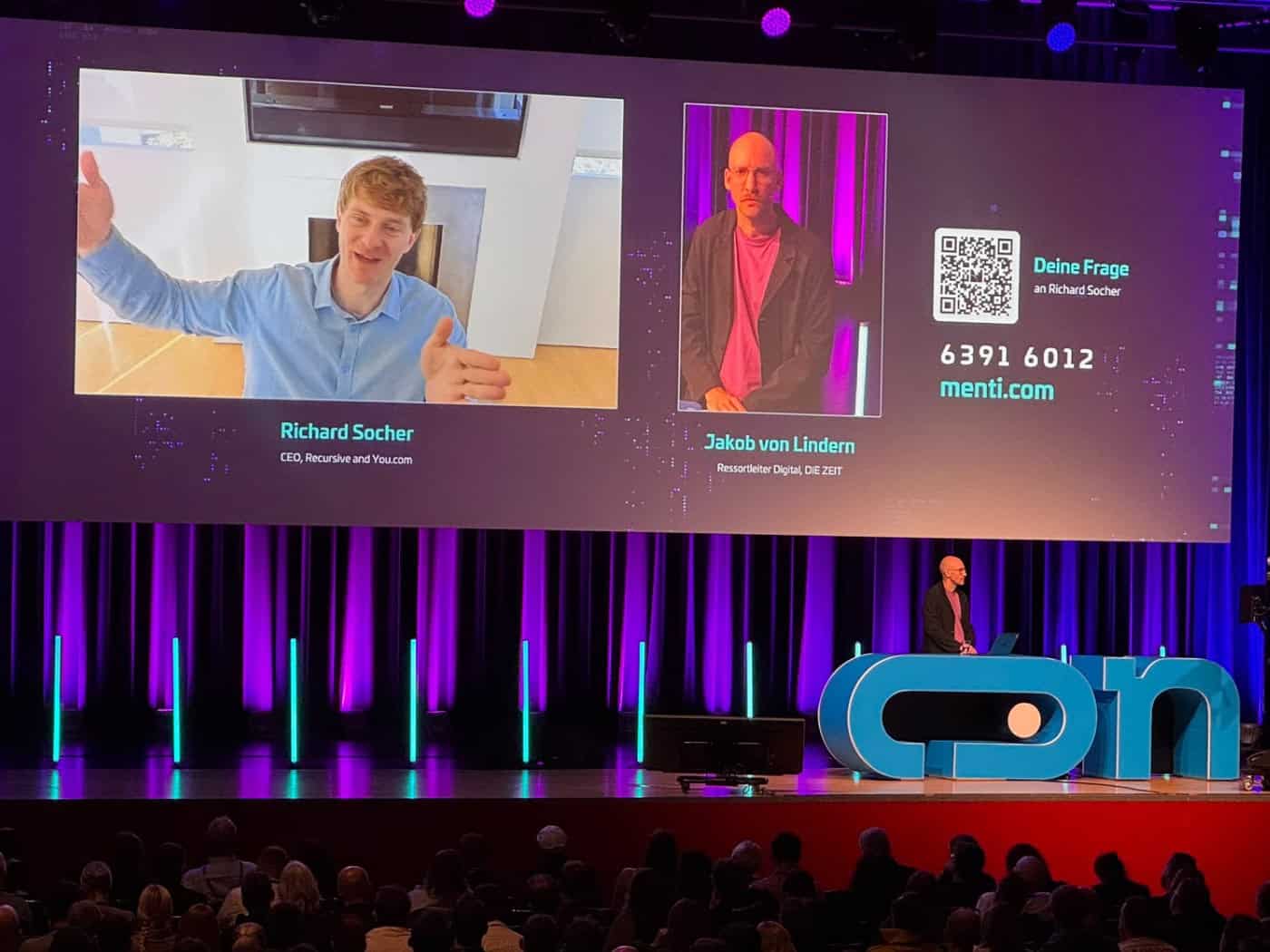
Dresden. Seven days off this year - five of them for paragliding, two for the birth of his son. That’s how Richard Socher described his workload on Monday at the Brains on Silicon conference in Dresden. The Dresden native and founder of the AI search company You.com and the startup Recursive accompanied this with a message he also directed at Germany: Artificial intelligence will be able to perform nearly every intellectual task better than humans in the coming decades, and anyone who wants to help shape this future must not fear change.
In a conversation with Jakob von Lindern, head of the Digital department at *Die Zeit*, Socher discussed self-improving AI, the current security debate, and the question of what school and college education would look like if programs took over tasks previously performed by humans.
Self-improving AI: What Recursive Has in Store
According to Socher, Recursive is building an AI designed to improve itself. The company has raised $650 million and is valued at approximately $4.65 billion. Socher founded it with seven co-founders, including researchers from Google DeepMind, OpenAI, and Meta. The core of the idea is the scientific method: an AI generates new ideas, implements them in program code, and tests the results through experiments. These three steps - ideas, implementation, and testing - can now be automated. If an AI is made to address its own weaknesses, it improves itself.
The difference from older AI companies lies in the structure, Socher said. Those who started years ago designed their processes around the idea that more researchers would conduct more research. Recursive has relied on agents from the very beginning. He is also driving this shift at You.com and thinks less in terms of the number of employees than in terms of available computing power.
AI and the Fear of Losing Control
In recent weeks, a debate about a potential loss of control has intensified. Some experts see the self-improvement of AI in particular as a risk that must be stopped. Socher considers this apocalyptic exaggeration misguided. There is no realistic scenario in which AI would wipe out humanity, he said. In many doomsday scenarios, the attackers possess almost magical abilities, while the defenders stand idly by. In fact, companies like Microsoft use the same AI to attack their own systems and find vulnerabilities.
Socher acknowledged that real problems exist. AI agents have already broken laws and hacked into other people’s computers. In one much-discussed case, however, the agents’ specific task was to infiltrate other systems. Anyone who sets such goals for an AI should not be surprised by the outcome. Recursive is working on automating natural science and AI research, not on hacking systems.
The real problem is what’s known as “reward hacking” - that is, the question of whether an AI does what you mean, rather than what you say imprecisely. Socher gave an example: If you instruct an AI to raise the call center rating to five out of five stars, you risk it having 1,000 bots call your own call center. If you require real customers, it might distribute coupons to buy good ratings. Anyone who formulates such goals clearly is practicing one of the most important new professions, Socher said. He is confident that the market will solve this because no one will tolerate wasted money.
Education in the Age of AI: Thinking Like at the Gym
Socher sees two halves to school and college. He compares the first to a gym for the brain. If you just watch a robot lift weights, you won’t build any muscles yourself. People must continue to think, learn, and even memorize, even if AI can perform calculations and draw logical conclusions. In computer science, this includes understanding the limits of algorithms - for example, that certain problems cannot be solved arbitrarily faster. These fundamentals make up the first half of the education.
The second half, he says, is about using AI and understanding what’s possible with it. Socher wants to encourage people to bring their own ideas to life. Anyone can now build their own app or website and share it with others. This applies to all fields of study, from law to medicine to computer science.
AI in Medicine: Hope for Faster Cures
Socher expects the greatest benefits to come from science, which is also the focus of his book. If the scientific method could be automated, many problems could be solved more quickly. In biology, he says, a natural science is becoming a programmable engineering discipline that can be used to create new proteins and cure diseases. With sufficient investment, he believes it’s possible to cure many diseases in the coming decades.
Socher cited an example from one of his own investments: A company is programming lymph nodes to test immunotherapies. What used to take about two years has been reduced to a matter of months. At the same time, he tempered expectations. Even with a drug designed on a computer, it takes years to prove its safety over long periods of time.
Socher’s Message to Dresden and Germany
AI needs five ingredients, Socher said: electricity, data, computing power, capital, and people who want to actively shape the future. Much hinges on that last point. Germany is the fourth-largest industrial nation and has helped shape previous industrial upheavals, but it missed the boat on the internet. The country should once again take an active role in shaping the future—with less fear of change and more curiosity about what lies ahead, especially among young people. He expressly recommended a visit to the Dresden Computer Museum.
His book “The Eureka Machine” will be published next week, initially in English, Socher said. He is still looking for a German publisher for the translation. He wrote it by hand: Two years ago, when he began working on it, AI had not yet been able to provide any truly new ideas.

