

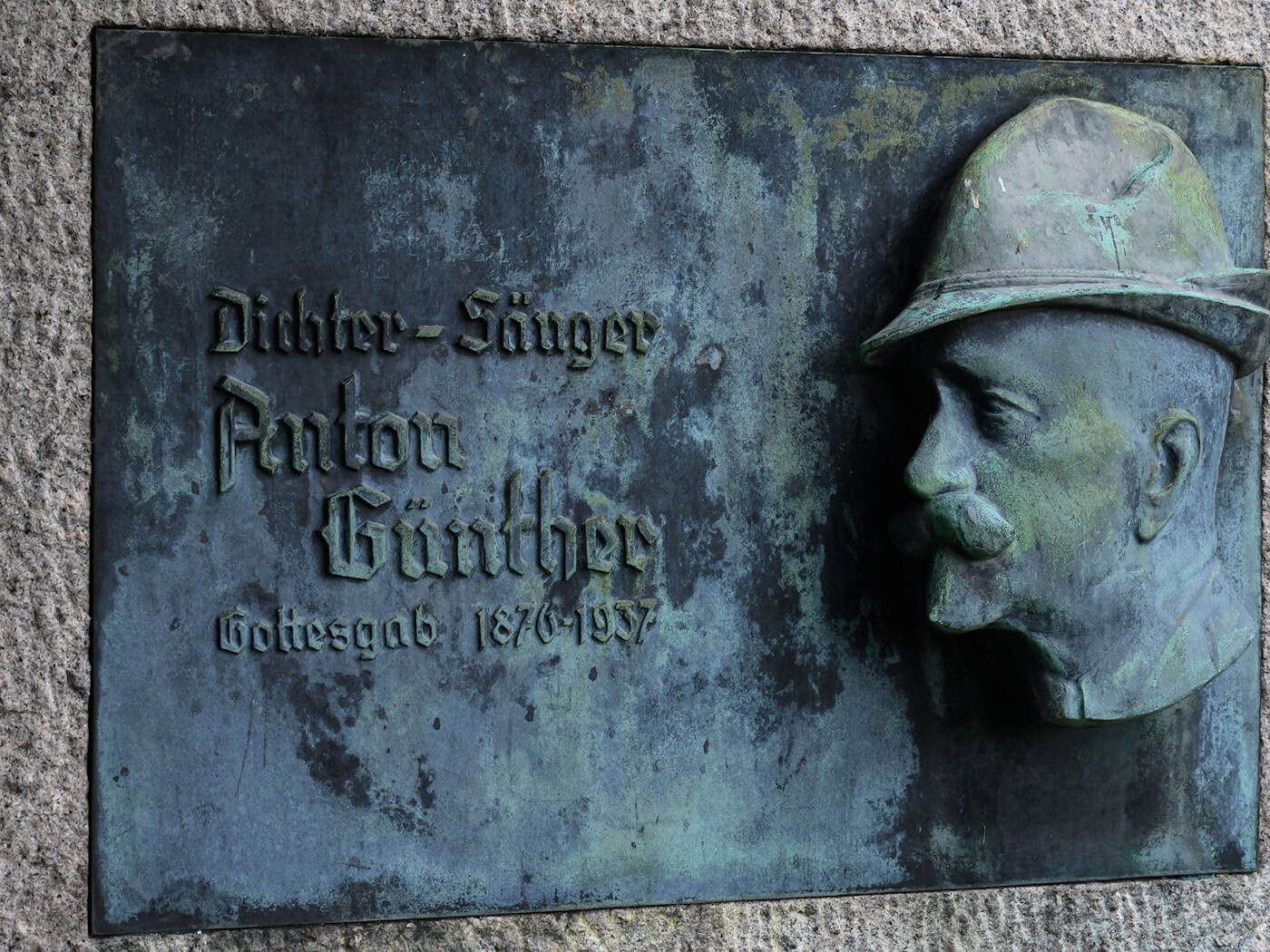
"O Arzgebirg, how beautiful you are", wrote Anton Günther in 1927, "with your forests, your meadows, Barg on Tol". This declaration of love for his homeland is just one of well over 100 songs in which he sang about the region and its people - in dialect. Many of them are as inseparable from the Ore Mountains today as arts and crafts and mining parades. Günther was born 150 years ago in Gottesgab - now Boží Dar in the Czech Republic. He not only made a name for himself as a songwriter beyond the region. One person who has accompanied Günther's songs since childhood is Alexander Böhm from Jahnsdorf. He has portraits of him hanging in his house and admits: "I'm a big Anton Günther fan." He holds a thick album in his hands. The 49-year-old keeps around 400 postcards in it. Günther was not only a dialect poet and composer. He is also considered the inventor of the song postcard. As a trained lithographer, he came up with the idea of printing his lyrics and sheet music on postcards. This not only made them widely known, but also brought him additional income. The first card, albeit without sheet music, dates back to 1895 and was dedicated to his song "Drham is' drham". At the time, Günther lived and worked far away from his parents' home in Prague. Having grown up in humble circumstances in the Bohemian part of the Ore Mountains, the nature-loving young man had wanted to become a forester. But he didn't have the money for this education. When he was 16, his mother died, leaving behind her husband and seven children. Anton went to a lithography school for training and then to Prague to earn money. He was so good at his trade that he even received an offer from Denmark. But when his father died, he returned to Gottesgab in 1901 to support the family as the eldest son. Around 100 years later, Böhm began to take an interest in Günther's song postcards. Many of them cost a few euros today, but some rarities go for several hundred euros, he says. "Collecting these postcards is finite," says Böhm. He wanted more: "My dream was to make my own contribution to Anton Günther's legacy." There were already biographies and he wasn't particularly good at singing. So he researched another topic and wrote a book about it: the memorial stones in honor of Anton Günther. After all, anyone traveling in the Ore Mountains will find the dialect poet's name in abundance: streets, restaurants and viewpoints are named after him. And there are also memorial stones in many places, not just in Saxony. Böhm says that he knows of more than 50. There are also memorials in the Czech Republic, Austria, Hesse, Bavaria, Baden-Württemberg and Lower Saxony. After the Second World War, many Germans had to leave their villages and towns in what was then Czechoslovakia and put down new roots elsewhere. Anton Günther's songs helped them to cherish the memories of their homeland. However, some of the lyrics raise questions today. In 1914, Günther joined in the jubilation at the outbreak of the First World War and wrote the song "Hurra! 's gieht lus". A few years earlier, he had already formulated the verses to "Deitsch on frei wolln mr sei" - one of his best-known songs. It says: "The last drop of blood goes to our old German homeland." The song is repeatedly appropriated by right-wing extremists. The NPD once even advertised with the slogan: "Our Anton would vote NPD." However, he wrote the lines decades before Hitler's Germany plunged the world into the greatest catastrophe of the 20th century and had six million Jews murdered, among other things. "He should be read from the time in which he was arrested," says Günther expert Richard Glöckner on the reception of Anton Günther. "He was a relatively simple man who was not made for world politics." Glöckner, 31, grew up in the Ore Mountains and knows Günther's songs from children's choirs and school, he says. He is a trained tenor and works at the Eduard-von-Winterstein-Theater in Annaberg-Buchholz. He has been on stage there since 2022 with the Anton Günther evening "Mei Harz braucht Lieder" - a hit with audiences. In the play, he conducts a dialog with the poet, who is present on stage as a puppet. Günther's texts invite nationalistic interpretations, Glöckner knows. He wants to critically reflect on this and also show the philanthropic and cosmopolitan ideas behind the songs. "Although they are quite simple songs musically, they have a wide range of lyrics," enthuses the singer. "They deal with great themes of longing, as can also be found in art songs by Schubert or Brahms." In 1937, the poet ended his own life. He suffered from depression. At the funeral, around 7,000 people are said to have bid him farewell in Gottesgab. On the 150th anniversary, the dialect poet is experiencing a new hype. He is being honored with song recitals in many places and a new memorial stone is also being dedicated. "So geht sächsisch" - the umbrella brand of the Free State of Saxony - even named him the "Bob Dylan of the Ore Mountains". His lyrics reflect the deep connection many people have with the landscape and traditions, says Glöckner, explaining his enduring popularity. "The lyrics manage to express this love incredibly well." Copyright 2026, dpa (www.dpa.de). All rights reserved"Drham is' drham" was the first song postcard
"German and free" - as a poet a child of his time
Anton Günther - the "Bob Dylan of the Ore Mountains"?


