

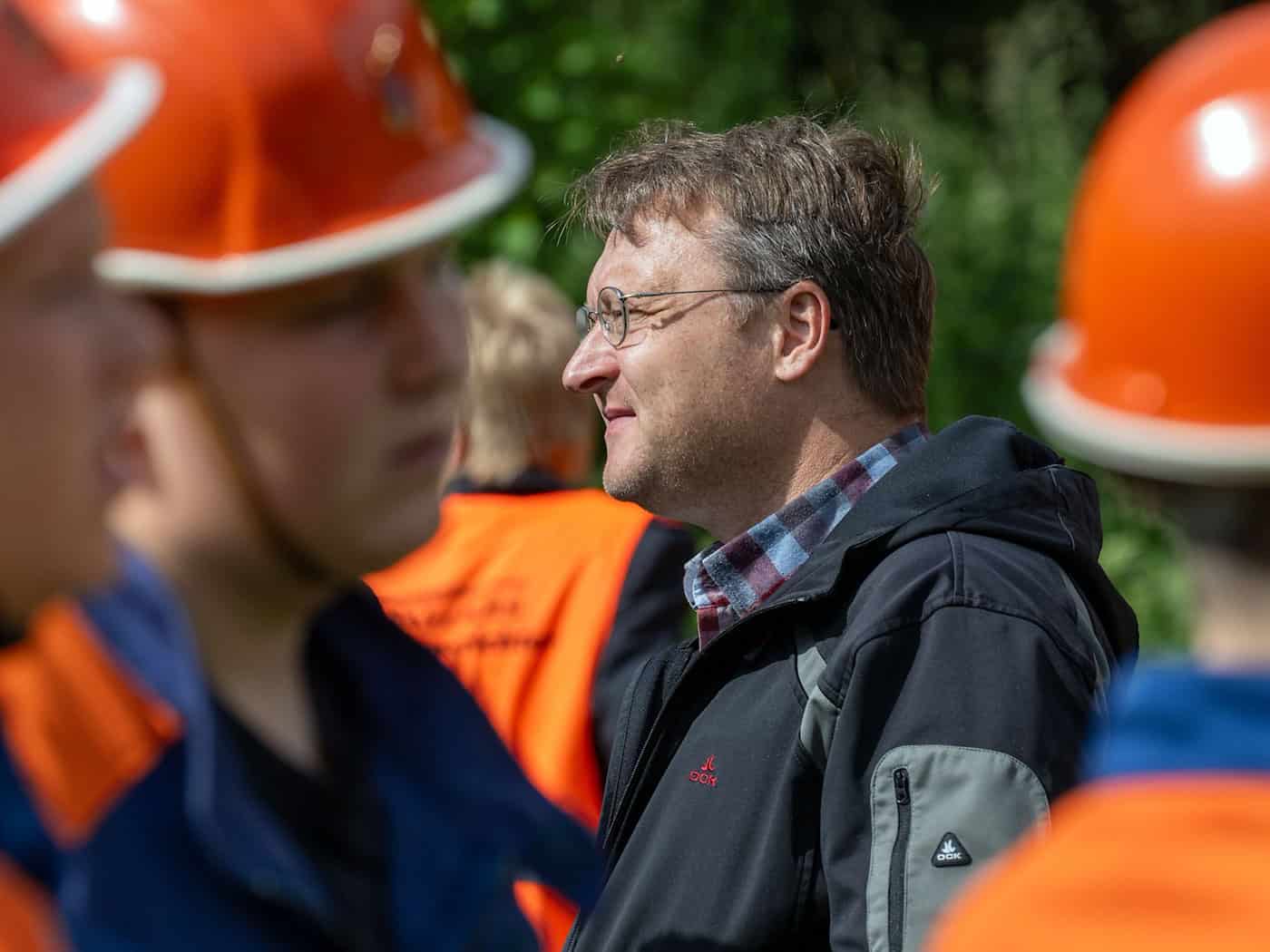
“Shaping, not just managing” read his posters. When Robert Sesselmann was elected Germany’s first AfD district administrator on a hot, humid day in June 2023, Björn Höcke spoke of a “political flash of lightning.” Today, the Thuringian AfD leader says, “He’s settled in well.” The initial fervor seems to have faded. Thuringian district administrators are elected for six years—it’s now the halfway point in the Sonneberg district. For the AfD, Sesselmann’s election as district administrator of Germany’s second-smallest district was a massive success at the time. He also won the election on platform demands he’ll never be able to implement as district administrator—such as leaving the eurozone or abolishing the broadcasting license fee. In Höcke’s AfD, some dreamed of a hardline approach toward refugees, of deportations and isolationism. Pure AfD. Three years later, Robert Sesselmann stands on the sports field of the small village of Lichte and looks at a fire department history book that a man is holding up in front of him. He is welcomed as a “guest of honor” in front of about 200 children and teenagers at the district youth fire department day and is invited to deliver a welcoming address. Sesselmann wishes them “the best of success,” he says. “And if things don’t go so well, it’s not so bad, because you learn best from your mistakes.” Sesselmann isn’t a gifted speaker; the applause is lukewarm. But the people here are well-disposed toward him. If you ask around, no one is brimming with enthusiasm, but there’s no criticism either. “That’s fine,” says a female visitor to the festival in the Franconian dialect typical of the region. A man praises the fact that the district has allocated more money for fire department needs. In Thuringian state politics, there are three narratives about Robert Sesselmann. There is the narrative in which Sesselmann is portrayed as a failure, a somewhat eccentric politician who is largely isolated among the district administrators—someone who falls short of his party’s expectations. It is a narrative that CDU politicians like to spread; such sentiments are also heard within the SPD and from some of his fellow district administrators. Then there is the image of Sesselmann as a representative of the far-right AfD, whose partner was active in the neo-Nazi scene, and who is said to be a follower of Höcke. It is an image of Sesselmann painted primarily by people on the left. Sesselmann made his relationship with the woman public in 2024. According to him, she had already left the NPD in 2019. She now occasionally appears in Sesselmann’s weekly videos, in which he reports on his work as district administrator. On his YouTube channel, for example, she promotes an event marking the midpoint of his term in office. Three years ago, the Thuringian AfD was already classified by the State Office for the Protection of the Constitution as a confirmed far-right extremist organization. However, Sesselmann had passed a suitability review by the local government oversight authority after his election. Katharina König-Preuss, a member of the Thuringian Left Party, says of Sesselmann: “In my assessment, Robert Sesselmann belongs politically to the ethno-nationalist camp around Björn Höcke in the AfD; his attack on democracy promotion at the beginning of his term in office is a prime example of this.” He contributes significantly to the normalization of far-right ideology. After taking office, Sesselmann sought to cut the district’s contribution to a federal program designed to promote democracy and prevent extremism. The relevant committee in the district council prevented this. And then there’s the narrative of Sesselmann as an administrator. A lawyer—correct, but boring. You hear this narrative when you speak with AfD politicians and assure them you won’t quote them by name. It sounds like normalization, like “no drama, everything is running its course.” No exclamation points, as, for example, former Green Party member Boris Palmer repeatedly makes as mayor of Tübingen—through provocation or his unconventional approach to governance. No high-profile politics that might even make it into the national media, like that of SPD District Administrator Matthias Jendricke in northern Thuringia, who has his public order office knock on the doors of basic income recipients to encourage them to work. The “blue miracle” that was supposed to unfold after Sesselmann’s election—as some in the AfD were still dreaming of in 2023—failed to materialize. Not a single AfD candidate has since managed to win a district administrator’s seat; all failed in the runoff election at the latest. Whether this will remain the case for the time being could be decided on Sunday in the runoff election in the Saale District in Saxony-Anhalt, where the AfD candidate was ahead of the CDU candidate in the first round of voting. Even after three years in office, it’s not easy to arrange an interview with Robert Sesselmann. “The district administrator’s prerequisite for this is that you send him your specific questions,” writes a staff member at the district office. “If questions other than those submitted are asked during the interview, Mr. Sesselmann reserves the right to terminate the interview.” The scheduled interview does not take place. The district office employee attaches a document titled “Review of District Administrator Robert Sesselmann’s Tenure Since Taking Office” to the email. “Complete renunciation of an official vehicle; travel exclusively by private vehicle,” it states, or “Expansion of efforts to place refugees in jobs subject to social insurance contributions,” “Introduction of a chatbot for the website.” Deportations aren’t listed there. “To my knowledge, he has also pushed for deportations. In migration policy, he’s already trying to do whatever he can at the district level,” says Höcke about the first and only AfD district administrator in Germany. In fact, other district administrators in Thuringia deport significantly more people from their districts than Robert Sesselmann. In 2024, seven people were deported from the Sonneberg district, which has a population of just over 54,000—one man, one woman, and five children. By comparison: The Nordhausen district, led by SPD District Administrator Jendricke, has around 80,000 residents but deported nearly three times as many refugees—eleven men, two women, seven children, for a total of 20 people. In 2025, the difference was even more pronounced: six deportations in the Sonneberg district, 40 in the Nordhausen district. Jendricke has his enforcement service take asylum seekers required to leave the country to the airport; they are only given their replacement passport documents once they arrive there, so that they don’t “slip away” from him again, as he puts it. In the Sonneberg district, 85 percent of deportation proceedings failed, as “Bild” recently reported. Together with two other municipalities, the Sonneberg district thus ranks last in a Thuringia-wide comparison. The main reason is the absence of individuals, a spokesperson for the district administration told “Bild.” On the sidelines of the district youth fire department day in Lichte, a spontaneous conversation with Robert Sesselmann does take place. He says he had recently been to the Syrian Embassy in Berlin and, with a sudden jerk, zips his jacket higher. It’s chilly on this June day at the sports field in Lichte. “Our problem is that the replacement passport documents aren’t being delivered on time. Deportations are failing because there are no current passport documents or replacement passport documents.” Sources within the Thuringian AfD say that in Erfurt, they are “moderately” satisfied with Sesselmann’s performance. They would have liked to see more initiative, for example, in the area of deportations. Although he does not follow the “CDU line” and does not focus on integration, a high-ranking AfD member says his approach to migration could be more consistent. On the positive side, he has consolidated the budget. Sesselmann also counts it as a success that there are no wind turbines in his district. As district administrator, he rejected the draft of the Southwest Thuringia Regional Plan but was unable to prevent its adoption. There are now three priority areas in the Sonneberg district; other district administrators believe it is only a matter of time before wind turbines are built there. Sesselmann considers this to be speculation. During Robert Sesselmann’s term in office, one section of a comprehensive school was closed. During the election campaign, he had spoken out in favor of keeping it open. In Sesselmann’s district, the future of a traditional school and an elementary school hangs in the balance—they no longer meet the state’s minimum enrollment requirements. “If the school network plan isn’t approved in its current form, it’s possible that students will withdraw from the schools,” Sesselmann admits. If you ask around in downtown Sonneberg, the opinions vary—none of those interviewed want to give their names. There’s the mother in the pedestrian zone who says she didn’t vote for him but thinks he has “charisma and authenticity.” Then there’s the retired couple strolling through downtown who offer a more nuanced view: Many had hoped District Administrator Sachen would do things that were simply beyond his power. “Actually, nothing is moving forward—it’s going backward,” said the woman. The man says that, at least when it comes to renovating schools, some progress has been made in the district. The situation is different when it comes to migration: Integration isn’t working, “because there are so many people.” Two teenagers in the city park believe there are entirely different issues in the district: things like infrastructure, catching up in school after the pandemic, and apprenticeship opportunities. “The mood is getting more and more gloomy,” says one of them, with red-dyed hair, a nose piercing, and a faded jacket. He himself lives ten minutes’ drive from Sonneberg in a Bavarian town, but often comes to Sonneberg to visit. “I can tell I’m not really welcome here—just from the way people look at me—or when I get spat on on the train. You do feel relatively unsafe. But you can’t let yourself be intimidated or beaten down.” Copyright 2026, dpa (www.dpa.de). All rights reservedAdministrator, failure, or far-right extremist?
Disillusionment in the AfD
No sensationalist politics
Other districts are making more progress
Visit to the Syrian Embassy
School location closed
The mood is somber


