


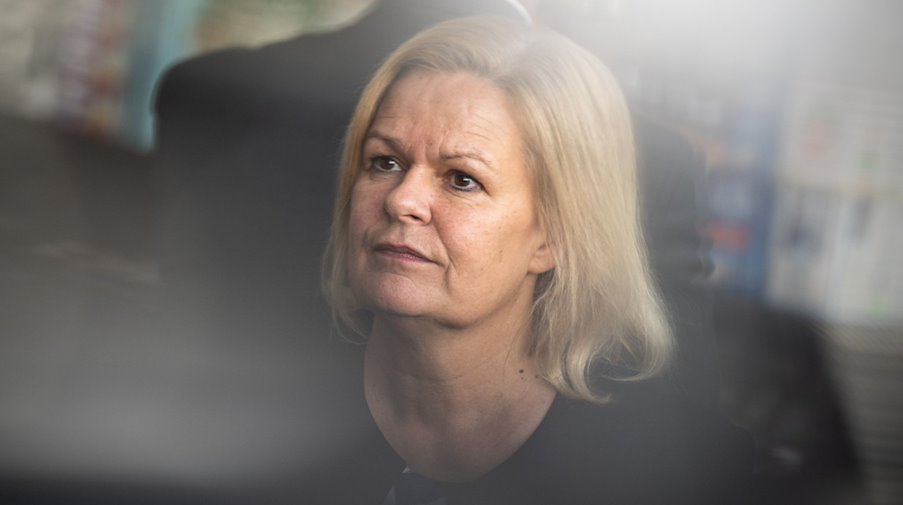
Mostly via the Czech Republic and Poland, but also on other routes, more asylum seekers have been coming to Germany again for several months. Between the beginning of January and the end of August, more than 204,000 people applied for asylum in Germany for the first time. Many of them come from countries such as Syria or Afghanistan, whose citizens can generally claim protection in the European Union. So that the proportion of those among them who make their asylum application in Germany does not continue to rise, some interior politicians in the federal government and the states have been calling for stationary controls on the borders with the Czech Republic and Poland for weeks. Federal Interior Minister Nancy Faeser (SPD) does not think that makes sense so far. In an interview, the Minister says on Tuesday, it prepares "stationary border controls with". Controls, as there are since 2015 in Bavaria at the border with Austria, but she probably does not mean. The most important questions and answers: Come now the stationary controls on the borders? No, that looks at the moment not so. Because those must be applied for at the EU Commission, and that has not happened so far - and according to information from the Federal Ministry of the Interior also not planned for now. Instead, Faeser is planning to step up controls near the border and is of the legal opinion that the federal police can also stop vehicles directly at the border on a selective basis - for example, if smuggling is suspected there. In addition, Faeser wants more joint patrols with Poland and the Czech Republic. What speaks for stationary controls? Smugglers are thus easier to catch, because in controls across the border, they are often already gone when police pick up the irregularly entered people. Rejections at internal Schengen borders are only legally permissible if the temporary reintroduction of border controls has been previously notified to the EU Commission. However, rejections are only used in relatively few cases anyway, such as when a foreigner is subject to an entry ban or does not apply for asylum. How often do rejections actually occur? According to the German government, 4489 people were rejected at border checkpoints on the German-Austrian land border in the first half of 2023. In the same period, 4787 foreigners were turned back at the German-Swiss land border, where the federal police are allowed to check on trains on Swiss territory under an agreement with Bern, mainly because they could not produce valid travel documents. What is the argument against stationary border controls? They tie up a lot of personnel. If the controls are strengthened at one point, experience shows that unauthorized entries increase after a while at another section of the border, because the people who want to get to Germany and their smugglers have adjusted to this. Moreover, once such controls have been introduced, it is often difficult to find a way out. This is because it then easily acts as a signal that a state wants to relax its regulations with regard to irregular migration. This is shown by the example of the controls in Bavaria. They were first requested in the fall of 2015 - when the federal interior minister was still Thomas de Maizière and came from the CDU. Since then, they have been extended again and again - also by Nancy Faeser. This annoys especially the Greens, who consider such controls generally wrong. Where else in the EU are there currently stationary controls? Although the principle of open internal borders actually applies in the Schengen area, there are currently several states that have pulled this card. Spain, for example, has announced controls for a few days from September 28 and justified this with security precautions around the informal meeting of heads of state and government in Granada. Norway is currently conducting checks at ports with ferry connections to Schengen states, citing risks to critical infrastructure on land and in the maritime area, as well as the threat posed by Russian intelligence activities. Denmark cites several reasons for its land border controls with Germany, including organized crime, irregular migration and the threat of Islamist terror. Austria has notified border controls for some sections, and Sweden for all internal borders. France has also requested controls at its borders with Belgium, Luxembourg, Germany, Italy, Spain and Switzerland, citing terror risks and irregular migration via the central Mediterranean route and the so-called Balkan route. However, the French do not control everywhere around the clock, but rather selectively and adapted to the situation. What do the unions say? The German police union is pushing for stationary controls. The police union (GdP), on the other hand, considers the French model better. "We had last twelve Hundertschaften of the riot police at the internal borders and in the border area," says Andreas Roßkopf, chairman of the GdP district Federal Police. On Tuesday, another two hundred units were added. This means that the limit of the workload has been reached. Area-wide stationary controls at the eastern border would, he is convinced, only be sustainable for a few weeks in terms of personnel.
Copyright 2023, dpa (www.dpa.de). All rights reserved
.

