


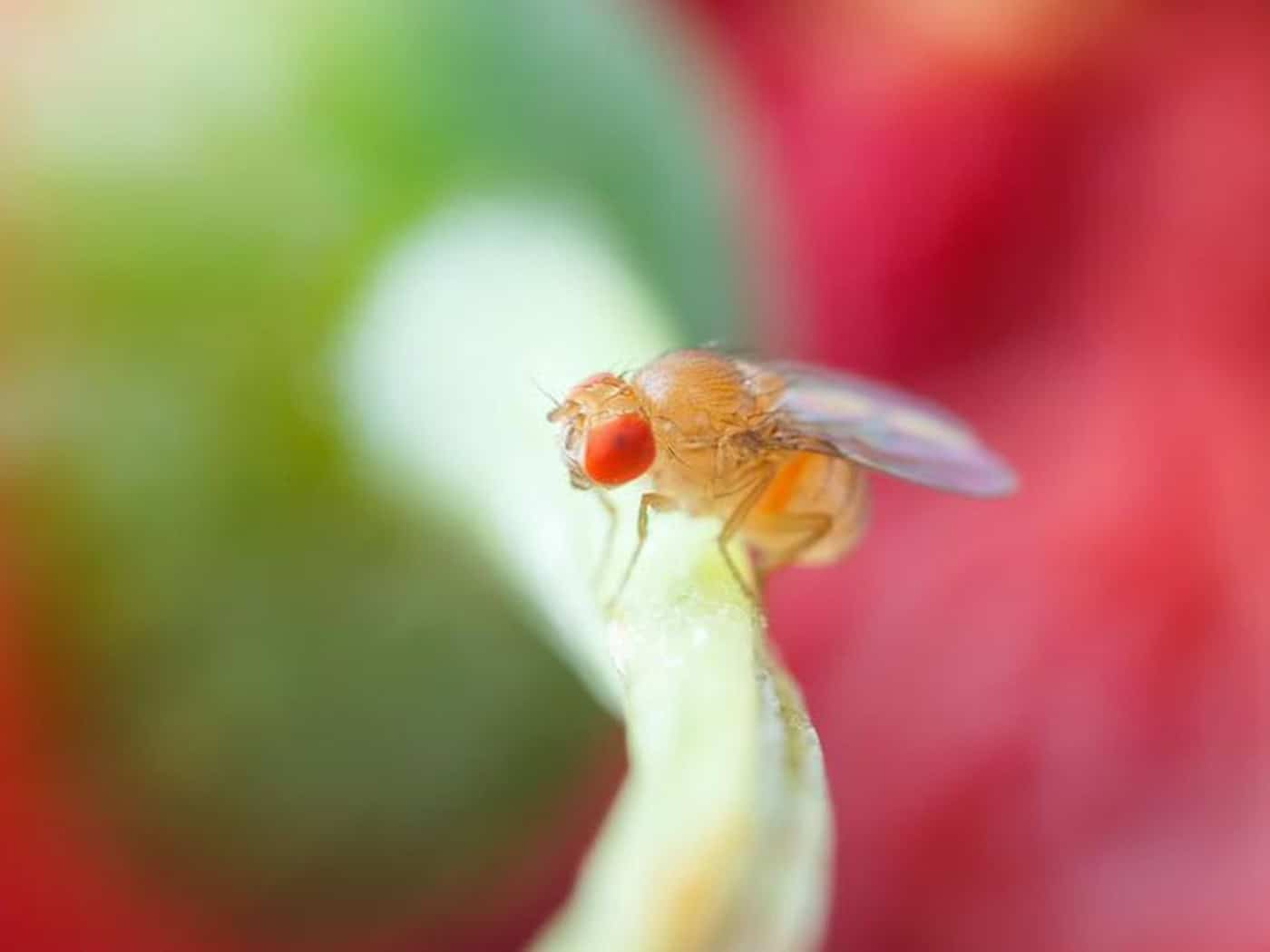
A child touches a hot stove once and never forgets it. A dog gets a treat for performing a trick and immediately repeats it. Reward and punishment shape what living beings remember and how they behave in the future. But how are such memories formed in the brain? Researchers at the Universität Leipzig have now gained new insights into this question — in the brain of a fruit fly.
The tiny fly Drosophila melanogaster has been an important model organism in neuroscience for decades. Although its brain is comparatively simple, many fundamental mechanisms of learning and memory can be studied particularly well in it. The Leipzig team investigated which nerve cells control learning processes. Their study was published in the journal Proceedings of the National Academy of Sciences.
A control center in the brain
At the center of the study are so-called octopaminergic neurons. These are nerve cells that release the signaling molecule octopamine. This substance influences the brain’s reward and punishment system, in which dopamine — an important signaling molecule involved in motivation and learning — also plays a central role. “Using special genetic methods, we were able to selectively activate the octopaminergic neurons. Interestingly, this alone was enough to create both positive and negative memories,” explains Samantha Aurich from the Animal and Behavioral Physiology research group. She was one of three doctoral researchers at Leipzig University who played a leading role in the study.
Timing turned out to be crucial. Depending on when these nerve cells became active during the learning process, either a positive or a negative memory was formed. The octopaminergic neurons act like switches: they activate different types of dopaminergic neurons, which then send signals associated with reward or punishment to the brain’s memory center.
How scientists’ understanding of learning has changed
For a long time, researchers believed that the functions were clearly separated. “It used to be thought that dopaminergic neurons were responsible only for punishment signals and octopaminergic neurons only for reward signals,” says Prof. Dr. Andreas Thum from the Genetics research group. That view has changed. According to Prof. Dr. Dennis Pauls from the Animal and Behavioral Physiology research group, octopamine influences how information is transmitted and therefore helps determine what kind of memory is formed.
Fruit flies have been among the most important model organisms in neuroscience for decades. Although their brains contain only a fraction of the neurons found in humans, many basic mechanisms of learning and memory are considered evolutionarily ancient. Because individual nerve cells in fruit flies can be precisely activated or deactivated, researchers can study in remarkable detail how memories form and how behavior is controlled.
The new findings are part of basic research aimed at understanding biological processes more deeply. In the long term, such work could contribute to a better understanding of learning and memory processes involved in neurological disorders. This field of research has been growing steadily at Leipzig University for years. The newly established DFG Research Training Group “NeuroTune” brings together researchers from genetics, behavioral physiology, and related disciplines to study how the brain works..
Original publication:
U.S. Franke, A. Großjohann, S. Aurich, I. Köhler, M. Lamberty, S. Granato, A. Fallaha, J. Breitfeld, P. Kovacs, M. Selcho, R.J. Kittel, A.S. Thum, & D. Pauls, Selective octopaminergic tuning of mushroom body circuits during memory formation, Proc. Natl. Acad. Sci. U.S.A. 123 (16) e2517403123, (2026).

