Logo Die Sachsen News
News / Food & Wine

Tourism Minister Barbara Klepsch: "We still see potential in Saxony when it comes to cuisine!"

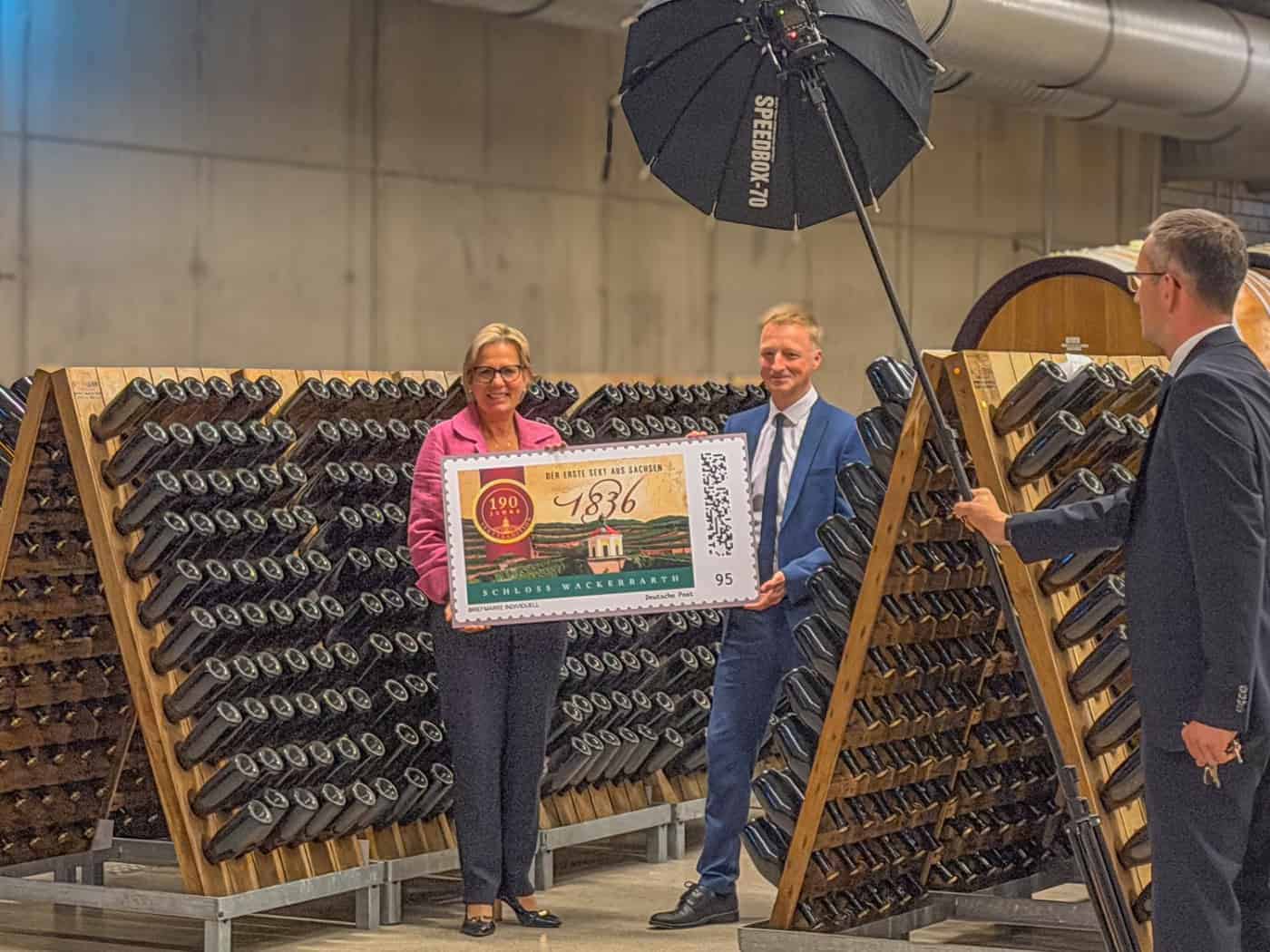
Stamp
Minister of Culture Barbara Klepsch, Marketing and Sales Director Michael Thomas, and Wackerbarth press spokesperson Martin Junge, who held the light for his colleague EM (Photo: Ulrich van Stipriaan)
From: Ulrich van Stipriaan
A commemorative stamp honors 190 years of sparkling wine tradition at Wackerbarth Castle. Minister of Culture Barbara Klepsch unveiled the stamp in Radebeul and praised Saxony’s wine tourism.

It’s really just a small thing, nothing major: a stamp. A stamp, dear digital natives, “is a confirmation from a postal service provider that the amount printed on it has been paid” (according to Wikipedia). They’re still around, even though fewer and fewer people use letters (or postcards) to communicate: 9.4 billion were sent in 2025 (20 years ago, the figure was still around 16 billion letters), most of which were advertising—and those certainly don’t have a stamp on them, but rather a “data-processing postage mark.” The things you see… So when a stamp was unveiled at Wackerbarth Castle by Barbara Klepsch, Saxony’s State Minister for Culture and Tourism, it was truly something special. Regular readers may have guessed it, since it’s been written about before: the Wackerbarths are celebrating an anniversary! Not quite a round number, but close enough: 190 years of sparkling wine tradition in Saxony. The stamp is a limited edition; in honor of the founding year, there are 1,836 copies, with a face value of 95 cents—enough for a postcard or a standard letter.
More from this category

Barbara Klepsch took her time and didn’t just quickly pose with the photogenic, oversized stamp alongside Michael Thomas, Head of Sales & Marketing at Schloss Wackerbarth—though she did that, of course; the press loves that. But the minister naturally has more up her sleeve—the mandatory part and the optional part. The mandatory part consists of impressive figures. Around 3.1 million overnight and day visitors come to Saxony as wine tourists—and they spend more money here than other travelers: exactly 11 percent (for overnight guests) and 55 percent (for day visitors) above the average for all travelers. During their stay in Saxony’s wine region, wine tourists spend just under 300 million euros.

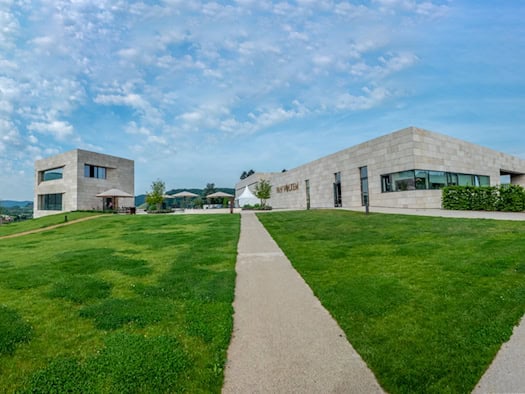
“In line with our ‘So schmeckt Sachsen’ initiative, the topic of cuisine is of great importance to us,” said the minister, “as it perfectly combines cultural and nature tourism.” But there’s still room for growth, said Barbara Klepsch, “We see a lot of potential in Saxony!” Wackerbarth Castle, as an experiential winery, is one of the region’s flagship attractions. “Its significance extends far beyond the Free State—not only through its products but also through its diverse range of experiential offerings.” As Europe’s first experiential winery, Wackerbarth Castle is a Saxon success story: With more than 240,000 annual visitors in Radebeul, it ranks among the world’s most-visited wineries, according to the “Global Wine Tourism Report 2025” by Geisenheim University. For this comprehensive international analysis of global wine tourism, the renowned authors surveyed more than 1,310 wineries from 47 countries.

And this comes exactly 190 years after three visionary winemakers in Radebeul founded an “Actienverein zur Fabrikation moussierender Weine” (Joint-Stock Association for the Production of Sparkling Wines) in 1836, thereby laying the foundation not only for Saxony’s first sparkling wine winery, but also for one of Europe’s oldest sparkling wine producers—albeit with a little help from Champagne: the first cellar master, Johann Joseph Mouzon, came from Reims. He taught the Saxons the art of riddling, as it is traditionally done by hand on riddling tables. In keeping with this tradition, Minister Barbara Klepsch has also checked off another part of her job-related training to become a well-informed minister: following the Traminer harvest last November, she recently received instruction in the art of riddling from bottling master Thomas Milster. The standard training covers more nuances and lasts four years—the minister gave it a try (still very cautiously) after just four minutes. But she took a liking to it and shook her way through the entire rack, from the comfortable top to the decidedly less comfortable bottom.

The translations are automated with the help of AI. We look forward to your feedback and your help in improving our multilingual service. Write to us at: language@diesachsen.com.
Ulrich van Stipriaan
Article from

Ulrich van Stipriaan

Ulrich van Stipriaan is responsible for the content itself. The platform's code of conduct applies. The platform checks and treats content in accordance with the legal requirements, in particular the NetzDG.

Social Media