


Rheingau Winery Schreiber: Focus on the Region
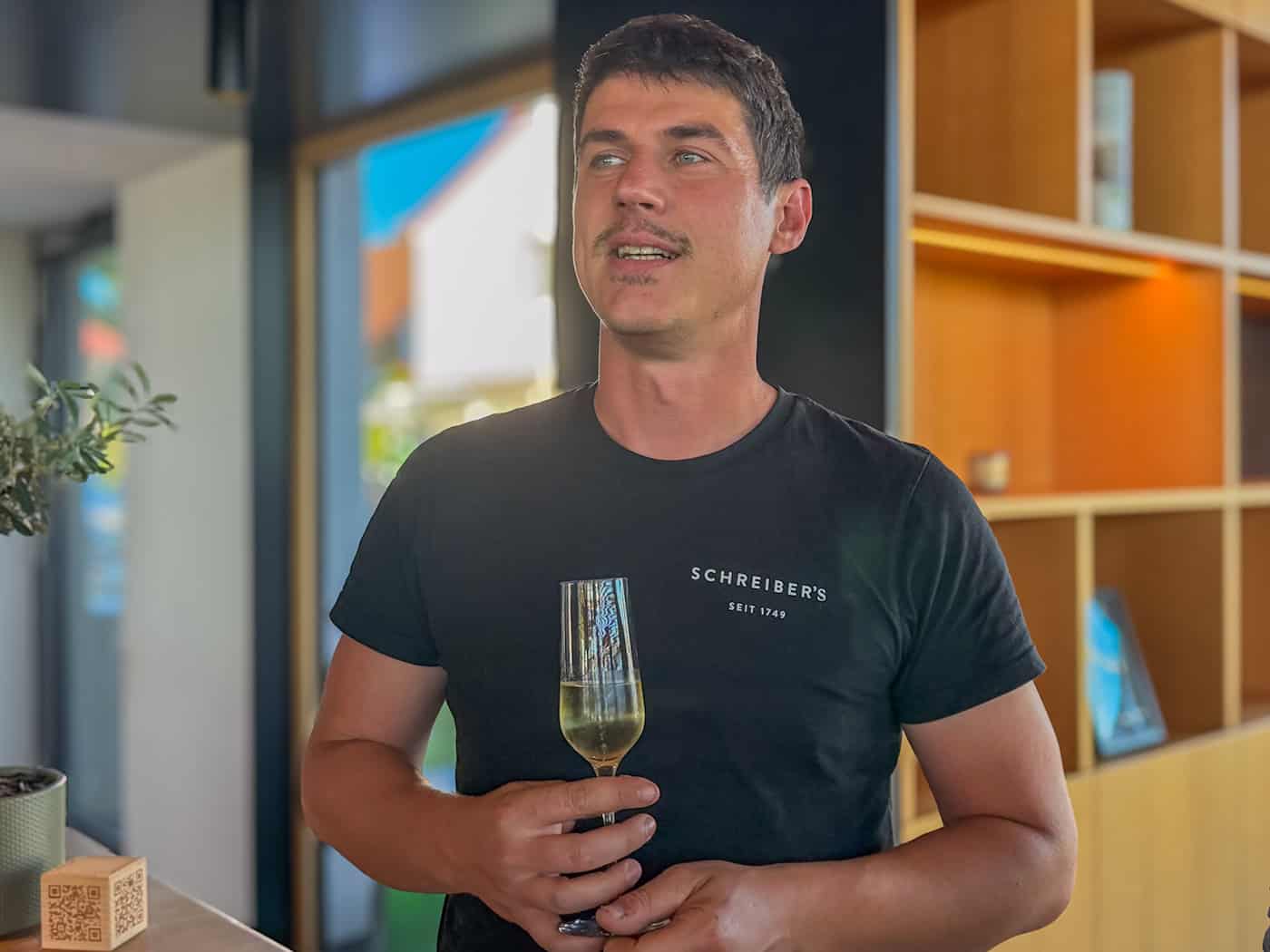
At Schreibers, they still shake the bottles by hand. Fourteen times per bottle, by hand. And they’re the only ones who still do it in Hochheim—even though Hochheim is the oldest sparkling wine production site in the Rheingau and once (a little over 120 years ago) had as many as seven sparkling wine producers. So, to start things off, we’re served their own sparkling wine—a Riesling, of course—after all, we’re in the Rheingau, even though Hochheim, along with the neighboring towns of Kostheim and Flörsheim-Wicker, lies on the Main River. Sounds like an exciting 4,000-euro question: on which river does the Rheingau town of Hochheim lie? Now we know. There are about 300 hectares of vineyards here, roughly ten percent of the entire Rheingau region. At the same time, the Schreiber family’s winery is located right in the heart of the Rhine-Main region: “If you take a dartboard, we’re the red dot, right in the middle!” says Simon Schreiber, describing a relatively advantageous location. Frankfurt, Mainz, and Wiesbaden are just a few kilometers away, and five million people live in this immediate catchment area. For 32-year-old Simon Schreiber, this forms a key part of the business model: instead of shipping the wine as far afield as possible, the winery deliberately focuses on the region.
Today, the family-run business cultivates 15 hectares at its location just outside Hochheim. In 1962, the Schreibers moved out of Hochheim’s old town; in the early 1990s, Simon’s father, Uwe, transformed the originally mixed agricultural operation—which included pigs, cows, arable farming, and viticulture—into a dedicated winery. The year 1749 in the logo certainly suggests that the history of winemaking extends much further back: 13 generations ago, Paul Schreiber sold wine to the Diocese of Mainz—the gentlemen there generally had quite good taste.
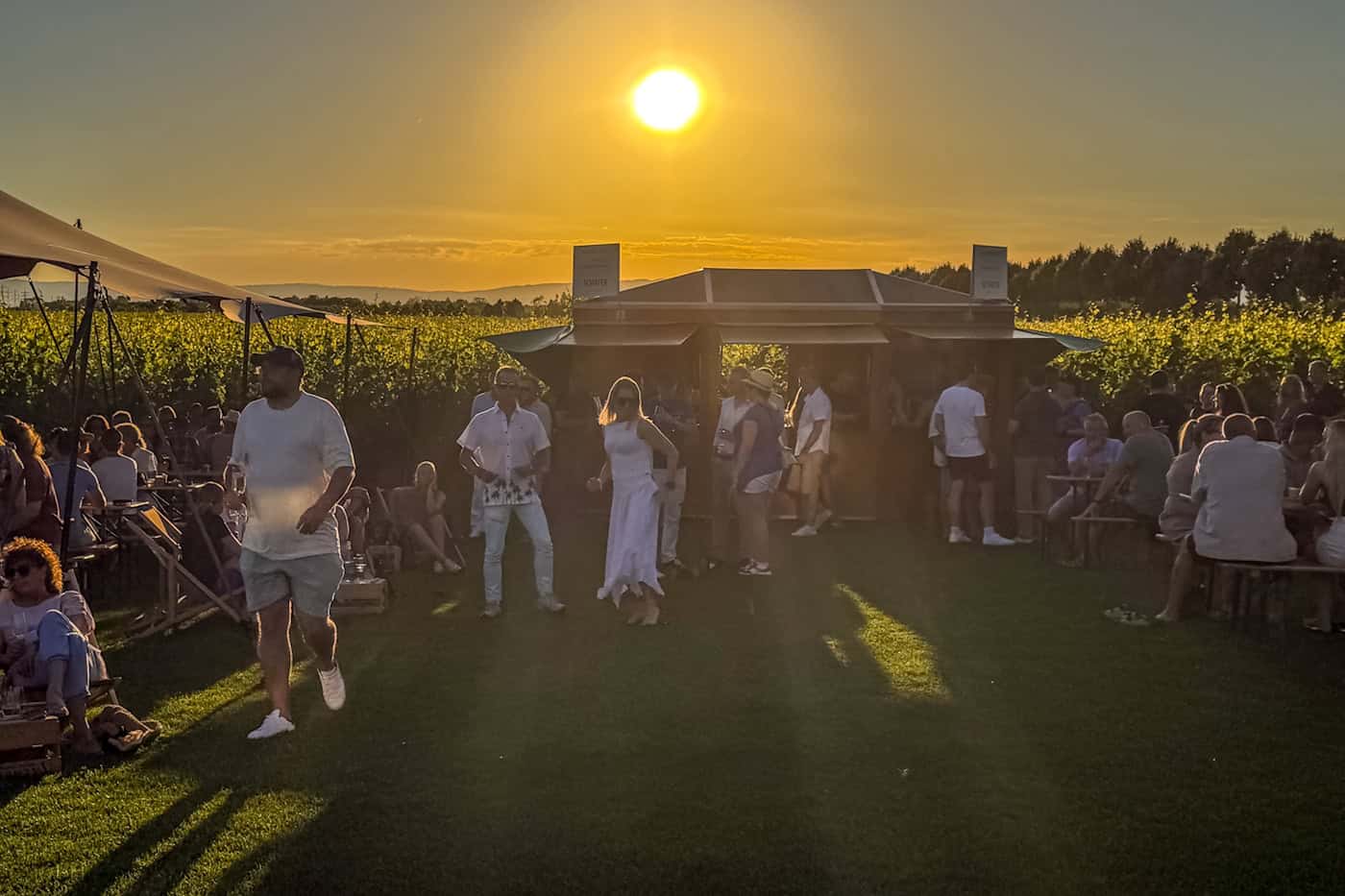
I forgot to ask whether any members of the diocese will be there when the celebration takes place today at the Johanneshof. The fact is, however, that during the summer months, up to 500 guests come to the monthly AfterWork event to leave their everyday lives behind for a while, enjoying live music or the sounds of a DJ. The estate is nestled amid the vineyards of the neighboring village of Massenheim, so you’re practically sitting right in the vines. Events like the AfterWork gatherings, the May Dance, and the White Wine Party even draw up to 1,500 guests—and they are a natural extension of the concept of an open winery that Simon Schreiber conceived during his stay in New Zealand. After all, a modern winery naturally includes a retail component: a wine shop was just the thing!
That’s easier said than done, because a wine shop modeled after New Zealand’s had to make a splash—and that costs money! It wasn’t just the parents who were worried about the financial burden—but in 2018, the family opened the wine shop. The investment paid off: at the time, the Schreibers were farming just seven hectares, but farm-gate sales alone increased by 10,000 to 15,000 bottles after the opening. So the theoretical aspirations became reality, and for Simon Schreiber, one thing is clear: “No one has to ring the doorbell, make an appointment, or feel like they’re bothering the winemaker. Anyone who wants to buy wine is welcome to come right in!” Today, around 50,000 of the approximately 100,000 bottles produced annually are sold directly over the counter. Another 30,000 or so bottles are sold through regional grocery retailers. The Schreibers supply about 40 stores operated by Rewe, Edeka, and other regional retailers. For Simon Schreiber, these stores are an “extension of the winery’s bar.”
The Schreibers have been practicing organic viticulture since 2013
This strong regional focus aligns with the winery’s philosophy. In 2013, Schreiber converted the operation to organic viticulture—“after all, it would be pointless to transport the wine halfway across Europe or around the world when enough people can drink it right on our doorstep!” And all this on-site at extremely reasonable prices: starting at €3 for a 0.1-liter glass—which amazes people from Frankfurt and leaves those from Wiesbaden wondering. Let them be amazed; for the Schreibers, pricing and commitment to events are part of the winery’s DNA. “It brings people to wine who wouldn’t necessarily come for a traditional wine tasting,” says Simon Schreiber. The after-work crowd ranges from young adults to significantly older regulars; the core age group is roughly between 25 and 60.
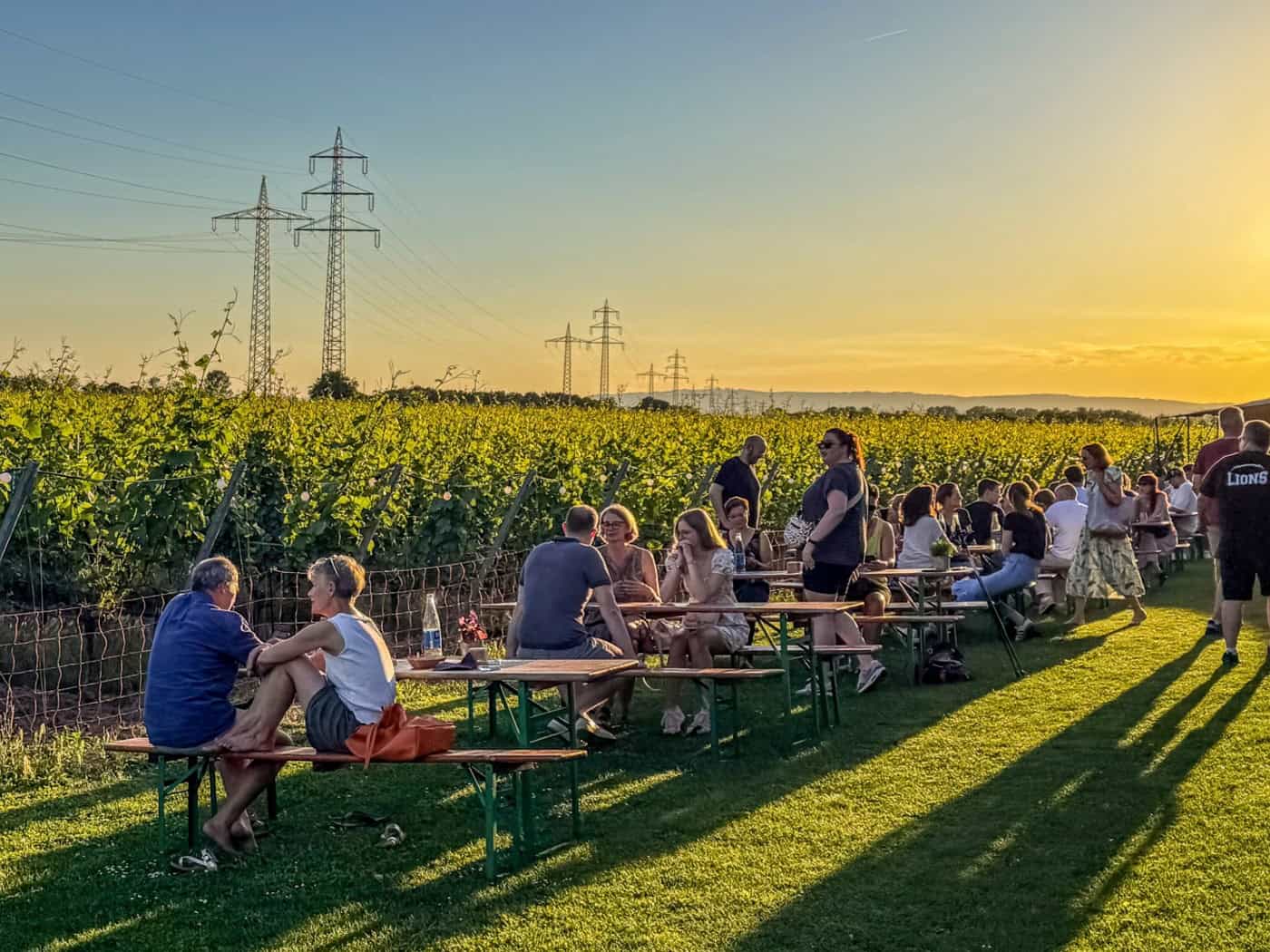
The second part of the winery’s philosophy is its consistent commitment to sustainability—because there’s more to it than just “organic” and regionality. For example, the winery accepts returns of used wine bottles and wine cartons. “About 30,000 to 40,000 bottles per year are sent to a workshop in Geisenheim to be rinsed and then returned to circulation,” reports Simon Schreiber. Above all, this conserves resources, but it’s also economical because the process costs significantly less than purchasing new bottles. In such a setting, the question of using fungus-resistant grape varieties almost arises naturally. The winemaker’s answer is prompt—and, in the Rheingau, hardly surprising at first glance: “For single-vineyard wines, Riesling is the grape variety of choice!” Of course, we put it to the test—namely, a glass of 2024 Hochheimer Hölle, Riesling, dry. The Hölle vineyard lies directly on the Main River, and anyone (like the Künstler Winery) who is a member of the VDP has long counted on hellishly good “Große Gewächse” from there. By the way, apologies for the pun—which, on closer inspection, is actually incorrect: when it comes to vineyard sites, “Hölle” has nothing to do with purgatory or the like; it comes from an old term for a sloping hollow… In any case, the Hölle Riesling brings a fine touch of terroir to the glass and proves to be a versatile food pairing (chicken, anyone—or perhaps a pumpkin risotto soon?), but it also pairs quite well on its own with the setting sun.
In addition to Riesling and the white Burgundy varieties, the selection includes Sauvignon Blanc, Gewürztraminer, Pinot Noir, and Merlot, among others. Added to these are Piwis and various cuvées. One of them is the “Cuvée unterm Storchennest”—the origin of the name becomes clear with a glance upward right in front of the wine shop, where several storks have formed a communal living arrangement on a power line tower. In the 2025 “Cuvée unterm Storchennest,” the two Piwi varieties, Souvignier Gris and Calardis Blanc, perfectly capture the lightness of summer (Ulrich Sautter from *Falstaff* wonderfully described the cuvée as “a sort of Vinho Verde substitute”).
Schreiber Winery
Johanneshof 2
65239 Hochheim am Main
Tel. +49 6146 9171
weingut-schreiber.de
[Visited on June 18, 2026]

