


Stork's Nest in Ostro Causes Controversy
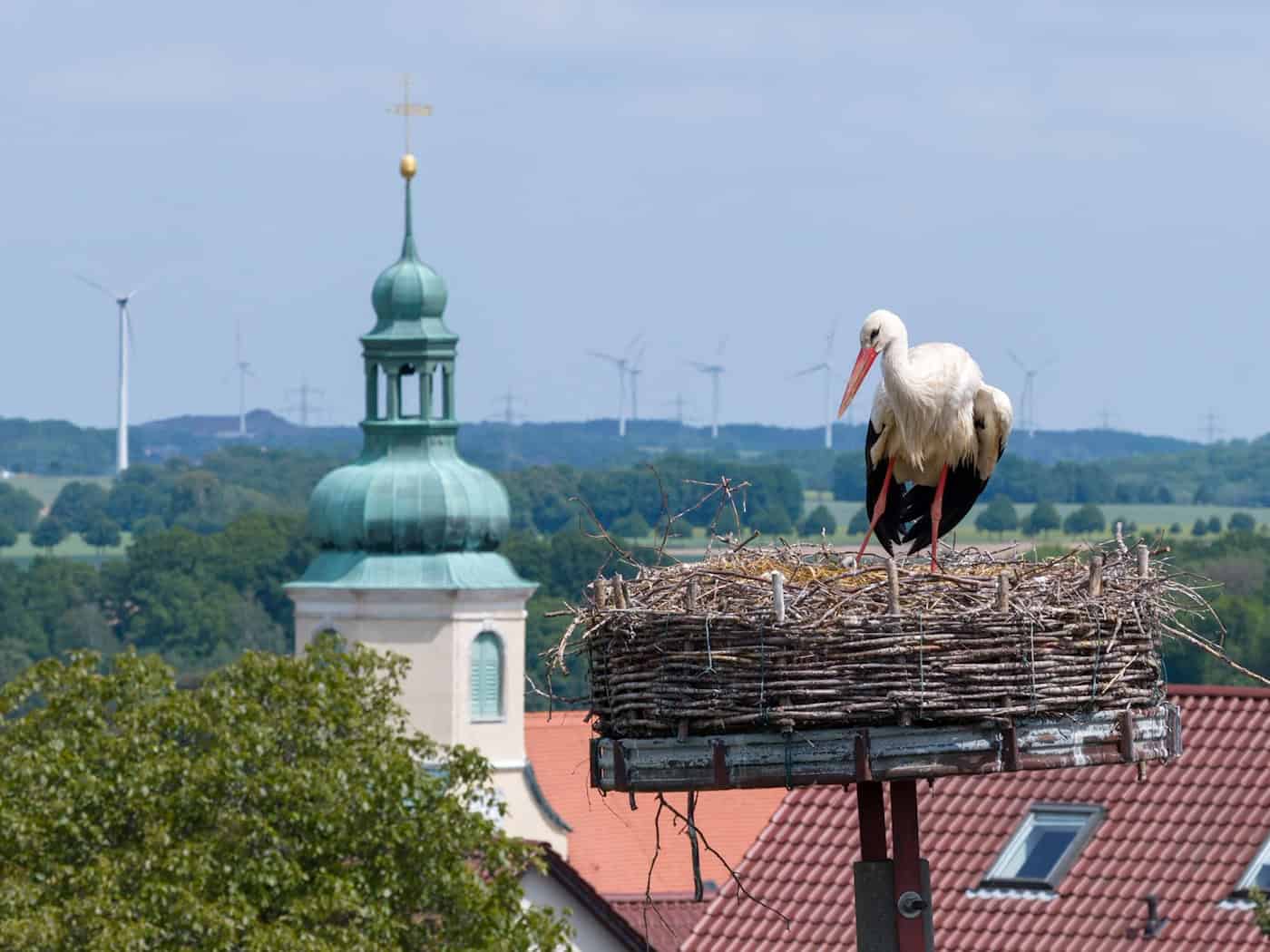
The corpus deliciti is 8.40 meters tall and stands in a meadow in the tranquil village of Ostro (Bautzen district). There, in the spring of 2023, Konrad Schkoda’s family erected a pole with a stork’s nest on their private property. It was occupied shortly thereafter. The Schkodas sought advice from independent members of the Nature and Biodiversity Conservation Union of Germany (NABU), who had already successfully installed many nests in Upper Lusatia. “We did it for the whole village. People are happy—only a very few aren’t,” says mother Monika. “When I used to drive through the villages in our area and see stork nests, I felt that Ostro needed one, too.” The family’s three children gave their parents the stork’s nest as a gift. Konrad Schkoda kept a record of the breeding activity in the meadow across from their home. From the kitchen window, he could rejoice every day at the fruitful success of his efforts. Shortly before Easter, Konrad Schkoda died at the age of 68. His wife Monika is convinced that the growing controversy surrounding the stork’s nest took a toll on him. This is because three objections were filed against the building permit for the nest—which was granted retroactively by the relevant authority—from private individuals as well as from the municipality. The municipal council is opposing the permit because the municipality’s concerns were “insufficiently” taken into account, according to the municipal office. The core of the differing views is not related to nature conservation law, but exclusively to building regulations, according to the municipality of Panschwitz-Kuckau, to which Ostro belongs. In its letter of objection, the municipality advocates on behalf of a neighbor whose property borders the meadow with the stork’s nest. The woman, who works shifts, relies on undisturbed sleep during the day, the letter states. “A restful sleep with the window open is no longer possible because of the stork’s nest.” In its letter to the building inspectorate, the municipality also addressed the “intended use as a residential building.” “A stork’s nest may provide visual delight for some individuals when they look out from their home. However, this does not provide any functional support for the residential purpose.” The municipality believes that, in the case of a stork, neither its mere presence nor its visibility nor its clattering should be considered “conducive to residential use.” To the experts at NABU, such cases sound like a classic neighborhood dispute. Currently, the Nabu state chapter has no legal complaints from citizens against nature conservation projects on its docket. “There are complaints here and there—for example, about trees that cast shadows or dirty cars during flowering season, about hedges that a neighbor feels aren’t properly trimmed, or a hunting ground that’s been waterlogged by beavers,” says Nabu Director Robert Beske. In most cases, however, these issues can be resolved through discussion. “I advocate for balanced species conservation that, at best, reconciles and balances existing interests,” says Saxony’s Environment Minister Georg Ludwig von Breitenbuch (CDU). His ministry does not have a systematic overview of projects prone to conflict. “We also have no evidence of a statewide increase in such conflicts, which does not mean that clusters cannot occur locally,” the ministry states. Conflicts often involve population increases or new settlements by protected animal species that could cause damage or problems, according to the ministry. “The spectrum here is very broad, ranging from the dirt in a swallow’s nest to flooding caused by beaver activity. In many cases, solutions can be found to eliminate or minimize such conflicts, making coexistence between humans and animals possible,” the ministry said. “It is in the municipality’s best interest to find an amicable solution between the various interested parties,” explains the administration responsible for Ostro. This requires a willingness to compromise on the part of all involved. The municipality proposes moving the nest to another location on the property or setting it up on the outskirts of town. The Schkoda family is willing to move the nest to their meadow and had already stated this previously. Preserving the nest certainly seems sensible. According to preliminary figures, the stork population in Saxony did increase to 495 breeding pairs last year. Nevertheless, experts believe the birds are not reproducing sufficiently to ensure the long-term survival of the population. According to these figures, fewer than two stork chicks per breeding pair currently survive on average. At least 2.4 would be necessary. Many chicks die due to a lack of food. Animal lovers have now launched an online petition under the slogan “Save the Stork Nest in Ostro.” So far, more than 350 people have signed it. “For three years now, the storks have been part of our town and our home. Their nest in Ostro has long been more than just a breeding site—it has become a symbol of nature, life, and hope,” the petition states. Especially today, when more and more habitats are being lost, we should do everything we can to preserve such special places instead of destroying them, the petition states. For the Schkodas, there’s even more at stake. They want to preserve the commitment of family man Konrad as a kind of legacy. For Konrad Schkoda, the birds were something special; their return in the spring heralded the season that is celebrated extensively among the Sorbs in Lusatia with customs such as the Easter Ride. The family believes the stork should remain a symbol of fertility and new beginnings. Copyright 2026, dpa (www.dpa.de). All rights reserved“We did it for the whole village.”
Stork Disturbs Neighbor’s Sleep
Environment Minister Calls for Balanced Species Conservation
Coexistence between humans and animals is possible
Saxony’s stork population needs more offspring
Petition for Stork Nest Gains Support
The stork as a symbol of fertility and new beginnings

