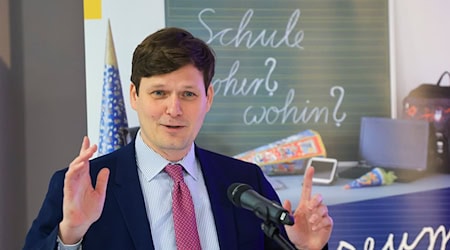
According to experts, psychological stress and problems in children and adolescents are becoming increasingly noticeable in everyday school life - with consequences for lessons, the school climate and teachers. "Not only the increase, but also the lack of coordinated procedures for dealing with mentally disturbed pupils is an additional burden," said Veit Roessner, Head of the Clinic for Child and Adolescent Psychiatry at Dresden University Hospital, to the German Press Agency.
If it is not clarified at an early stage who takes which steps and when, help sometimes runs side by side, is no longer effective or comes too late, the professor emphasized. This can be seen, for example, in the case of truancy. If a child stops going to school, it is often discussed without the involvement of child and adolescent psychiatrists whether a fine should be imposed on the parents or what educational measures could be considered.
School absenteeism can also be the result of mental illness
"However, absenteeism can be caused by a variety of factors, including mental illness - such as anxiety or obsessive-compulsive disorders," said Roessner. There is a risk that measures will be taken over a long period of time without clarifying the actual problem.
According to Roessner, there is currently no uniform strategy across Germany: "We first need a proper diagnosis." However, this cannot be done by a GP or social worker, but only by a child and adolescent psychiatrist. "Only on this basis can a sensible decision be made: Who does what?" With limited resources, it makes little sense for many agencies to work in parallel and for schools and youth welfare offices to react with contradictory measures.
Saxony launches project to relieve everyday school life
In Saxony, a project is now set to provide a remedy. The project partners are the Clinic for Child and Adolescent Psychiatry at Dresden University Hospital, Arnsdorf State Hospital and the Ministry of Education. The Otto Beisheim Foundation is funding the majority of the measures - with the aim of expanding and consolidating the project if it has a positive impact.
The first of three modules is called the "Procedure Navigator". This is an interactive, easy-to-understand guide for dealing with psychological stress and problems among pupils. The navigator will be permanently available via a central website - not only for schools, but also for other professionals and parents.
In module two ("knowledge transfer"), school administrators and teachers will learn how to apply the guidance in everyday school life. Module three is entitled "Transfer workshop" and is intended to practise the procedure using specific case studies under the guidance of experts. The aim is to reliably relieve the burden on schools in everyday life - through coordinated processes, clear responsibilities and early diagnostics, as Roessner clarified.
Copyright 2026, dpa (www.dpa.de). All rights reserved