


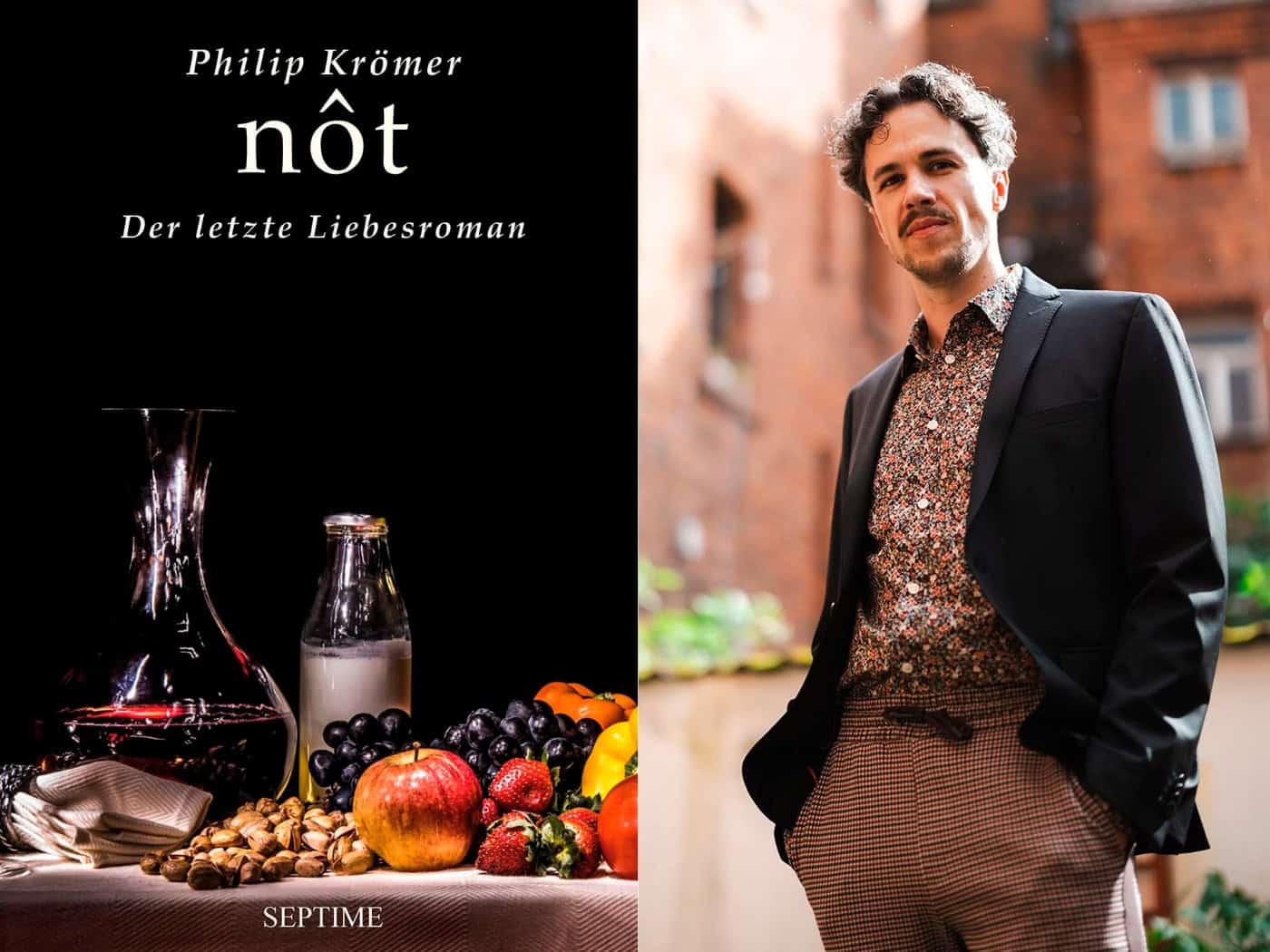
The last line of the rather lengthy *Nibelungenlied* reads roughly as follows in the original (depending on the version…): “dâ hât daz mære ein ende / diz ist der nibelunge nôt.” The last word—nôt—is the title of Philip Krömer’s latest book, with the meaningful subtitle “The Last Love Story.”
Philip Krömer, born in 1988, studied German language and literature and book studies, earning both a bachelor’s and a master’s degree. With this combination of subjects, he could have become many things—from a taxi driver to a waiter or bar owner to a journalist—but Krömer chose to become a writer.
He made the right choice, because Krömer’s writing is wonderfully captivating. *The Last Love Story*—in terms of length and readability—is actually more of a gripping short novel, so you can read the little book in one sitting on a day set aside for lazing around. You don’t have to drink all the wines mentioned in each chapter, of course.
The book is set on a winery in Austria (I’m guessing Styria, because of the Morillon…), and naturally, there’s always something to drink there. Vacationers usually assume that the wine comes from the estate itself. Here, things are different—and the author and publisher make no secret of it: you can read all about it in the blurb, which is called that even though, due to the lack of a dust jacket with flaps, it’s now printed on the back cover of the book.
You also get to know all the main characters right away: clearly (which makes for easier reading). Marget (without an “r” after the “g”) is a scholar working on her dissertation. Her third attempt at a preface to the dissertation kicks off the novel—and you can tell right away that it’s going to be good. Above all, by the third paragraph at the latest, you find yourself thinking: oh, how nice it would be if dissertations were written in such a friendly, narrative, sometimes almost casual tone! By the way, Marget writes on a Mac using Pages, which makes her very likable, doesn’t it? Other quoted documents in *nôt* also reveal the use of different operating systems: The professor wrote his summer festival welcome speech on a PC using Word (with tracking changes enabled—always good to know what was deleted!), and there’s also a LibreOffice document—though not written on Linux, as one might initially think, but on a PC as well. What is the author trying to tell us with such details? No idea—at best: nothing.
The story of the researcher Marget, who prefers to see love rather than the slaughter at Etzel’s in the *Nibelungenlied*, quickly gains momentum, although the verse epic certainly combines both variants of human interaction (for reference, here’s my summary in four words: First love, then blows). The fact that she takes up residence at the Fetzel Winery is, of course, also due to the landlady’s first name: Kriemhild. The fact that she meets the lute player Volkmar and the two of them—thanks to their vacation—very quickly bring the musician’s “Knickhalslaute” to life in this interesting setting, is a literary device by the author, as is the fact that the Zagel couple provides material for a rather amusing orgy of synonyms revolving around the topic of the penis. I won’t reveal any more here, otherwise reading the seven “Aventiure” (a bit of Nibelung loyalty is a must) won’t be as much fun.
After finishing the book—aside from the fun and suspense I experienced while reading—I took two things away with me: first, I should read the *Nibelungenlied* in the original again. It’s a challenge, but it can be done. Though, of course, I have to qualify “original”—Middle High German isn’t really my thing for long stretches—but Karl Simrock’s adaptation captures the spirit quite well—and it’s even freely available on this not-always-bad internet. Second, I’d really love to see a film adaptation of the last romance novel. It would be an extremely multi-layered romance-mystery-wine-tragicomedy. After all, you can already enjoy plenty of dead bodies on TV as early as the early evening, while sex—which certainly occurs much more frequently in real life—doesn’t appear on TV, if at all, until midnight. A good film adaptation of *nôt* would therefore also be perfect for late-night programming.
Philip Krömer, *nôt*—The Last Love Story
Hardcover, 144 pages
Septime-Verlag
ISBN: 978-3-99120-088-8
Price: €20.00

