


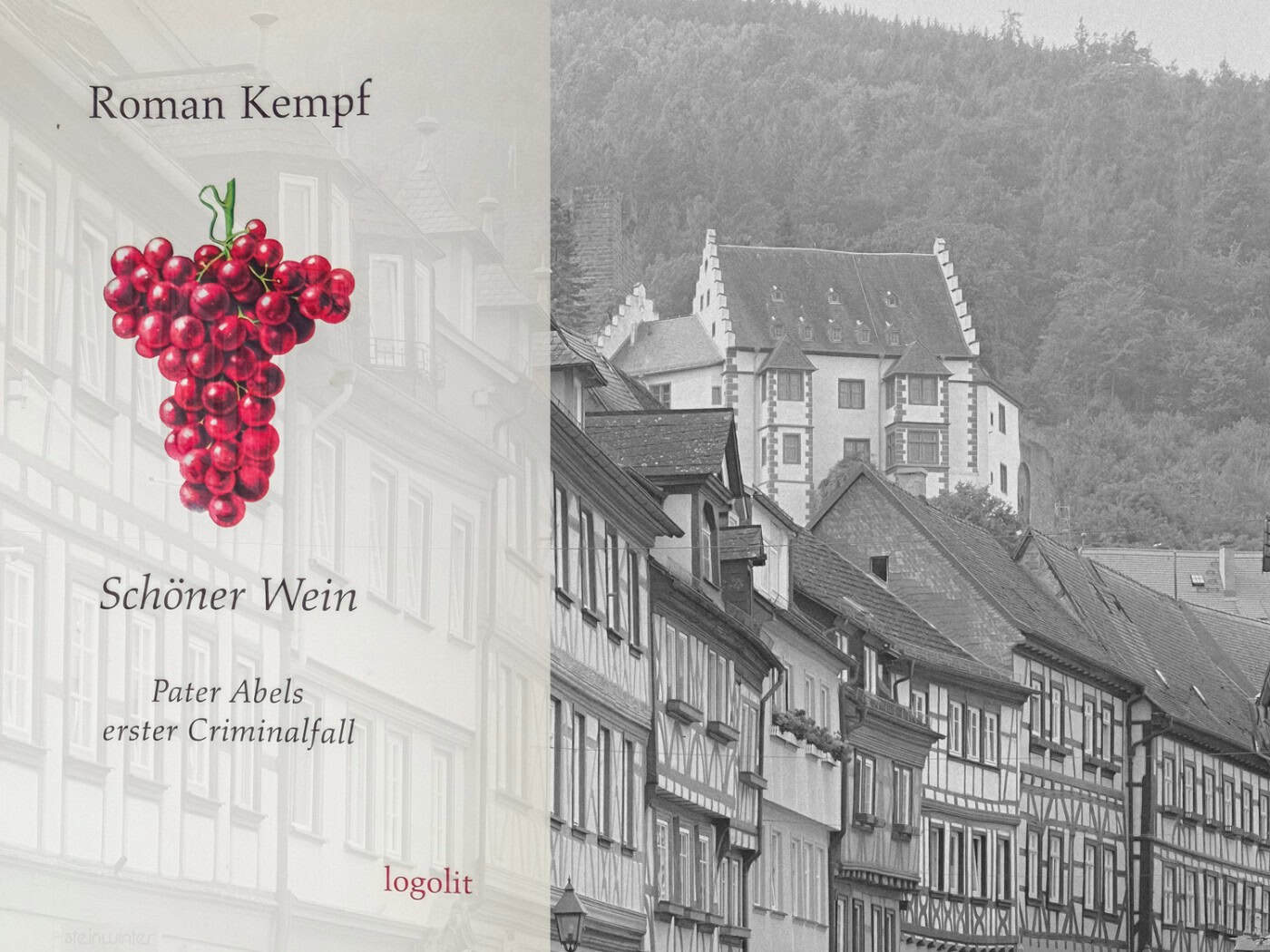
If Roman Kempf were not the author but a character in his own crime novels, the answer to everything—and above all, the identity of the murderer—would be crystal clear: Kempf is a trained gardener and thus predestined for the role of the main villain. But he decided otherwise: in his crime stories featuring the monk Peter Abel, the others are the ones committing the murders, while the young cellarer of the Benedictine Abbey of Amorbach prefers to investigate. In the book *Schöner Wein*, published as early as 2007, everything takes its course—the tenth and, so far, final volume has been available since 2025. That’s a long span of time—but, interestingly, it roughly corresponds to the period during which Peter Abel accompanies us: from 1781 to 1800.
Winemakers had brought the novel to my attention on several occasions (and independently of one another) during my visits to Churfranken. The story takes place (back then there were neither late trains nor gas-guzzling cars) within a small area: in Amorbach with its Benedictine monastery, Großheubach (home not only to the Engelberg Monastery but also to the magnificent Bischofsberg estate) —and in Miltenberg, the town of (wine) trade and pilgrims, where Abel encounters “good conversation, good wine,” and Marie. He loves it all.
It’s about wine—no surprise, given the novel’s title—but it’s also about new ideas, rivalries, witchcraft, and a dead man. There’s a bit of romance thrown in as well; after all, that certain tingle doesn’t stop at the monastery walls, and the monastery’s head steward gets out of the monastery quite a bit—and he’s only 30 years old, after all… At the sight of Marie, his heart races and his cheeks flush—but his thoughts are free, and only the novel (the author) can guess what they are. As a reader, I sense that something is developing—but if you want to know more, you’ll have to buy the next volumes.
It’s a different story with the corpse. It’s been found, and tracking down the murderer is the cellarer’s greatest pleasure. In the search for the murderer, we experience life in all its vibrancy at the end of the 18th century. Envy, resentment, self-serving behavior—all that sort of thing. And of course, even back then there were “those at the top” and “those at the bottom,” as well as schemes both big and small. Roman Kempf has thoroughly researched the material he has woven into this exciting and wonderfully accessible work of fiction; there’s more reality hidden between the lines than one can imagine. So much for the idea that “everything was better back then”…
Fiction with a Historical Background
Roman Kempf has done extensive research; his fiction makes the novel exciting and engaging, but the research provides a solid foundation for gaining insight into that era. And so, of course, the quotes from the “Häcker” (as the winemakers in the area are called) and other characters are purely fictional—but not without a grain of truth. The Häckers’ complaints, for example (“late frosts and a lack of rainfall last year”), were certainly justified—and unlike in our modern, interconnected world, crop failures were life-threatening for winemakers and other farmers, especially when one bad year followed another. Quality was just as important over 200 years ago: “Bad weather is God’s will, but bad wine is our fault!” says (on p. 12) Albert Hofmeister from “Großheubach, the village below the Engelberg Monastery” (p. 11).
The plot moves along briskly. It doesn’t stop at a single murder; there’s apparently some shenanigans to improve quality, there are occasional “Marie moments”—and, of course, everything resolves itself quite convincingly toward the end. To reveal more would be unfair—after all, it is a crime story. But the fact that you can still visit the places from back then today, and that winemakers are still at the mercy of the weather—yet manage to weather even frosty years like 2024 and then confidently clear out the cellars of more mature vintages or come up with tasty cuvées: that much I can reveal.
Roman Kempf: Schöner Wein
LOGO VERLAG Eric Erfurth
Publication date: September 24, 2007
7th edition, 208 pages
€12.80
ISBN 978-3939462040
The author’s website, where he generously shares historical background information on each book

