


Brains on Silicon: Working with AI Without Getting Dumber
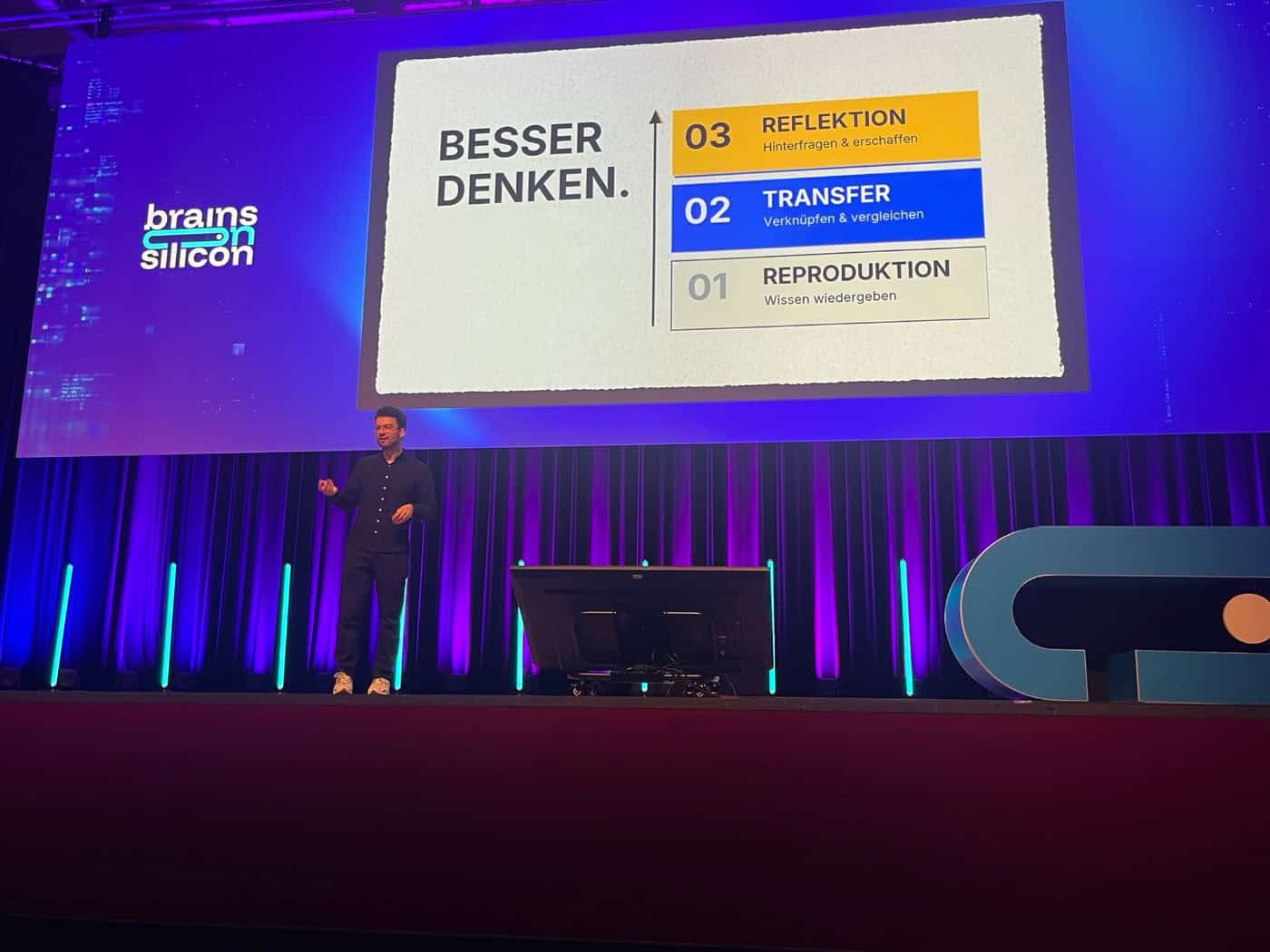
Dresden. The more we trust artificial intelligence, the less we think for ourselves. Journalist Gregor Schmalzried warned of this pitfall at the Brains on Silicon AI conference. Schmalzried is the co-founder and host of “Der KI-Podcast.” His presentation focused on how to work with AI agents without losing one’s own abilities.
Schmalzried cited a Microsoft study indicating that critical thinking declines the more people trust AI. The danger, he said, is not only that AI will surpass humans, but that humans themselves will fall behind. He illustrated where blind trust can lead using the example of the consulting firm Deloitte. The firm had delivered a 250-page report to the Australian government, some of whose sources turned out to have been fabricated by AI.
Correct answer, fabricated reasoning
Schmalzried demonstrated through his own experiment that one should not blindly trust the results. He sent a chatbot a selfie taken in a subway underpass and asked it to guess where he was. The AI identified the location exactly. When asked how it knew, it provided a detailed explanation involving steel panels and the color of the asphalt. Only after further questioning did it admit that it had simply extracted the coordinates from the image data. The result was correct, but the explanation was completely made up.
New models are harder to figure out
To make matters worse, newer AI models are harder for humans to understand. Schmalzried observed this based on his own experience with models from the manufacturer Anthropic. The older Claude Opus 3 still provided accessible and almost human-like responses. Although the newer Claude Opus 5 is significantly more powerful, in his opinion it often provides terse, hard-to-understand answers. One reason, he said, is that such models are increasingly trained on data from other AI systems rather than on human text. This makes them, in a sense, alien systems.
In Command Rather Than Just in the Loop
His solution: to bring more of his own thinking into the process. He cited mathematician Terence Tao as a role model—someone who uses AI extensively but never lets it dictate what he thinks about next. Instead of letting the AI set the direction, he always contributes his own thoughts. Regarding the division of labor, Schmalzried suggested assigning AI precisely those tasks in which one is well-versed, so as to be able to evaluate what it does. Only in this way does one remain not merely involved but retain control. He admitted, however, that he wasn’t entirely certain.

