


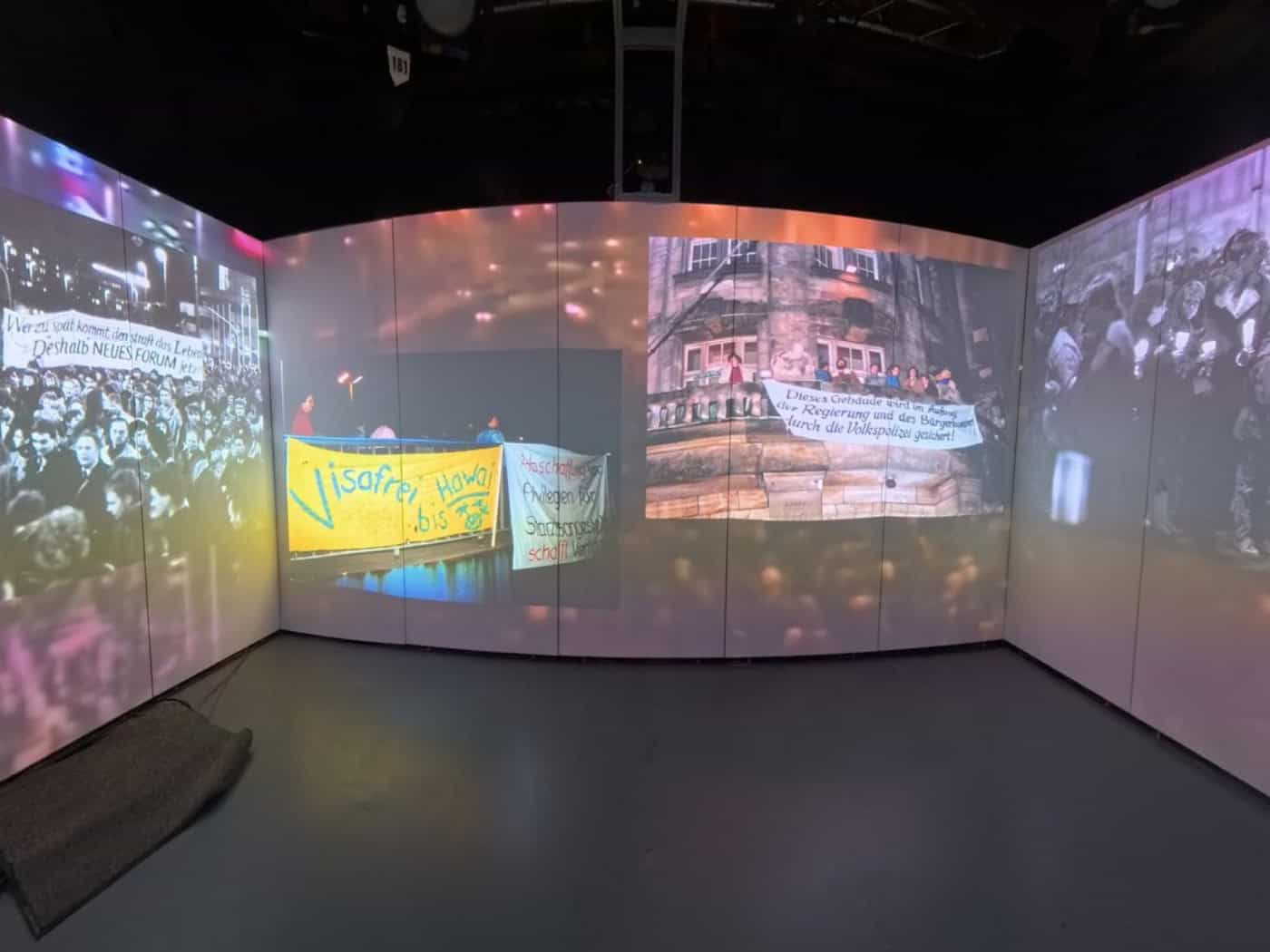
Fall 1989. Thousands of people marched through the streets of Leipzig, chanting, “We are the people.” What followed changed Germany. Today, nearly 37 years later, students at the Leipzig University of Applied Sciences (HTWK Leipzig) are seeking people who lived through that time and are willing to share their memories. The Faculty of Computer Science and Media is creating an artistic-documentary video installation about the Monday demonstrations and the Peaceful Revolution.
The project will bring together archival footage, current footage, and personal eyewitness accounts. The goal is to create a so-called “Cube” – a walk-in exhibition space designed to give young people, in particular, an emotional yet reflective way to engage with this important chapter in Leipzig’s and Germany’s history.
Seeking a Variety of Perspectives
We are looking for people with a wide range of experiences. Some took part in the demonstrations; others did not. Former members of the so-called “armed forces” or people who experienced the events from a completely different perspective are also invited to share their stories.
The conversations are intended to be open and narrative-driven. The focus is on personal memories of everyday life in the GDR and during the period of reunification, experiences with the Monday demonstrations, as well as current reflections on democracy, freedom, and social change. The process and use of the material will be transparently coordinated with the participants.
Bringing History to Life for Young People
The project is supervised by Uwe Kulisch, professor of Electronic Media Systems Engineering at HTWK Leipzig. “The main goal of this student project is to enable younger people in particular to relate to the events of that time – not just intellectually, but above all emotionally,” says Kulisch. What makes this project special is that the students themselves were born long after the events of 1989 and are now engaging with that era.
The installation is primarily aimed at teenagers and young adults between the ages of 15 and 25. It is initially scheduled to be shown at HTWK Leipzig in 2026. Afterward, there are plans to make it accessible to the general public in Leipzig as part of an exhibition.
Those interested can contact elisabeth.gienapp@stud.htwk-leipzig.de by email.

