

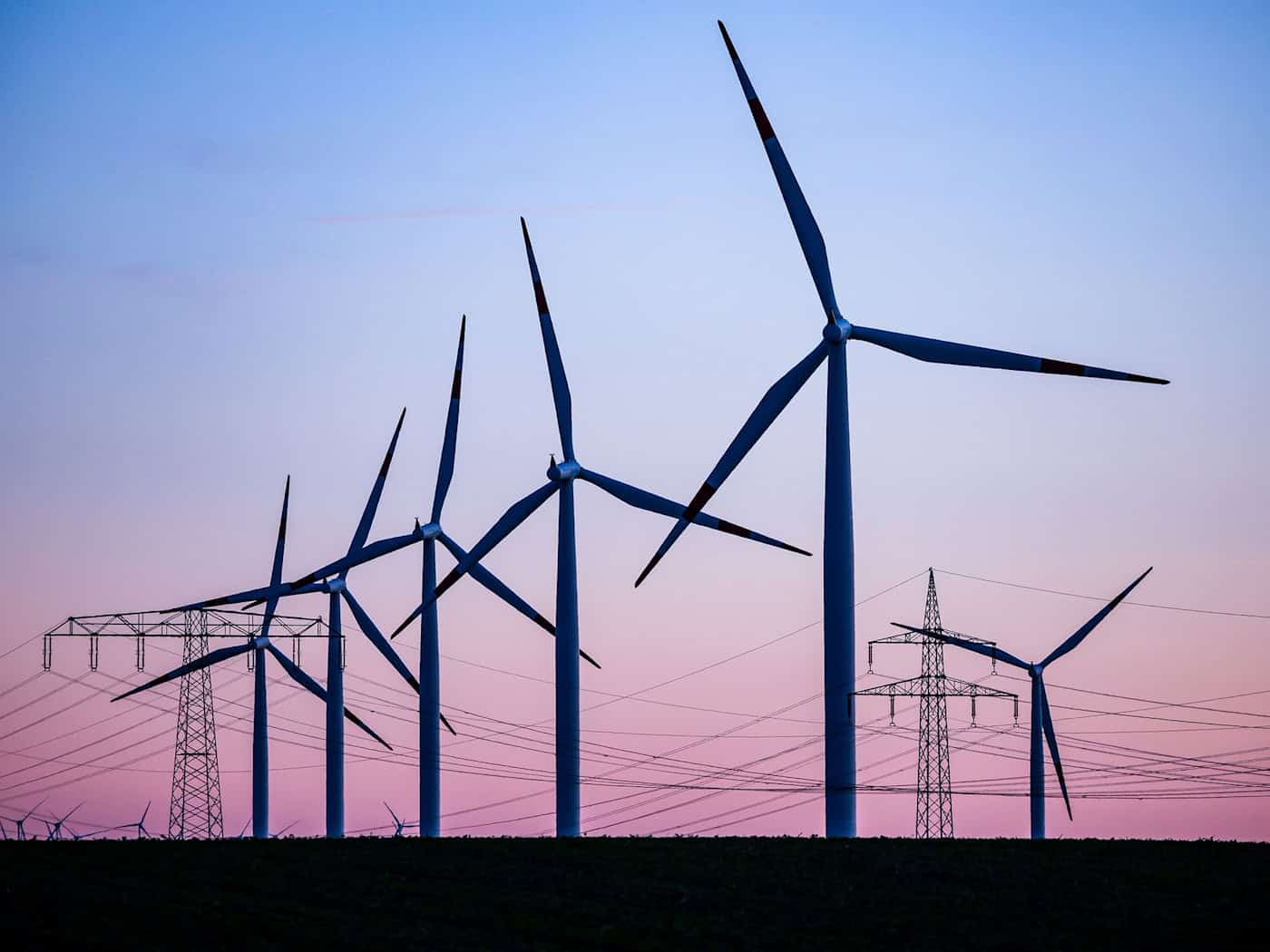
In order to avoid overloading the electricity grids, power generation in the eastern German states was curtailed much less frequently last year than in previous years. In Saxony-Anhalt, around 470 gigawatt hours of electricity were curtailed last year, according to the Ministry of Energy. According to the figures, this figure was 800 gigawatt hours in 2023 - a decrease of around 40 percent. According to data from the Federal Network Agency, the trend is similar in Saxony and Thuringia. In contrast, the number of curtailments increased nationwide. Wind turbines that do not turn even though the wind is blowing: some people are surprised by this. In order to prevent overloading of the electricity grids, grid operators repeatedly stop the feed-in. The background to this is the expansion of renewable energies in regions with comparatively low demand and a grid expansion that is lagging behind. Wind turbines and photovoltaic systems in particular, which are flexible in terms of feed-in, are then switched off. Saxony-Anhalt's Energy Minister Armin Willingmann (SPD) is therefore once again calling for the expansion of the electricity grids to be continued quickly so that the number of interventions can be further reduced in the coming years. Regulations continue to be a nuisance because they give a completely false impression of the energy transition, said Willingmann. "We have lost too much time, especially in the Merkel era, due to hesitation in the Federal Ministry of Energy." The pace now set by Federal Economics Minister Katherina Reiche (CDU) for the expansion of the electricity grids must be maintained in the coming years. For electricity customers, the occasional curtailment of power generation is important because compensation is paid to producers who have to temporarily shut down their plants. The costs of this are passed on to electricity customers via the grid fees. If the so-called redispatch costs increase, the price of electricity also rises, the Ministry of Energy announced. While 474 gigawatt hours of electricity could not be fed into the grids in Saxony-Anhalt, the figure in Saxony was 682 gigawatt hours, according to data from the Federal Network Agency. In Thuringia, the figure was 28 gigawatt hours. However, at more than 17% and almost 60% respectively, the total amount of electricity not fed into the grid also fell in Saxony and Thuringia, in some cases significantly, compared to 2023. In a comparison of the federal states, Saxony and Saxony-Anhalt are around mid-table. By contrast, Thuringia, with 28 gigawatt hours, is one of the federal states in which particularly little electricity has to be switched off. Lower Saxony and Schleswig-Holstein were the most affected, each with more than 2,700 gigawatt hours of electricity switched off last year - although the figures there also fell compared to 2023. In contrast, Bavaria, North Rhine-Westphalia and Rhineland-Palatinate recorded sharp increases. The Federal Network Agency recently pointed out that curtailments had decreased, particularly in the area of wind energy, both onshore and offshore, but that there had been a significant increase in photovoltaic systems: by 94 percent from 2024 to 2025. The main reason for the development of this so-called redispatch in photovoltaic systems was the significant increase in generation capacity, combined with above-average solar radiation in spring and summer. In total, around 96% of electricity from renewable energies was used last year, according to the Federal Network Agency. In Saxony-Anhalt, the figure was around 98 percent, according to the energy ministry there. "Curtailments are not a phenomenon of the energy transition: They have existed before," the ministry stated. According to the plans of Federal Economics Minister Reiche, operators of new wind and solar power plants in areas with heavily overloaded grids will no longer receive financial compensation for ten years in the event of curtailment. However, both the "grid package" planned by Reiche, the amendment to the energy industry law, and the amendment to the Renewable Energy Sources Act have not yet been decided. In Saxony, the debate about new rules for grid operation and the distribution of costs in the energy industry is controversial. The background to this is the question of how grid congestion can be reduced more quickly and the costs of congestion management limited. Suppliers in particular believe that the economic viability of new expansion projects could be jeopardized by the potential loss of compensation payments. Copyright 2026, dpa (www.dpa.de). All rights reservedCosts are passed on to customers via grid fees
Some significant decreases in Saxony and Thuringia too
Increase mainly due to photovoltaics
"Curtailments are not a phenomenon of the energy transition"
Energy suppliers criticize federal plans


