


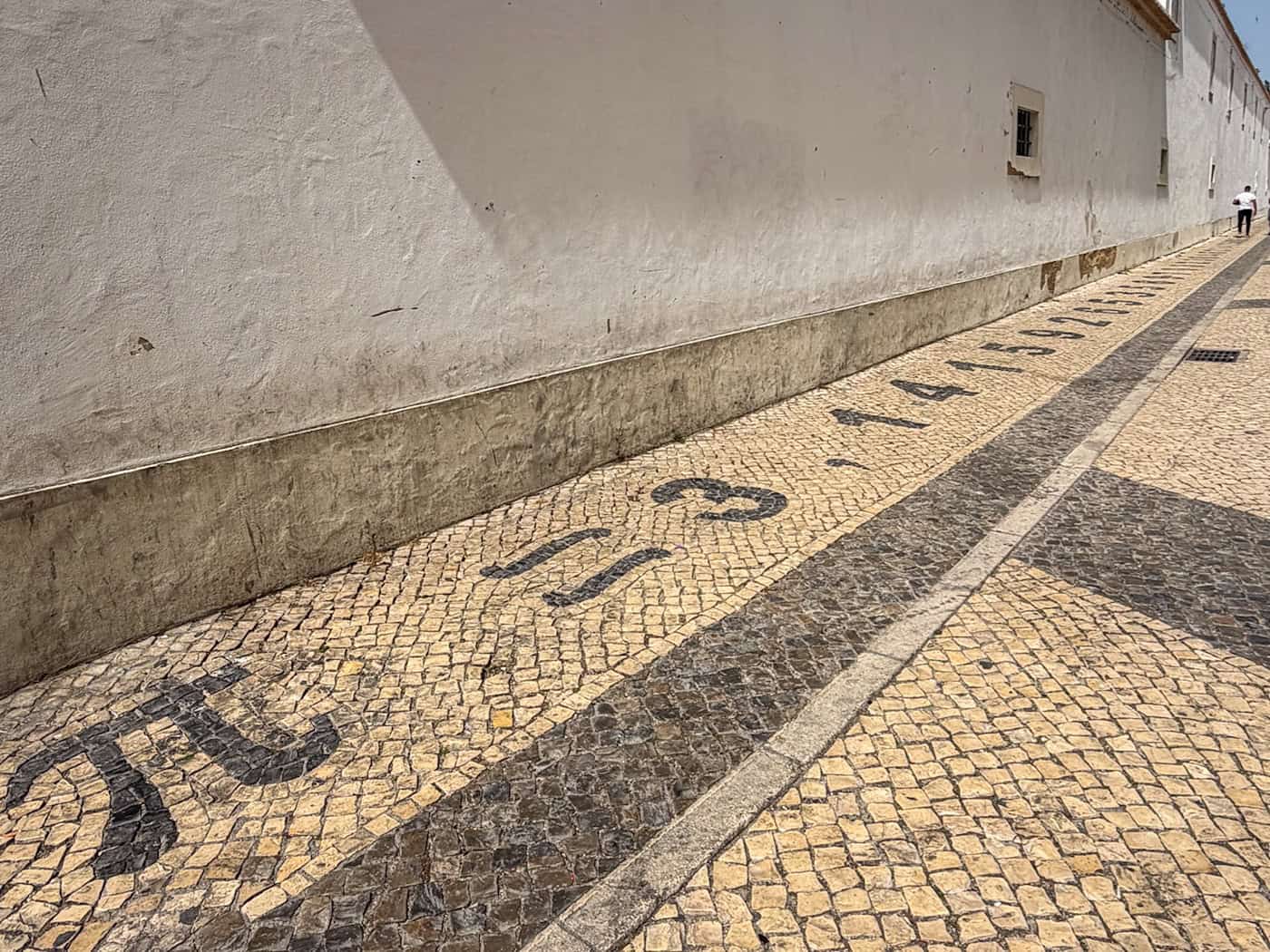
Ten years ago, a number of streets in Faro were completely renovated. One million euros were available - and the money was not only used in a pragmatic and practical way, but the Portuguese tradition of the calçada portuguesa (Portuguese sidewalk) was also maintained.The characteristic Portuguese paving (mostly made of white limestone and black basalt) was supplemented with a special kind of eye-catcher: on the Passeio da Rainha, the number Pi (or as the mathematicians say: π) is not carved in stone, but is nicely paved as a sidewalk with the 3 in front and the first 79 digits after the decimal point. We could have gone on indefinitely (who doesn't like to remember math lessons!? Or at least the Wikipedia article...), but unlike π, the Passeio da Rainha is real and finite.
Why did such an old mathematical thing (Archimedes was already working on the ratio of the circumference of a circle to its diameter in 250 BC and came to an acceptable result - to two decimal places, after all) find its way into the pavement? Is it because Faro's mayor Rogério Bacalhau has a degree in mathematics and has taught mathematics to several generations of pupils and taught mathematics at the University of the Algarve (between 1990 and 2000)? (Source) In a report on the construction measures, colleagues from the southern Portuguese information portal Sul Informação naturally also speculated about connections between the professor's job as mayor and the sidewalk design - but he waved it off: "I like the fact that it's a mathematical symbol, but it was a joint decision in the city council," Bacalhau told Sul Informação.
To walk the first 79 decimal places of the circle number π, it is best to start near the marina at the traffic circle in the street - then you can immediately see what it is all about: π ≈ 3.14159265358979323846264338327950288419?1693993751058209749445923078164062862089... Three dots at the end and the sign for approximately the same indicate that there is more - while for normal people the answer "3.14 and then some more" is enough, computers are now at 314 trillion decimal places after the decimal point.
In case anyone has read the 79 digits above carefully (or has walked along the number line in Faro): there is a question mark in the 39th place. Of course, this is not intended in real π-life - here the community has allowed itself a joke and hopes that there will be people looking for the missing correct digit. Asking the AI here would be a thing, wouldn't it? I did it and (as is so often the case) got into a dubious discussion in which they tried to sell me 77 decimal places - but I had counted on the spot and came up with 79. It was actually quite easy to verify this: you only need to know the (photographed) last digits, then you've done it on the computer because of the uniqueness of the sequence of digits. Because I'm sometimes nice, I offered to correct the AI, which promptly brought me an unsolicited thank-you message: "The missing digit was a 1 (in the 39th position after the decimal point)". Too bad that wasn't correct...

