

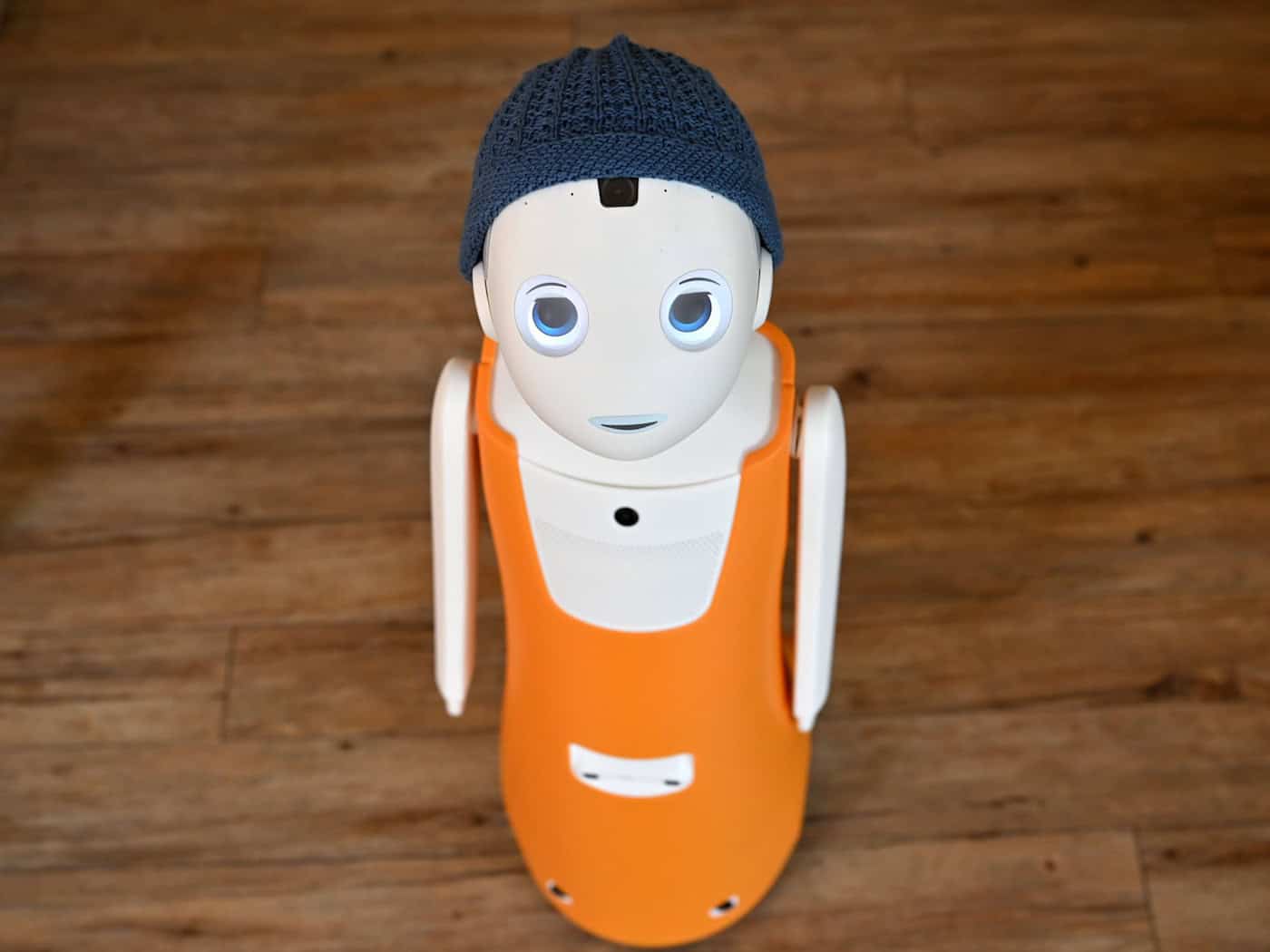
“And every beginning has its own magic.” “Paul” stands in the center of the semicircle and recites Hermann Hesse in a steady voice. After the poem, he politely thanks the group for listening so attentively. Later, he tells a joke, laughs at the punchline, and moves on to an animal quiz. “You really know a lot,” says one of the older ladies appreciatively. In between, he asks about their favorite pastimes. The conversations sometimes flow surprisingly smoothly, and other times are a bit choppy. “Paul” is a robot. For more than a quarter of a year, the AI-powered empathy robot has been part of daily life at the Sonnenhof senior care home in Ilfeld in the South Harz region. “We fell head over heels in love with him,” says home director Kerstin Jülich. No wonder: Instead of metal and a futuristic design, the robot has big, round eyes, a friendly expression, and a blue knit cap. “He just looks like a child, which inspires trust,” says Jülich. As a result, many residents don’t treat him with the distance one might expect toward a machine, but rather with curiosity and kindness. The residents of Sonnenhof have named him “Paul.” It was developed by the Munich-based startup navel robotics. According to founder Claude Toussaint, the company has sold and delivered around 130 of its Navels since the end of 2023—about 90 of them to care facilities in Germany, and another 40 to research institutions throughout Europe. In Thuringia, three robots are in use in Jena, Saalfeld, and Ilfeld; there are also three in Saxony and two in Saxony-Anhalt. The Sonnenhof acquired the social robot to complement its services for residents, as facility director Jülich emphasizes. “We absolutely cannot imagine a robot taking over caregiving tasks, and we don’t want that either. Then humanity is lost.” What “Paul” can do is something else entirely: He’s never stressed, doesn’t get sick, doesn’t need vacation, and remains calm and polite in every situation. In addition, thanks to its internet connection, it can provide information on any topic. Given the growing crisis, the question of what machines are allowed and expected to do in the care sector is also a concern for policymakers. According to the Federal Statistical Office, there will be a shortage of between 280,000 and 690,000 nursing professionals by 2049, depending on the scenario. The use of robots in nursing homes therefore raises expectations, but also leads to misunderstandings. Thuringia’s Minister of Social Affairs, Katharina Schenk (SPD), sees these technologies as offering new opportunities to engage residents, promote social participation, and enrich daily care routines. “It’s important to note that a social robot does not replace a caregiver and cannot replace human affection. Care thrives on relationships, trust, and personal interaction,” Schenk clarifies. Jülich, the nursing home director, agrees: “We have enough staff. It can’t replace staff, and it’s not supposed to either.” So how viable are such robotic systems really? Robert Ranisch, a medical ethicist at the University of Potsdam who is himself experimenting with several robotic systems in the lab, tempers exaggerated expectations. Social robots are all still in their infancy at this point. “You won’t find a single care facility where robots are currently a game-changer—neither in Germany nor abroad,” says Ranisch. According to his own account, he developed guidelines on robotics in elder care as a project manager for the Federal Ministry of Health. Social assistants like Navel have indeed become significantly more capable than earlier systems—such as the therapy seal “Paro” or the humanoid robot “Pepper”—thanks to the integration of large language models. However, they have not yet provided any real relief for care staff. “When you have systems like these, they generally only work if you have people standing right next to them,” explains Ranisch. There are also practical hurdles: Such robots require a stable Wi-Fi connection—without a reliable internet connection, communication stalls. And models like the Navel are still quite expensive at present. The Sonnenhof, for example, spent more than 33,300 euros on the purchase with the help of sponsors. For the time being, such robots do nothing to alleviate the care crisis, which is continuing to worsen due to demographic change and a shortage of skilled workers: “These systems won’t solve the problems in care—neither today nor tomorrow,” concludes Ranisch. Nevertheless, he does see positive effects on the quality of life for individual residents: entertainment, companionship, and someone to talk to—especially for people who suffer from loneliness. Ranisch, however, also points out ethical concerns. These social robots are designed to encourage and flatter people—never to contradict them. “These systems simply aren’t programmed to be critical—and that can be problematic for some people.” Especially for people with dementia, there is a risk that the line between a conversation with a robot and one with a real person will become blurred. In the long term, however, the medical ethicist expects such systems to become widespread—not least because society is increasingly getting used to interacting with artificial intelligence. Andrea Kenkmann, acting professor of social gerontology at Nordhausen University of Applied Sciences, also takes a broader view: “In the future, the question will no longer be whether a human or a robot speaks with the residents—but whether the robot speaks or no one does at all.” Kenkmann is conducting scientific research on the use of “Paul” at the Sonnenhof—together with students who are interviewing residents, family members, and staff. Given the growing shortage of skilled workers, she expects such systems to become increasingly common in the long run—even though she regrets this trend. However, she already sees the value in experimenting with them: “Paul” familiarizes staff and residents with technology—and Kenkmann believes that, in an aging society, that’s not a bad start. Copyright 2026, dpa (www.dpa.de). All rights reservedNever stressed and always polite
“Paul” supports, but does not replace, a caregiver
Medical ethicist: Robots are not yet a game-changer in care
Expensive and No Solution to the Care Crisis


