

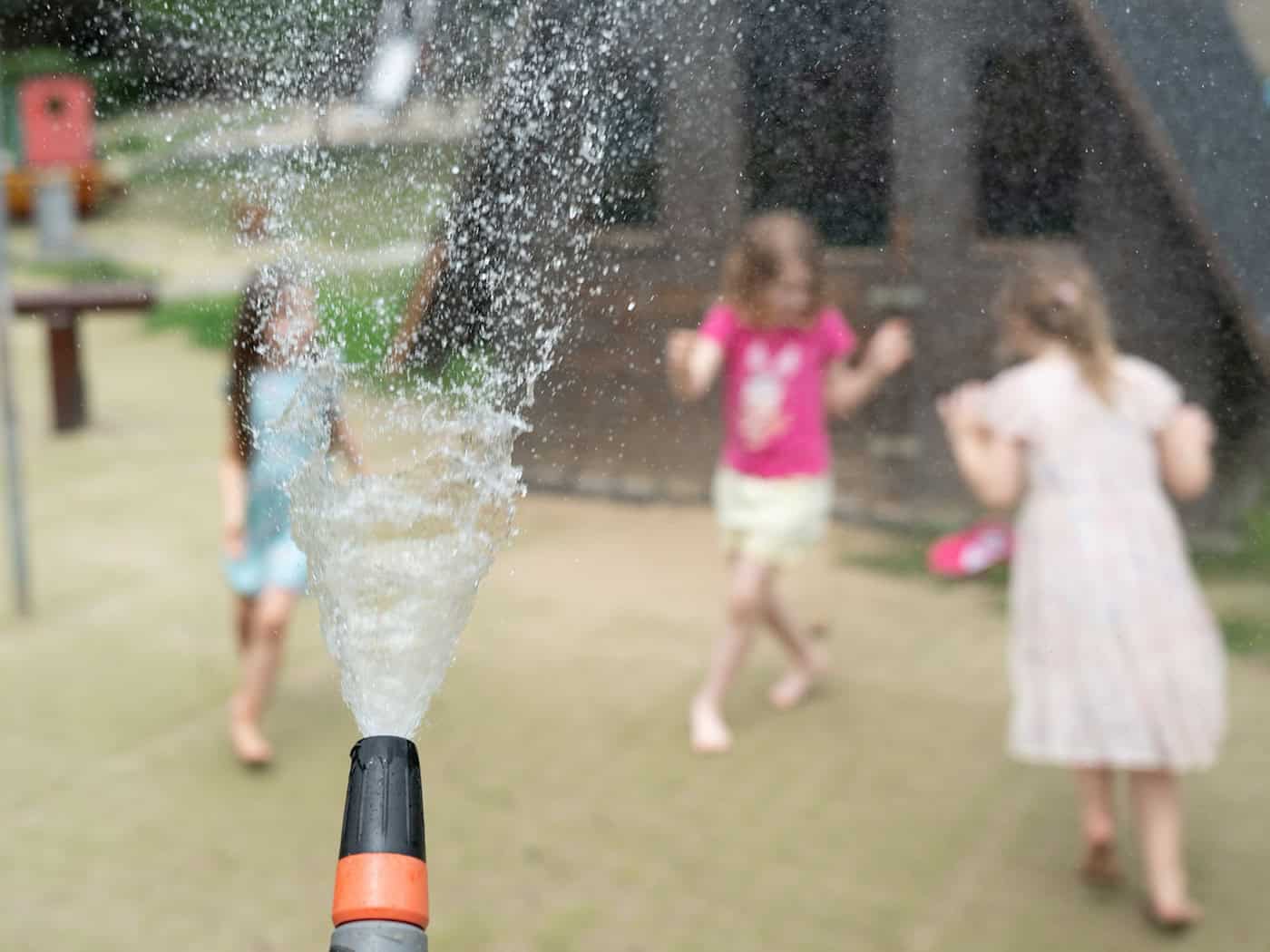
Daycare centers in Saxony are not adequately prepared for heat waves. According to Michael Richter, state director of the Paritätischer Wohlfahrtsverband in Saxony, there is a need for more systematic adaptation to heat events that are increasing due to climate change. “We need more shade outside and air conditioning to cool down the indoor spaces. However, nonprofit organizations cannot afford the necessary investments on their own,” Richter told the German Press Agency in Dresden. The state director is calling for assistance from the federal government, the states, and local municipalities. This makes it all the more concerning that the government’s draft of the upcoming two-year budget calls for cuts to investment funds for daycare centers, Richter criticizes. The problem has long since extended beyond just old buildings, reports Barbara Gärtner, chairwoman of the board of the Dresden-based operator “Kinderarche,” which runs daycare centers, residential groups, and day groups for young people, as well as youth welfare facilities in Saxony. “We have a new low-energy building with a ventilation system. During the first two years, we realized that this was somehow the worst idea of all for the summer, because the ventilation system tended to bring in the warm air from outside.” Often, the organization is merely a tenant of municipal properties, so renovations and investments would have to be initiated by city halls. The organizations themselves, on the other hand, could at least cover the costs of minor adjustments—such as sun shades, blinds, fans, or portable air conditioners—using existing reserves if necessary. The issue is “increasingly on the radar,” reports Gärtner. In daycare centers, shade is created using awnings. And: “You can actually manage to cool down with water and by being outside quite well.” However, this has its limits. The Saxony Accident Insurance Fund, whose recommendations the facilities follow, advises that during intense sunlight, children should be supervised indoors or in the shade. In some facilities, however, room temperatures reach unbearable levels during the summer heat. “There are actually only a limited number of air-conditioned facilities in that sense,” reports Thomas Neumann, spokesperson for the Paritätische in Saxony. There are no resources for climate change adaptation in either older or newer buildings. “When you consider that half of Germany’s social service facilities are run by nonprofit organizations, this isn’t just a minor problem for a single provider—it’s a nationwide issue.” In a residential group for teens run by the Kinderarche association in a former barracks building in Kamenz, the effects of the summer heat were particularly severe, reports Executive Director Gärtner. A lack of insulation and insufficient sun protection on the windows turned the attic into a heat trap. “They couldn’t stay cool at all during the heat wave. That just wasn’t possible. And then it got to the point where some children couldn’t go to school because they simply hadn’t slept all night.” The association’s chairwoman now hopes to find a solution through federal funding for climate adaptation. The Kinderarche association was awarded the grant in the fall. Possible measures were developed in workshops with a civil engineering firm and an architectural firm. The experts propose more greenery, but also structural changes such as air conditioning or roof insulation. “But it’s becoming increasingly clear that the federal government only funds green measures—specifically, greening facades or outdoor areas,” reports Gärtner. There remains a gap, the chairwoman of the board believes. “We’re actually facing the challenges of the heat right now, and no one is doing anything about it. No one is offering funding, and we simply can’t afford it.” Michael Richter, state director of the Paritätische, speaks of a problem that affects both long-term care facilities and hospitals equally. According to estimates by the Robert Koch Institute, the heat wave beginning in mid-June claimed the lives of around 5,100 people. According to these figures, the number of heat-related deaths had already significantly exceeded the totals for entire previous years by mid-year: from 2023 to 2025, there were an average of 2,900 heat-related deaths per year. During the heat wave in June, the German Weather Service recorded temperatures above 41 degrees on several occasions. Copyright 2026, dpa (www.dpa.de). All rights reservedDaycare Providers: New Buildings Also Affected by Heat Problems
Paritätischer: Widespread Problem Among Social Service Providers
Heat Keeps Teens in Kamenz Residential Group Awake
RKI: 5,100 deaths during June heat wave


