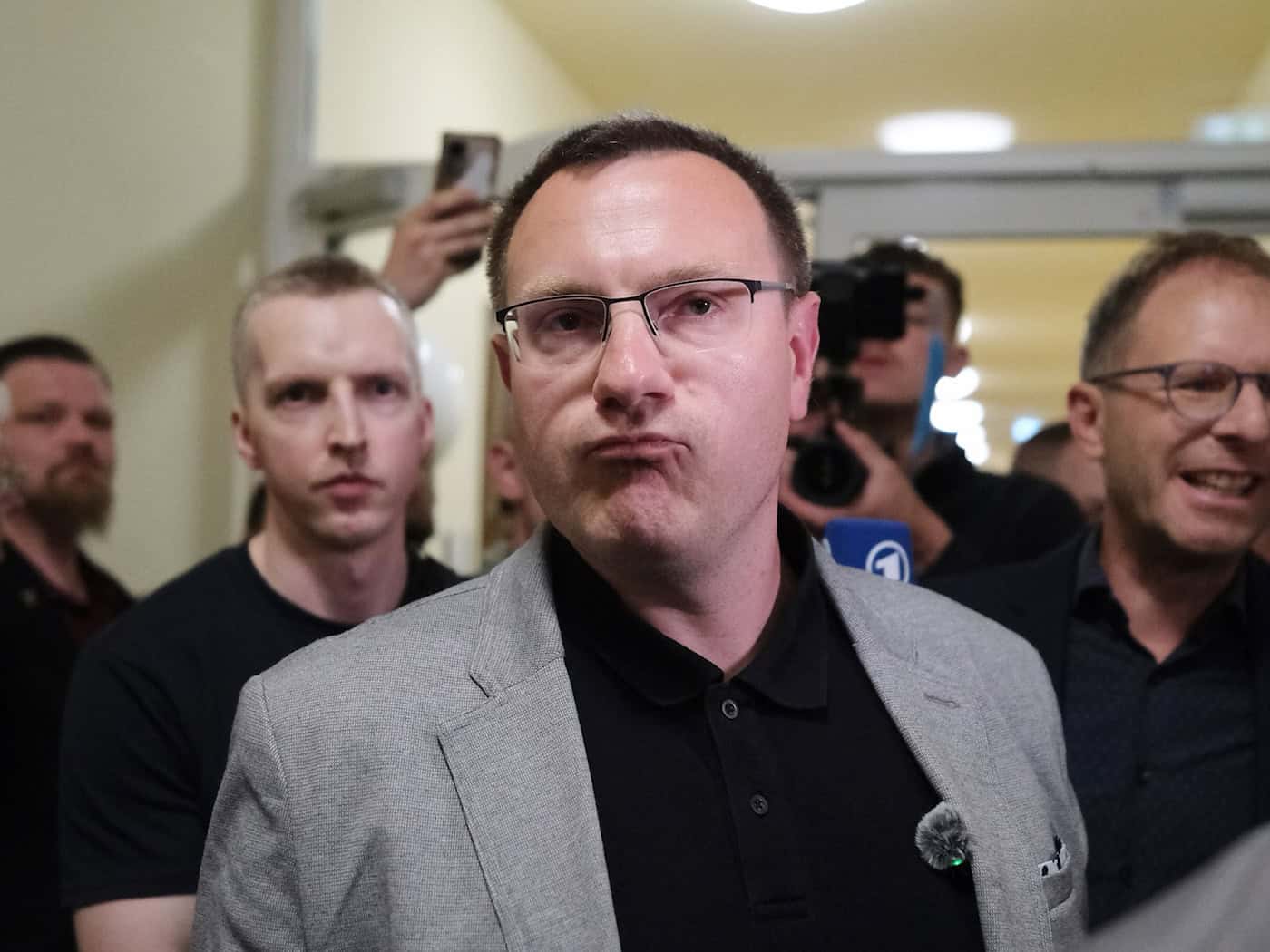
The election of the new mayor of Aue-Bad Schlema in Saxony has resulted in a much-noticed election thriller. The candidate from the far-right Free Saxony party was well in the running until the very end and was only narrowly defeated by the CDU candidate on Sunday. However, many people are wondering about future elections: Is a right-wing extremist even allowed to hold such an office? As a city mayor, he would be a temporary civil servant. And according to the law, only those who "offer the guarantee of standing up for the free democratic basic order in the sense of the Basic Law at all times" may be appointed as civil servants. However, this criterion is only checked in detail in Saxony after the election of a mayor or district administrator. In order to be eligible for election, it is first sufficient to declare in writing that the personal requirements for appointment as a civil servant are met. According to the city administration, Stefan Hartung, co-founder and vice chairman of "Freie Sachsen" and long-time NPD functionary, submitted this to the municipal election committee. This will only be examined in detail once an applicant has actually been elected. The legal supervisory authority is responsible for this - in this specific case, the district administration of the Erzgebirgskreis. The deadline for the election audit is one month and begins on the day after the election result has been publicly announced, the district administration office said on request. The basis is "all admissible sources of information". "The involvement of the Office for the Protection of the Constitution is not automatic in this context." The "Free Saxons", for example, are well known to the State Office for the Protection of the Constitution. They are a "group of neo-National Socialists, Die Heimat functionaries and other scene members or sympathizers organized as a party". The anti-constitutional activities were directed against the existence of the federal government, it continues. They also attracted attention by "disparaging and threatening public officials and elected representatives". The report for 2021 - their founding year - already states: "They reject the free democratic basic order and want to overcome it." And what happens if the subsequent election audit turns out to be negative for an elected official? Then the election would be declared invalid by the district office and the city council would have to call a new election. The elected candidate would then not be allowed to stand again. However, they can take legal action against the decision of the legal supervisory authority and file a complaint with the competent administrative court. It would be a precedent in Saxony for an elected official to fail the electoral review and not be able to take office due to a lack of constitutional compliance. "There have never been any such cases," says Martin Strunden, spokesperson for the Saxon Ministry of the Interior. In other federal states, however, candidates have already been excluded from running for office for this reason - but before the election. This recently affected AfD politician Joachim Paul, who wanted to become mayor of Ludwigshafen (Rhineland-Palatinate). In Lage (North Rhine-Westphalia), an AfD candidate was also barred from standing in the mayoral election by the election committee due to lack of constitutional compliance. Will Saxony follow this example and carry out detailed checks on candidates before the election in future? There are no such considerations, explains Strunden. There are good reasons for the current practice. Firstly, any inquiries to the Office for the Protection of the Constitution are limited to the one candidate who wins the election. "Secondly, the regulation takes into account the importance of the right to stand for election." And the municipal election committee works on a voluntary basis - a detailed check in advance would involve considerable additional work for the committee. And the previous procedure offers more procedural security, they say. This is because any legal disputes are only resolved after the election and therefore do not affect the conduct of the election. Saxony's SPD leader Henning Homann takes a different view - and is calling for a new regulation. "I don't think it's a good situation if it's only established after the election that Stefan Hartung could never have become mayor because he doesn't meet the requirements in terms of loyalty to the constitution," he explained the day after the election. If he would not have been appointable anyway, then it made no sense to put him to the vote.Constitutional loyalty is only checked after the election
Free Saxons well known to the Office for the Protection of the Constitution
Ministry sees no need to change current practice