

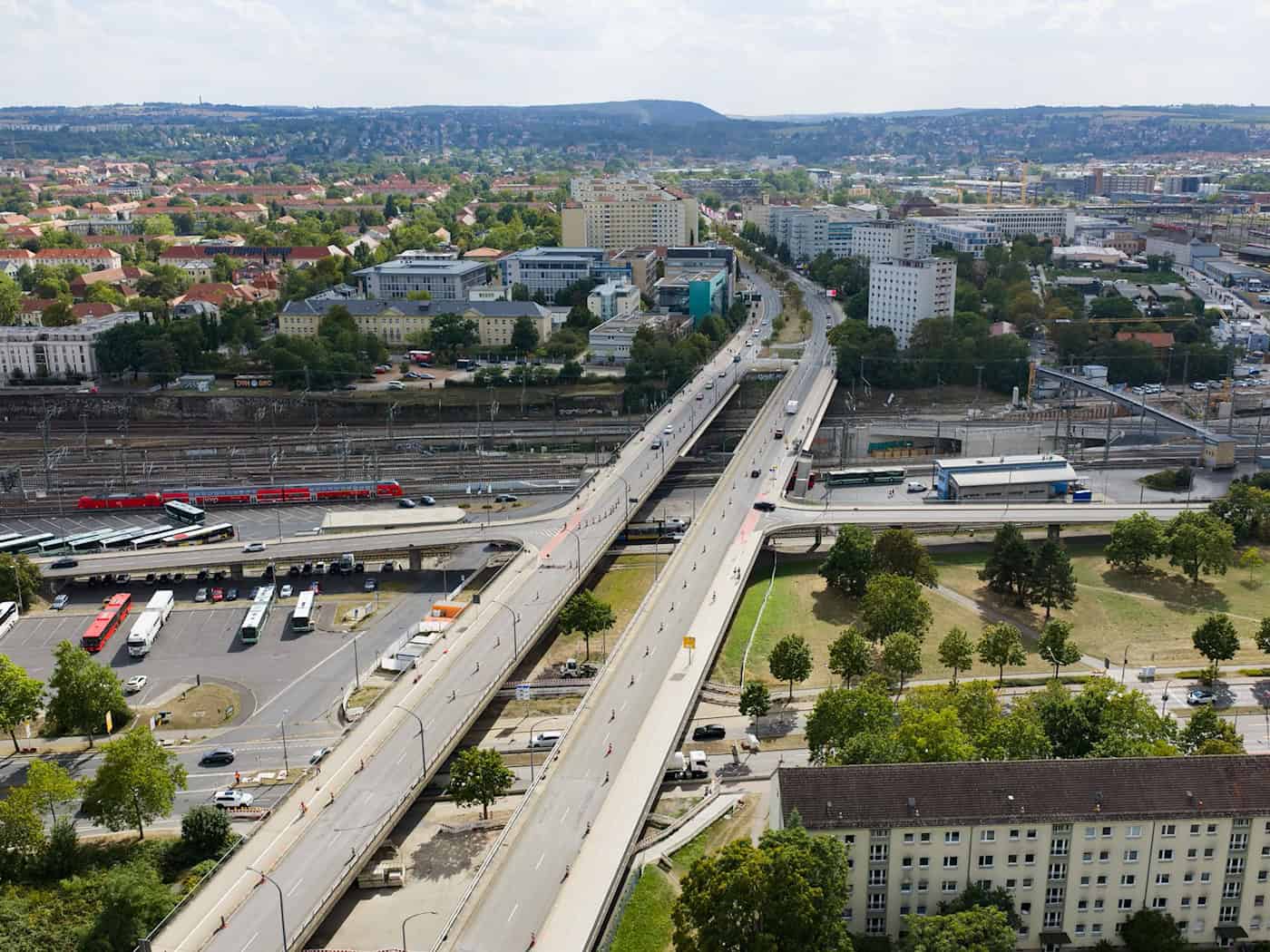
A load test has begun on the dilapidated Budapester Straße Bridge near Dresden Central Station. According to city officials, the test is intended to provide more detailed information about the stability of the prestressed concrete structure, which is largely closed due to numerous broken tension cables. If the results allow, the bridge could be gradually reopened to traffic. During the test, four heavy-duty vehicles with progressively increasing weights will drive across the bridge, which will be continuously monitored. Sensors will record how the structure behaves under the load, whether further damage occurs, and how deformations and stresses develop. The test costs around 900,000 euros. “326 metric tons will be applied in stages,” said test director Oliver Mosig before the start. The four vehicles will be loaded with additional weight in stages during the test to reach the planned total weight. “We want to use the load test to determine the bridge’s residual load-bearing capacity.” The goal is to determine whether it can be reopened in the future for reduced traffic, Mosig said. A total of three evenings and nights are scheduled. Bridge section C will be tested first. That is where the majority of the tension cable breaks were detected, which had led to the closure of this important Dresden traffic artery. Starting Tuesday evening, heavy-duty vehicles will then travel across Bridge Section A. Wednesday is set aside as a backup date. Comprehensive closures will be in effect from 6 p.m. to 6 a.m. each day, including the section that is currently still open to traffic. The test itself will run from 7 p.m. to 5 a.m. each night. A similar test took place in Bad Schandau in April 2025. The months-long full closure of the Elbe Bridge there was subsequently lifted for vehicles weighing up to 7.5 metric tons. The two bridges in Dresden and Bad Schandau were built using the same construction method as the partially collapsed Carolabrücke in Dresden. Because they were built using Hennigsdorf prestressing steel, they are considered at risk of so-called stress corrosion cracking, which, according to expert reports, caused the collapse of the Carolabrücke in September 2024. Following the collapse, similar bridge structures in Dresden and throughout Saxony were also scrutinized. Due to the damage discovered during this inspection, traffic on the Budapester Straße Bridge was initially restricted in early May and largely halted on May 13 following the discovery of further damage. If traffic had continued to be allowed, the structure would have collapsed, bridge expert Steffen Marx made unmistakably clear at the time. To relieve the load on bridge span C, additional supports were installed in recent weeks. Copyright 2026, dpa (www.dpa.de). All rights reservedTest to run through midweek
Same Construction Method as the Carolabrücke
Closure due to risk of collapse


