

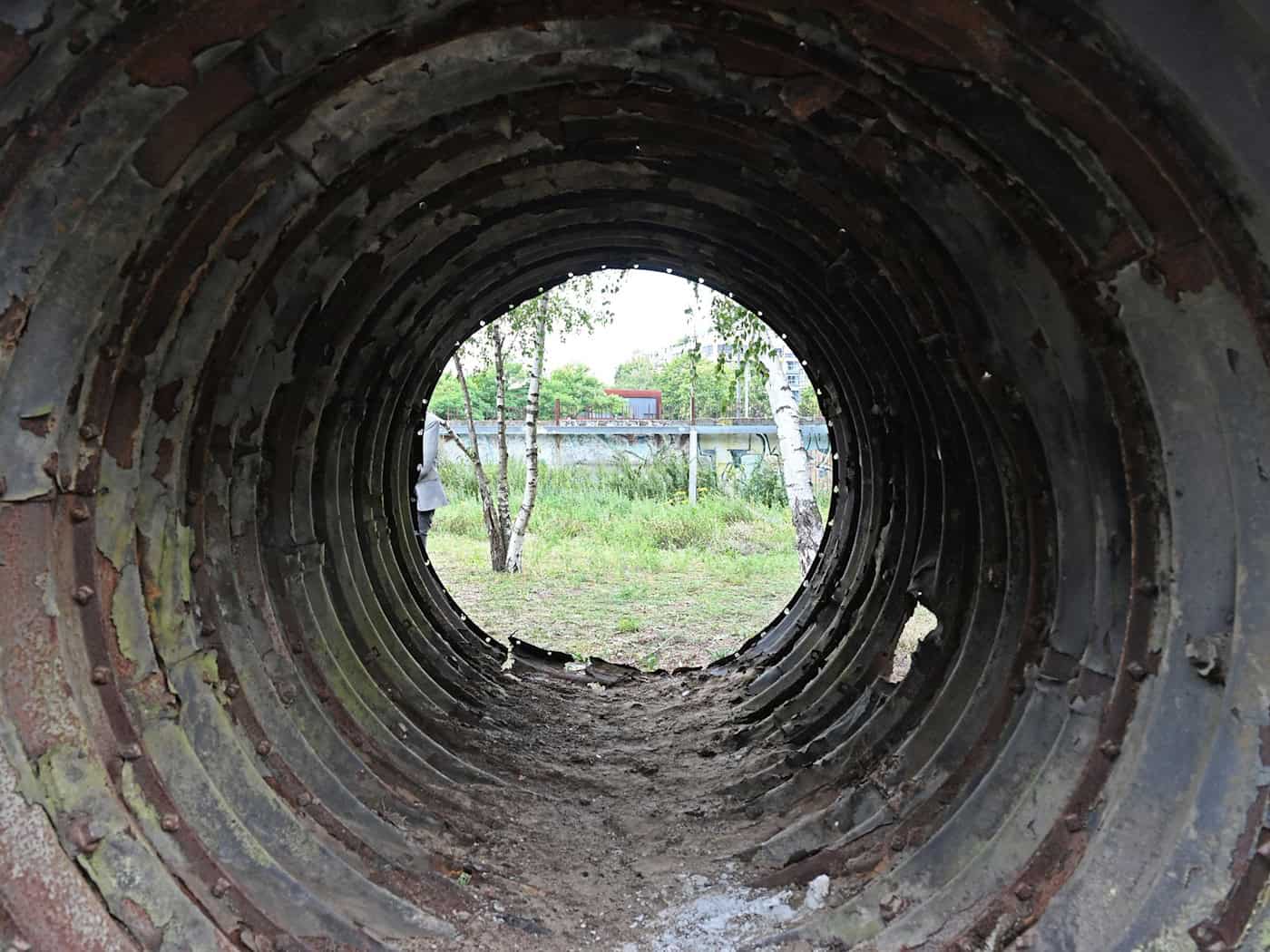
At the start of the Cold War, the U.S. Central Intelligence Agency (CIA) and the British Secret Intelligence Service (SIS) built a tunnel through divided Berlin in order to tap into the Soviet Army’s secret telephone lines. But the project was quickly exposed—about 70 years ago. The National People’s Army (NVA) excavated the tunnel—and transported sections of it to various military bases. Now, three segments of this Cold War relic have been brought back to Berlin. They are to be preserved and will be on display here in the future. A member of the “Berliner Unterwelten” organization had discovered the three steel tubes—each weighing several metric tons and measuring three to four meters in length—by chance near Storkow in Brandenburg in mid-August. One of the segments is to be housed at the DDR Museum. One section of the tunnel is to become part of the “Subway, Bunkers, Cold War” tour organized by the “Berliner Unterwelten” association. The third tunnel section could be installed in the future at its original location along the Wall Trail between Rudow and Altglienicke, as suggested by the association’s chairman, Dietmar Arnold. According to him, this would complement the four steles that currently commemorate the spy tunnel there. Between 1954 and 1955, the CIA and the SIS built a tunnel—approximately 460 meters long, according to “Berliner Unterwelten”—through Berlin, leading from the Rudow district in the American sector to Altglienicke in the Soviet sector. According to reports, between May 1955 and April 1956, the Americans and British intercepted over 400,000 telephone calls. “These were pieces of a puzzle involving communications between the Soviet Army here and Moscow, Warsaw, and Prague, which, when put together, provided a precise picture of the military situation and possible attack options,” explained political scientist Helmut Müller-Enbergs, who specializes in intelligence services. He added: “In 1955–1956, this tunnel provided access to information that helped ensure it remained a Cold War and not a hot one.” According to “Berliner Unterwelten,” the tunnel extended about 330 meters into East German territory. However, it was reported that the Soviets had known about the operation even before it became operational: a British double agent had informed the Soviet secret service, the KGB, of the plans. The KGB nevertheless allowed the project to continue for a while—primarily to avoid endangering the double agent. A storm one night in April 1956 caused disruptions to telephone lines. It was then announced in the GDR that the tunnel had been discovered during repair work by Soviet and East German telecommunications technicians. The spy tunnel remained open to the public in the GDR until June 1956. The NVA then excavated it and removed it, as the association’s statement further notes. Some segments were distributed among various NVA bases. According to “Berliner Unterwelten,” the three recently discovered steel pipes, each with a diameter of about two meters, were found in a forested area that is part of the training ground for what is now the Kurmak Barracks in Storkow, Brandenburg. During the GDR era, there was an NVA base there. The tunnel sections were reportedly buried there for training purposes. Other segments had already been found in the 1990s. In 2012, according to “Berliner Unterwelten,” sections were discovered in a forested area near Pasewalk in Mecklenburg-Western Pomerania, which had been used as a military training area during the GDR era. In 2005, additional sections were unearthed during the expansion of the Berlin urban highway near the tunnel’s former location. Copyright 2026, dpa (www.dpa.de). All rights reservedRemnants of a legendary espionage operation
Tunnel sections used as training targets for NVA soldiers


