

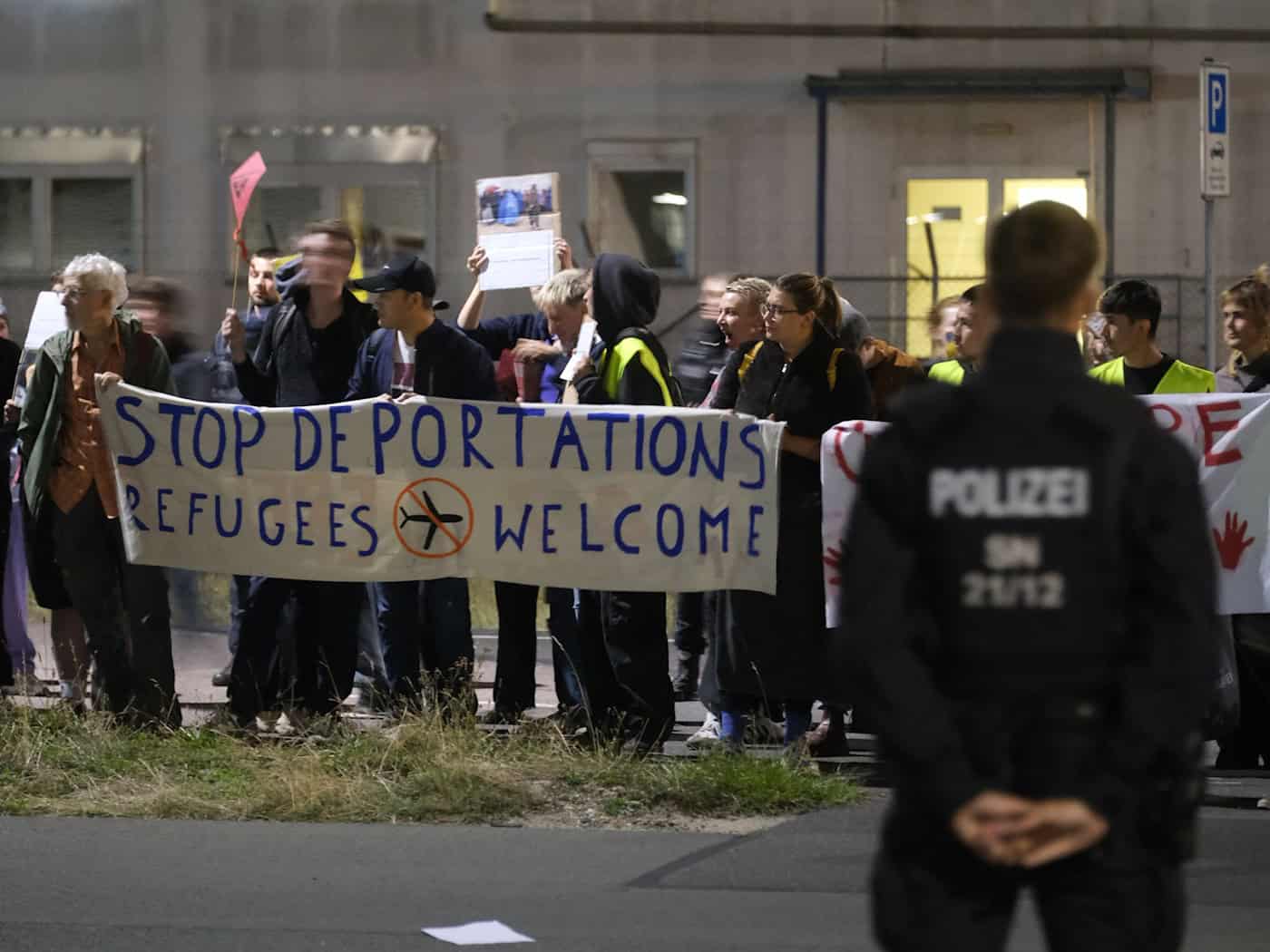
The Federal Police used a chartered plane to transport Afghans subject to deportation back to their country of origin. The deportation from Leipzig/Halle Airport to Kabul began in the early morning hours. According to information from the German Press Agency, officers accompanied 23 men on the flight to the Afghan capital. Following a deportation at the end of July, Federal Interior Minister Alexander Dobrindt (CSU) stated that deportations to Afghanistan would no longer be limited exclusively to criminals and “persons posing a threat.” Rather, as agreed in the coalition agreement, other individuals required to leave the country would also be deported there effective immediately. Criticism has recently been directed at the federal government’s agreements with the ruling Taliban in Kabul. Green Party members of the Bundestag, Schahina Gambir and Sara Nanni, accused the government of pandering to the Taliban—who have deprived women and girls of basic human rights—in order to achieve its goal of “deportations at any cost.” By cooperating with the Taliban, they argued, the government is helping them “become socially acceptable on the international stage.” The federal government does not recognize the Taliban—which seized power in Kabul five years ago—as a legitimate government. The first mass deportation of Afghan criminals to their country of origin was organized two years ago with the support of the Gulf emirate of Qatar. At that time, Nancy Faeser of the SPD was Federal Minister of the Interior. One of the 31 men who were deported from Germany to Afghanistan at the end of July subsequently told the dpa in a phone interview that he had arrived in Germany at the age of 14 and had partially forgotten his native language, Dari. The deportation separated him from his wife and child. “There’s no work for me here in Kabul. If my older brother weren’t here, I’d be living on the street,” he says. His goal is to return to Germany. Afghanistan, with its more than 48 million inhabitants, is currently in the midst of a severe humanitarian crisis. Malnutrition has reached unprecedented levels, the United Nations World Food Programme recently warned. According to the International Labor Organization (ILO), only about 33 percent of the working-age population has a job. Copyright 2026, dpa (www.dpa.de). All rights reservedContacts with the Taliban
Afghanistan in a humanitarian crisis


