

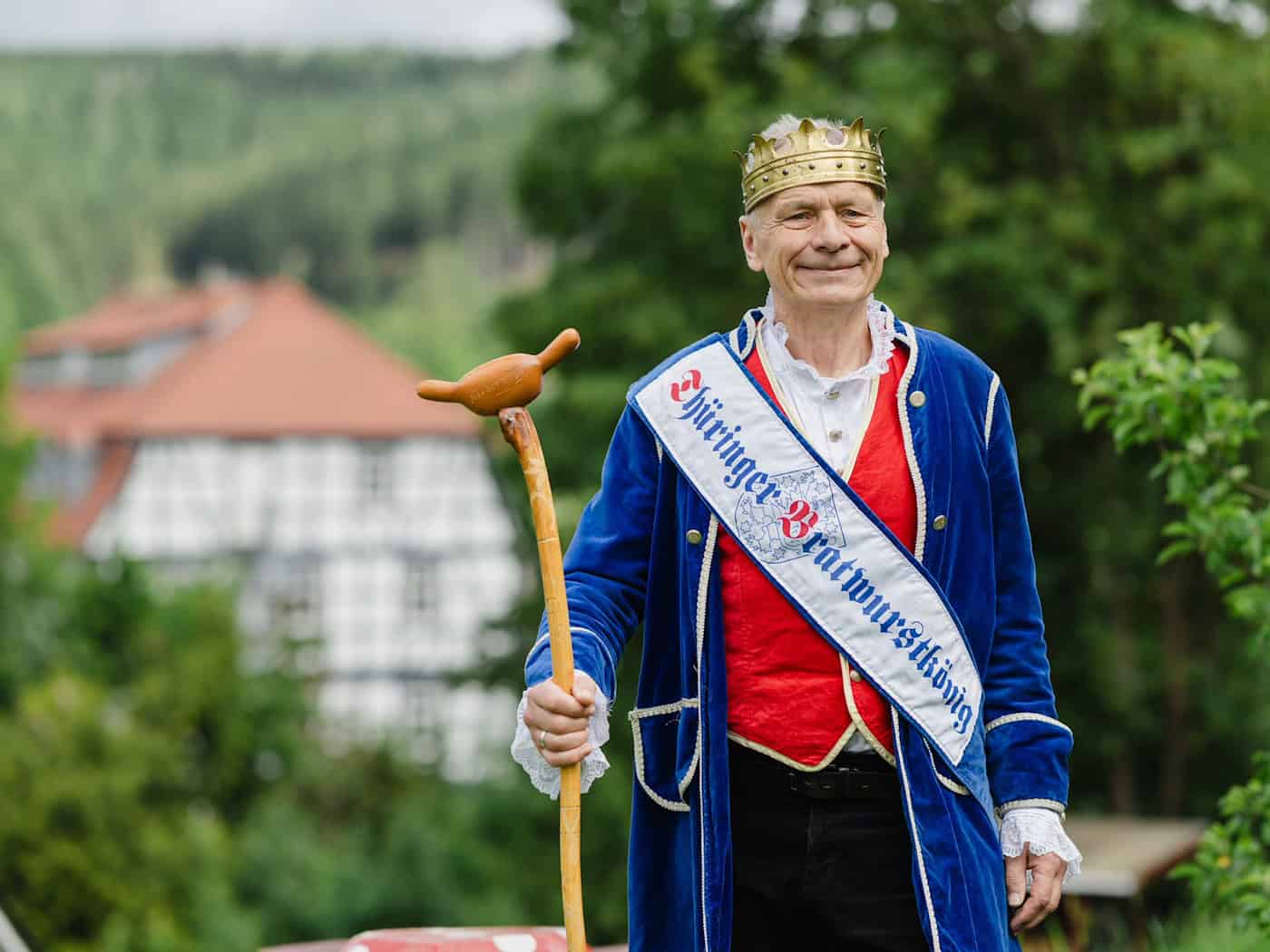
There have been no real kings and queens in Saxony and Thuringia for a long time, or never have been, as in Saxony-Anhalt. Nevertheless, the states are ruled majestically to a certain extent: there is an almost unmanageable number of product majesties for lavender, roses, onions, potatoes, bratwurst, plum jam, hops, porcelain and mountain railroads. They are supposed to give their region or certain products a face. These so-called sovereigns are more than just a cultural symbol. More than 100 years after Frederick Augustus III abdicated as the last King of Saxony on November 13, 1918, numerous sovereigns rule the Free State. Their Majesties convey positive messages about Saxony's agriculture, food industry and forestry. The queens are also important ambassadors for tourism. Last year, for the first time in 40 years, no new Saxon Wine Queen was crowned. The election was canceled due to a lack of candidates. It is becoming increasingly difficult to find candidates who want to hold an honorary office. For this reason, the office was deliberately opened up to men in this year's process. The background to this is the development of the industry itself, according to the Saxony Winegrowers' Association. There are a large number of female winegrowers in Saxony working in all areas - in the vineyard, in the cellar and also in management positions. The classic division of roles no longer exists in practice. No distinction is made as to whether someone is a woman or a man - the decisive factors are professional competence and commitment. It is therefore only logical that men can also represent the wine-growing region as wine sovereigns. Jenny I has been the Nutcracker Queen in Neuhausen in the Ore Mountains since 2019. Her family runs the Nutcracker Museum with more than 4300 pieces. "There has been a Nutcracker Queen since 2005. But when there were too many appointments, she was given a princess at her side," explains museum director Uwe Löschner. Now Nutcracker Princess Antonia accompanies Her Majesty. The two are a permanent fixture at the Neuhausen Nutcracker Festival at the end of May. They will also hold court at the Queen's Meeting on August 23, where around ten other product majesties are expected to attend. The last king of the historic Thuringian Empire was Herminafried. He ruled until his defeat in the Battle of the Unstrut in 531. After his death in 534, the empire was broken up and Thuringia fell to the Frankish Empire. The diversity of today's majesties is great and they play an important role in the visibility of regional characteristics, according to Thüringer Tourismus GmbH. Among other things, they present potatoes, dumplings, brine, bratwurst, wine, roses, onions, herbs, cherries, strawberries or blueberries, but also porcelain or buttons. Since 2018, Norbert I has been presenting the culture of Thuringian bratwurst as a culinary ambassador. This weekend, he wants to defend his title as Bratwurst King on Suhl's market square. Ten teams will be competing for the favor of the jury, which includes Minister of Justice Beate Meißner, with their grilling skills and presentation of the sausage. The reigning king competes with his Suhl barbecue dwarves under the motto "Only the sausage makes it big". Each team gets ten sausages and then there are no limits to their creativity when it comes to grilling and presentation, explains the bratwurst king. "We've even brought Snow White to life with the help of the smell of the sausage," explains the 66-year-old. In addition, ten specialist questions have to be answered. The jury has to be convinced by the team's imaginative appearance, specialist knowledge of bratwurst, an original charcoal fire, perfect grilling technique and entertaining presentation of the sausages. In addition to bratwurst, the Thuringian dumpling is the national dish in the Free State. This is presented by the Kloßmarie. "It's an image figure. Employees slip into the appropriate dress for special occasions," explains Torsten Langbein, one of the Managing Directors of Ablig Feinfrost GmbH. It is important that Marie knows the special features of the Thuringian dumpling and the differences to other dumplings. She should also know how they are made. The state of Saxony-Anhalt only existed as such from 1947 to 1952 and never had a king or queen. The state was dissolved as part of the administrative reforms in the GDR. It was not until German reunification in 1990 that Saxony-Anhalt re-emerged as one of the five new federal states. The Saxony-Anhalt Ministry of Tourism states that regional tourism benefits from the current product sovereigns, as does the local food industry and agriculture. The history of the town of Bad Dürrenberg is closely linked to salt mining. In 1763, miners discovered a brine layer at a depth of 223 meters. The Bad Dürrenberg Well Festival is now an intangible cultural heritage. According to UNESCO, the festival serves to preserve and pass on tradition and history to future generations. Laetitia I is currently reigning as the Fountain Queen. Her successor, the current Princess Emma I, has already been chosen. But here, too, it is becoming more difficult to find new royalty. "It's probably because young people are no longer so interested in history," says Sina Mähnert, chairwoman of the local history association. Paula Löber is the reigning regional wine queen of Saale-Unstrut. The 28-year-old represents the northernmost quality wine-growing region in Germany. There are also 13 other wine queens who represent the respective localities. "The Wine Queen has around 200 appointments a year. This requires a special level of commitment," says Yannik Einhellinger from the Saale-Unstrut Winegrowers' Association. Each year, there is a complex selection process. The applicants complete around ten training courses on wine, rhetoric and social media. For the actual selection, they present themselves with a ten-minute video, have to answer three specialist questions, including one in English, and give a short presentation on a previously unknown topic. This year, the new Wine Queen will be elected on August 4. For the first time, men were also admitted. According to the association, however, there were no male applicants. Copyright 2026, dpa (www.dpa.de). All rights reservedSaxony
Wine Queen
Nutcracker Queen
Thuringia
King of the Bratwurst
Kloßmarie
Saxony-Anhalt
Fountain Queen and Fountain Princess Bad Dürrenberg
Wine Queen Saale-Unstrut


