

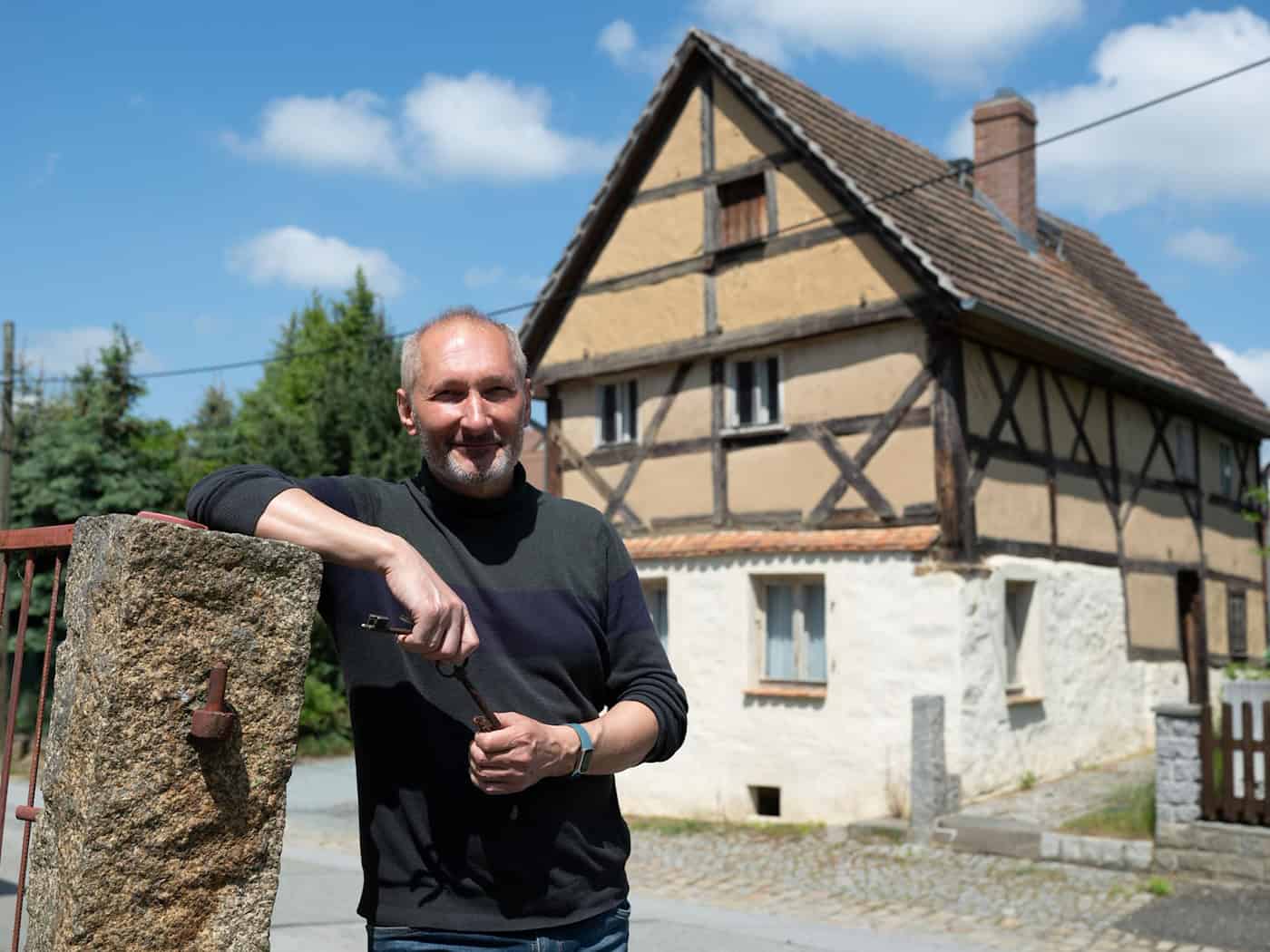
Whether on a personal or professional level: Arnd Matthes is undoubtedly passionate about half-timbered houses. In Waditz near Bautzen, the 63-year-old lives in a property built in 1661, which he renovated privately. In his professional career, he has also done everything in his power to preserve as many examples of the unique vernacular architecture that is typical of Upper Lusatia as possible. The heritage conservationist has headed the office of the Umgebindehaus Foundation in Ebersbach-Neugersdorf since 2013 and advises homeowners. "I've certainly infected quite a few people with the Umgebinde virus," Matthes suspects. He will retire in the middle of the year. The trained car mechanic came to heritage conservation as a career changer in 1992. "It was a direction that suited me," says the native of Löbau, who grew up in the Upper Lusatian village of Kleindehsa. He calls his specialization in half-timbered houses a "stroke of luck". Even as a child, he learned to love the coziness of the rustic monuments at his grandparents' home in Cunewalde. "It was simply cozy there," says the father of two grown-up sons, looking back. Matthes renovated a half-timbered house for the first time in 1988. In 2002, he began to extend the building in Waditz, where he lives today. "I spent 20 years working on it in my spare time," he says about the farm, which once belonged to a manor. He has experienced a number of surprises in the process. The striking wooden supporting structure, the half-timbering and the log parlor as the "heart of the house" first had to be uncovered. "Everything was completely hidden and plastered over." While draining a wall, old wall remains and finds were uncovered that indicate that the property was used as far back as the 13th century. "Reading the history of the house is always interesting and appealing." The Saxon State Conservator Alf Furkert calls half-timbered houses "the face of Upper Lusatia". Around 6,500 are listed as cultural monuments in the state. The houses combine elements of half-timbered, log and solid construction to create a unique building style. The eponymous Umgebinde surrounds the log cabin in an arch. According to estimates, there are still around 20,000 of these typical regional buildings in northern Bohemia, Lower Silesia in Poland and Saxony. In some places, half-timbered houses are literally clustered together, for example in Großschönau, Eibau, Obercunnersdorf and Ebersbach. Matthes raves about this "ensemble effect", which is unparalleled anywhere in Germany. This great structure is hardly disturbed by "eyesores". Vacancies are mainly found directly on main roads such as the Bundesstraße 96. During his time at the foundation, which was established in 2004, Matthes says he has advised around 2,000 owners of Umgebinde houses. He tends to recommend prospective buyers to buy an "unspoiled" house - i.e. one that has not yet been renovated, or at least without the use of modern materials such as plastic. The heritage conservationist says that today's homeowners are more attentive in their approach. "Contemporary tastes have changed." Today's generation is very conscious of using ecological building materials such as wood, clay, straw and stone, which have traditionally stood the test of time. The high construction costs are now a huge challenge. Where possible, it is therefore worth doing it yourself. Every Umgebinde house is different, especially those built before 1820. "It wasn't until the 19th century that the architectural style converged," says Matthes. He is happy every time a house is saved - for example in Weißenberg, where the old church school and a former craftsman's house were saved from demolition. Over the past ten years, young people have repeatedly helped out in the 17th century buildings by chipping old plaster off the walls or trying their hand at clay construction. Matthes believes that project work with 8th and 9th graders is important in order to awaken an interest in building culture and craftsmanship at an early age. The expert believes that research into the special vernacular building method and its origins will never be complete. "New findings are constantly being added." The Umgebindehaus Foundation will not run out of work, but money will become scarcer. The position of the previous office manager has been re-advertised with twelve fewer hours. Matthes will be back in action at the Umgebindehaus Open House Day at the end of May, guiding visitors through the old church school in Weißenberg. Copyright 2026, dpa (www.dpa.de). All rights reservedExperienced the original monument with his grandparents
Ecological building materials such as wood, clay and straw


