

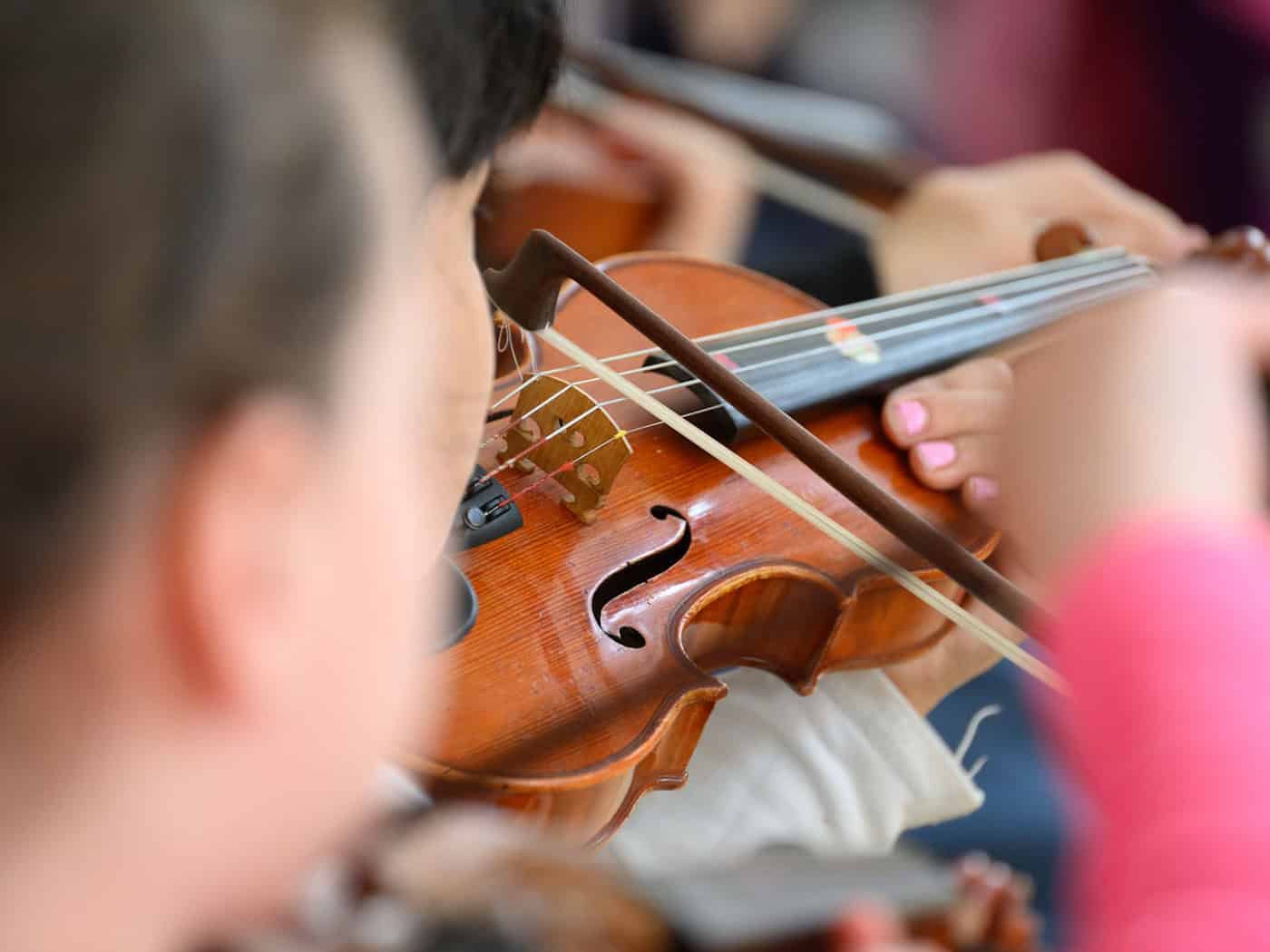
The "Musaik – Grenzenlos musizieren" project continues to make music history in Dresden. Soon, the Prohlis neighborhood in the southeast of the city—known for its prefabricated apartment blocks—will even have its own opera; more precisely, a "neighborhood opera." That is how the piece, titled “Plattenspieler:innen,” is described. 350 amateur performers, mostly children but also adults, are collaborating with professionals to bring a jointly developed musical theater piece to the stage. Four performances are scheduled for this Friday and Saturday. The subject has a cosmic dimension. Halley’s Comet loses a piece of itself—Halley, a singing stone. This stone lands in Dresden-Prohlis and witnesses, in fast-forward, how a prehistoric settlement becomes a vibrant city. A news broadcast in the year 2061 reports on how Halley travels through the ages and whom he encounters along the way. “The opera combines music from different centuries—from Handel’s ‘Water Music’ to Richard Strauss’s ‘Thus Spoke Zarathustra’—with live animation, drama, dance, and choir,” says “Musaik” spokesperson Heike Bronn. In addition to the 130-member “Musaik” orchestra, 150 children from a Prohlis elementary school and a high school are participating, as well as members of the Staatskapelle Dresden, ensembles from the Protestant parish of Prohlis, and choirs. The audience is also encouraged to participate. The opera explores questions such as “What is home?” or “How do people deal with the unfamiliar? What remains when everything changes?” In doing so, “Musaik” is also returning to its own roots. The project was launched in 2017, modeled after “El Sistema” in Venezuela. Children from lower-income families receive free music lessons and instruments. Luise Börner and Deborah Oehler, two musicians from Dresden, had experienced “El Sistema” in a similar form in Peru. From then on, they taught children and teenagers for free in Prohlis, initially in a former ice cream shop in a shopping center. Many of the children here come from refugee families. To reach as many of them as possible, they developed their own teaching system. Currently, 15 teachers from five countries are teaching the young students to play string and wind instruments. “'Musaik' uses musical training in the orchestra as a tool for social change,” emphasizes Tim Vollmann, who manages the association’s office. Many of the children and young people from about 15 countries come from socially and financially disadvantaged backgrounds. “The orchestra helps break down prejudices against strangers and outsiders and fosters a climate of respectful coexistence and mindfulness.” The musical social project has been supported by the Sächsische Staatskapelle Dresden for quite some time. The two “Musaik” founders, Luise Börner and Deborah Oehler, have since been honored with the Cross of Merit on Ribbon of the Federal Republic of Germany. “Musaik” has become an integral part of Prohlis—and the neighborhood, with about 17,000 residents, is still considered a socially disadvantaged area. People from many nations live here. Prohlis had already proven itself once before as the stage for a spectacular project. In 2020, musicians from the Dresden Symphony Orchestra climbed onto the roofs of several high-rises and turned the entire neighborhood into an open-air concert hall. For “Himmel über Prohlis,” four alphorn quartets and various wind ensembles played at lofty heights, while drummers on Chinese Dà Gǔ drums filled the residential neighborhood with sound. Copyright 2026, dpa (www.dpa.de). All rights reserved“Musaik” returns to its roots with the opera
Training in string and wind instruments
"Musaik" as an Instrument for Social Change
The Staatskapelle Dresden supports the project
Donations for the project are welcome
For its current project, “Musaik” is once again relying on the residents’ involvement. “Make the neighborhood opera colorful!” is the call to action. For the performance, costumes for about 100 schoolchildren, T-shirts, leggings, and aprons are needed. Each costume is estimated to cost 20 euros. The children need the money for materials. Using paint and brushes, they plan to build a castle out of banana crates; wood and glitter paper will be used to create a “Future Studio”; and gold foil and a fog machine will form a “time machine.”


