

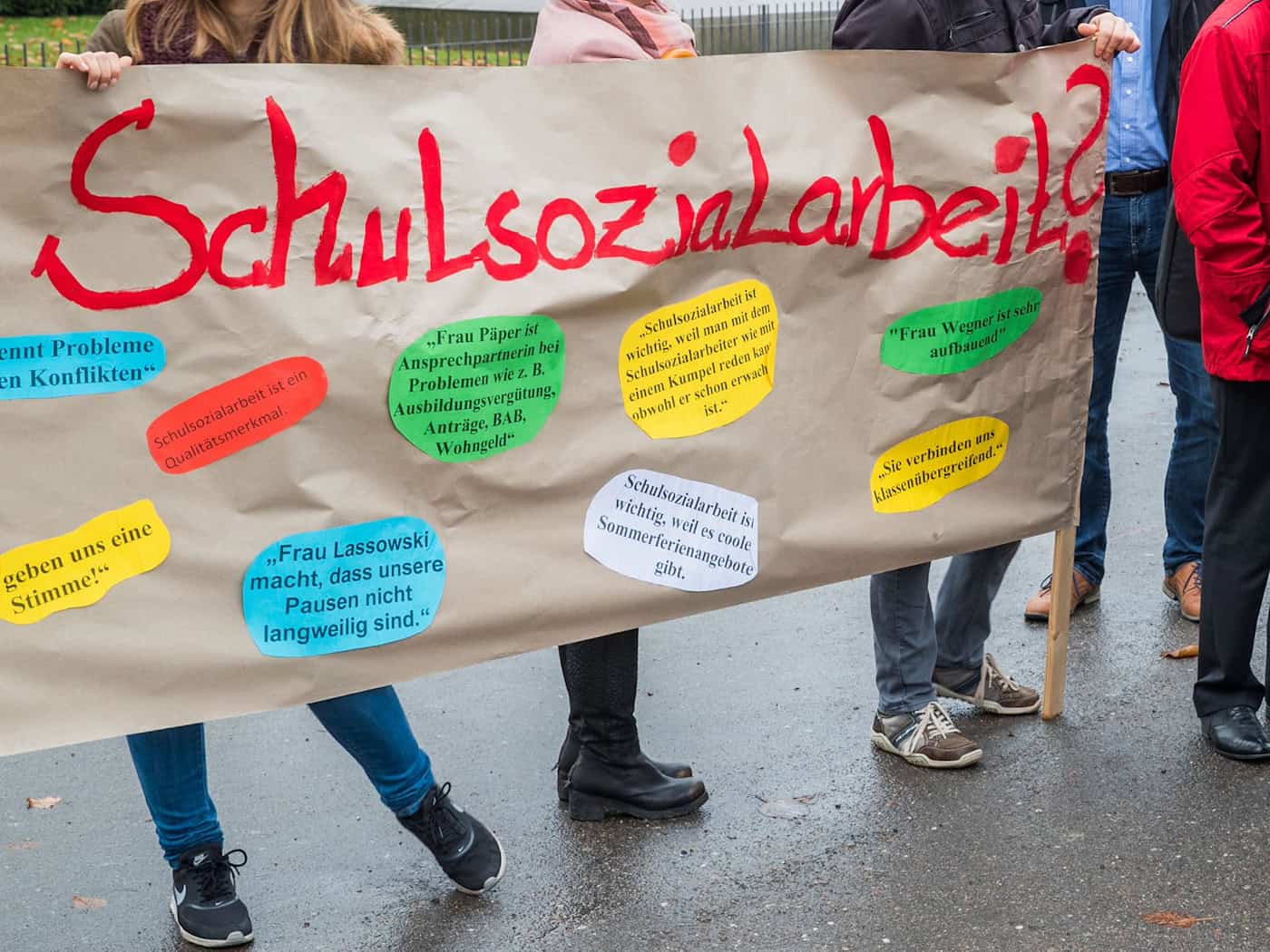
There is still a lot of room for improvement when it comes to school social work in Saxony. This is the conclusion of a study that compared the situation in this area in all federal states. Study director Lars Bieringer from the Saarland University of Applied Sciences saw Saxony in the middle of the field. School social work is on the right track in the Free State, but there are individual areas for improvement. The Education and Science Trade Union (Gewerkschaft Erziehung und Wissenschaft), like the State Working Group on School Social Work (Landesarbeitsgemeinschaft Schulsozialarbeit - LAG), called for a gradual expansion of the service by 2032. By then, social work should be a matter of course in every school. "The psychological strain on pupils is increasing enormously, especially in families with low incomes," said GEW head Burkhard Naumann. The number of school dropouts and truants is at an all-time high. According to Naumann, schools are confronted with these problems on a daily basis. At the same time, the expansion of school social work has been stagnating for years. In the Free State's double budget, the funding had remained at the same level, but the increase in costs meant that this was de facto a reduction. According to LAG education officer Wolfgang Müller, around 40 percent of schools in Saxony have had a social worker since 2019. By law, this is only mandatory at state secondary schools and community schools. There are currently 640 full-time positions for 417,000 schoolchildren and young people at 1,575 schools, which are shared by 750 social workers. In purely mathematical terms, this means that there are 651 pupils for every one position. However, many schools have no social worker at all. According to Müller, comprehensive expansion by 2032 would cost around 100 million euros. With a state share of 90 percent, this would be around 90 million euros for the Free State of Bavaria. Currently, the Free State spends around 37.5 million per year. In relation to the budget of the Ministry of Culture, however, this is a negligible sum. According to Bieringer, only Berlin and, to a limited extent, Saarland offer school social work nationwide. The service has become firmly established in German schools. In Saxony, 85.4 percent of those surveyed in the study also stated that they had a permanent employment contract. Just under half (47.4 percent) thought about changing careers in the past year. 67.6 percent work as lone fighters. Just under 60 percent feel well supported by their employer. In Saxony, a third of school social workers took part in the survey. Bieringer recommended that Saxony expand team structures across the board, provide professional support and further training for young professionals with little professional experience and secure the existing funding and employment structures financially and structurally in the long term. Copyright 2026, dpa (www.dpa.de). All rights reservedDemand for nationwide expansion by 2032
School social work stagnating, costs rising
Only 40 percent of schools have school social workers
Comprehensive expansion costs around 100 million euros
Recommendation for long-term financial security


