

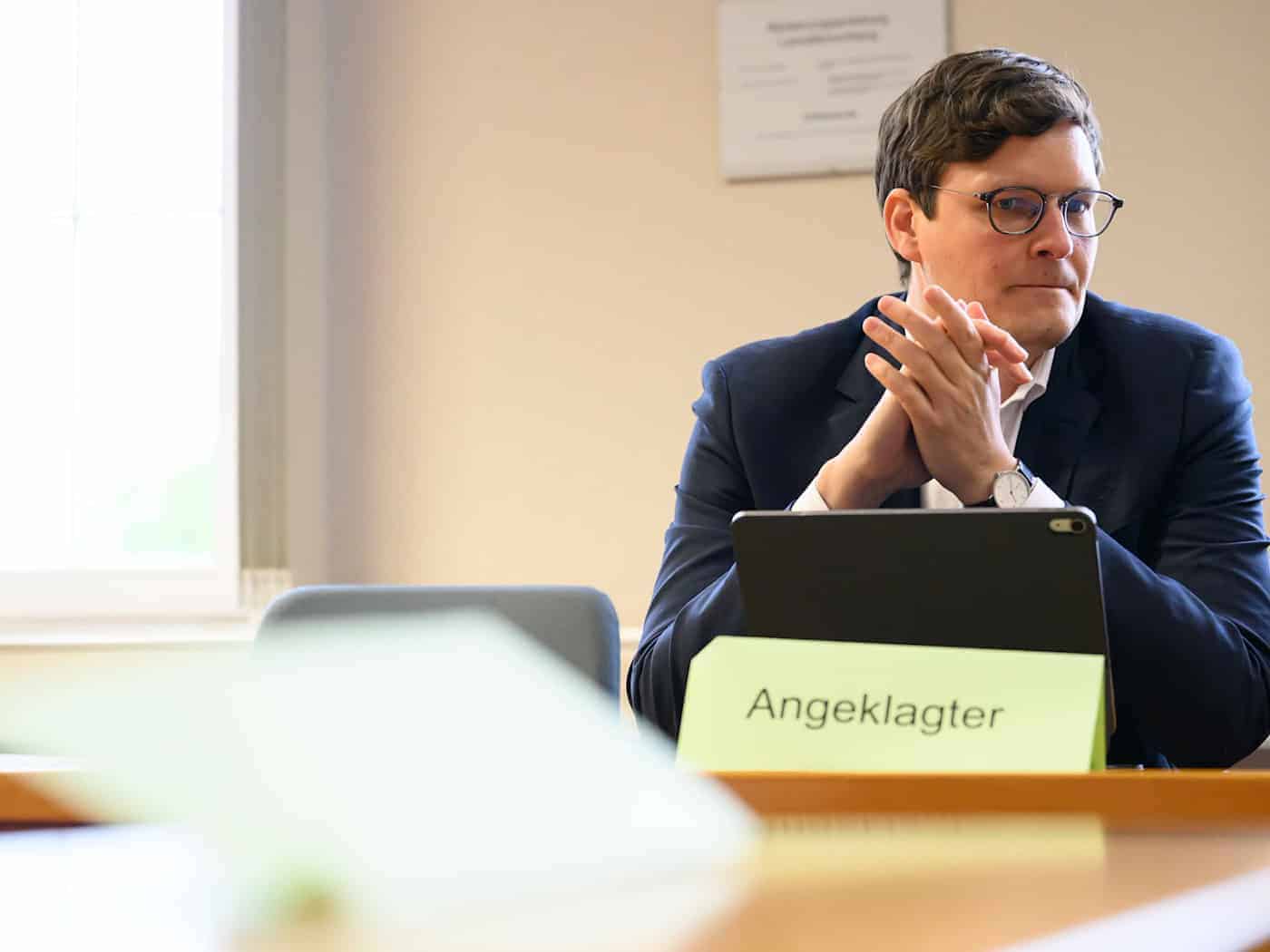
Saxony’s Minister of Culture, Conrad Clemens, has been found guilty by the Weißwasser District Court of a traffic offense. The court had charged him with illegal street racing and misuse of license plates. Clemens received a warning. He is therefore not considered to have a criminal record. He is required to pay 8,500 euros to the victim support organization Weißer Ring. He must also cover the costs of the proceedings. Judge Alex Theile reserved the right to impose a fine of 60 daily rates of 400 euros each—totaling 24,000 euros. This is subject to a two-year probationary period. Theile also ordered Clemens to complete at least 20 hours of traffic safety education within one year. The prosecution and the defense had unanimously requested an acquittal—an unusual occurrence. Both intend to appeal the verdict. Clemens had admitted to the speeding violation and expressed regret. He denied the other charges. “I have taken responsibility for my behavior. From the very beginning, I have emphasized my respect for the court and our constitutional state,” he said afterward. This also includes having the verdict reviewed. “That is why I will file an appeal.” In September 2023, —while still serving as head of the Saxon state representation in Berlin—was caught by a speed camera driving 81 kilometers per hour in a 30-kilometer-per-hour zone near a retirement home in Krauschwitz (Görlitz district). He initially filed an objection to a fine of 560 euros and a two-month driving ban. The Weißwasser Municipal Court converted the original administrative fine proceedings into a criminal case after learning that Clemens had repeatedly committed speeding offenses. The allegation of license plate misuse stemmed from the fact that Clemens’ vehicle had a so-called “camouflage license plate.” These are used to prevent vandalism, for example, on vehicles belonging to the State Chancellery. Judge Theile acknowledged that the decision to convert the case into a criminal proceeding is controversial among legal experts. The offenses Clemens is accused of are minor offenses for which the legislature has chosen dramatic terminology. When people think of an illegal car race, they imagine a race in which drivers compete against one another. Although Clemens was alone, he crossed the threshold of criminal liability by driving at high speed. The court was required to investigate the matter, as there was sufficient suspicion of a crime. In her closing argument, Prosecutor Esther Aenderl rebuked the court in unusually sharp terms. She argued that the entire factual situation had already been established before the presentation of evidence began. The case had come before the court as an appeal against a fine notice. Nevertheless, the court had converted it into a criminal proceeding. “The foundation was already lacking here.” Assumptions cannot serve as the basis for criminal liability. Defense attorney Lukas Schefer seized on this opportunity. It is rare for a defense attorney to have little to add to the prosecution’s closing argument. He also criticized the judge’s conduct. Such a course of action and such behavior were “unlawful and unworthy of a state governed by the rule of law.” “A courtroom must not be misused as a stage.” Copyright 2026, dpa (www.dpa.de). All rights reservedHeavy Fine Threatened—Probation Period
Clemens plans to file an appeal
Driving at 81 kilometers per hour in a 30-kilometer-per-hour zone
Administrative fine proceedings turned into criminal proceedings
Judge found sufficient grounds for suspicion
Prosecutor Rebukes the Court
There was a complete lack of factual findings necessary for a conviction.


