


2026 Grape Harvest: Ideal Conditions for High Quality
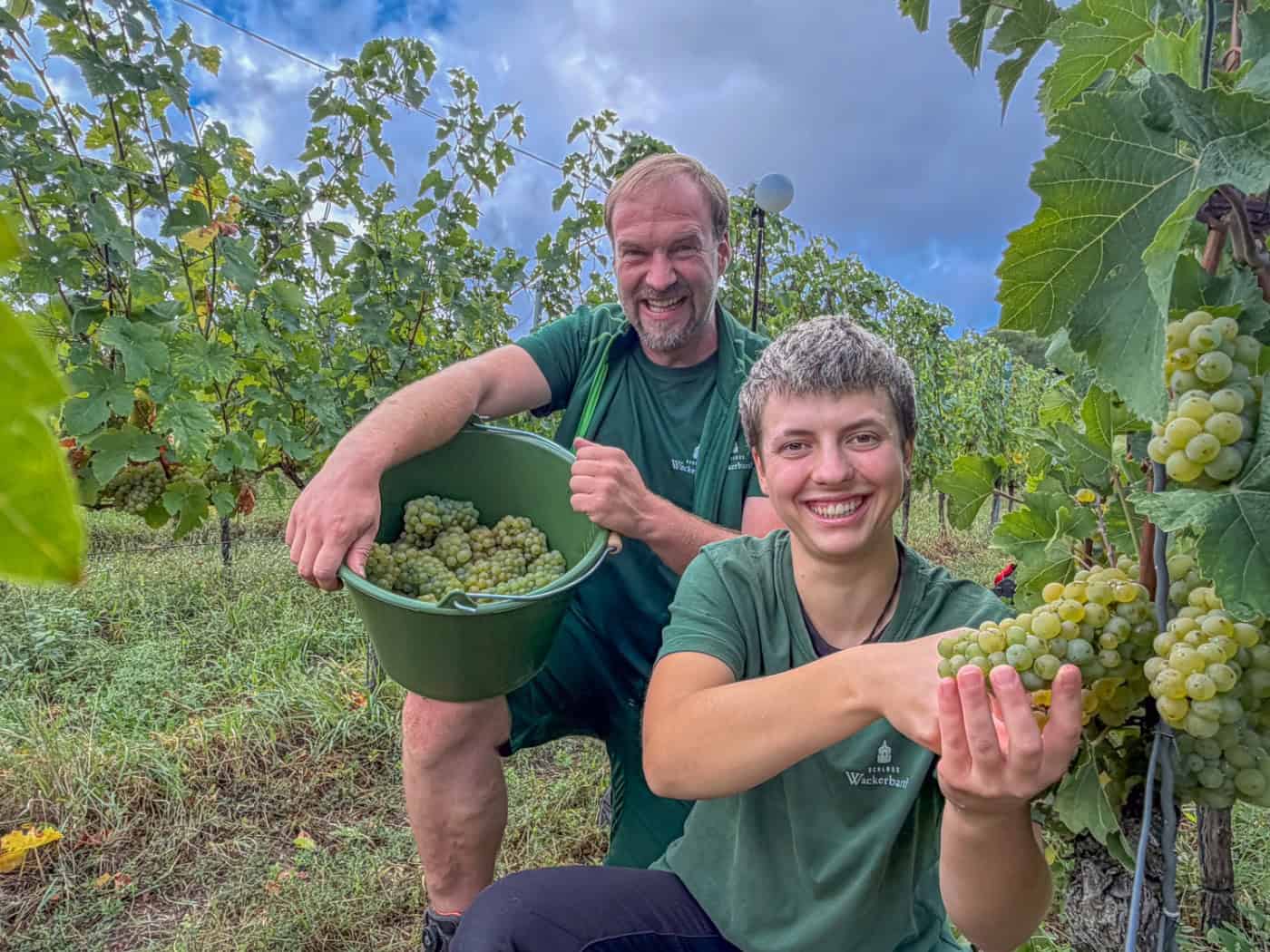
Other wine-growing regions have vineyards called Hell. Saxony doesn’t have anything like that—but it does have a vineyard called Paradise. And this despite the terroir being hellishly steep in places—up to 60%—which means winemakers (m/f/d) really need to have the agility of mountain goats. But “Paradise” can also be flat, up in the upper reaches. The selection of grape varieties is correspondingly diverse in this approximately 5.6-hectare vineyard, most of which is managed by Schloss Wackerbarth (the other, smaller part belongs to the Paradiesberg winery, which I visited in 2015). On the steep slopes, the Wackerbarths grow Riesling and Traminer; on the one-hectare flat area, they grow Goldriesling. And that’s where the harvest for the 2026 vintage began today.
The start of the harvest is only slightly earlier than the average of recent years, as Till Neumeister, head viticulturist at Schloss Wackerbarth, reported: “Compared to last year, we’re a week ahead of schedule. In the very hot and dry year of 2018, for example, the harvest began 14 days earlier, on August 6.” It was still hot, however—and notably so early on, specifically in mid- to late June (with peak temperatures of 41.7 degrees in Diesbar-Seußlitz on the Thonberg)—and dry as well during that period. The vines, however, handled it well. A little experience also comes into play, as the always cheerful and modest Till Neumeister adds: “With the right measures, we’ve helped our vines cope with the current weather conditions. These include, in addition to targeted irrigation of our young vines, individually tailored soil cultivation, and meticulous care of the canopy.” All in all, the conclusion at the start of the harvest is: “Our grapes are currently in very good condition and are healthy.”
So, ideal conditions for good quality—if nothing else goes wrong. Because winemakers know one thing (just like their colleagues in other agricultural professions): The final reckoning comes only when everything is in the cellar (or the barn, wherever it may be). “At Wackerbarth, we grow 20 grape varieties, and the harvest stretches over a period of about two months. It’s impossible to say today what will happen in two months. But the basic conditions for a truly excellent vintage are in place,” said Neumeister, who is starting this vintage with optimism alongside his team of about 30 people (the “hand-harvesting crew”).
The team for the hand-harvest is very experienced—and that’s important, Neumeister emphasized. Experience is crucial here to ensure high quality from the vineyard to the cellar. “It’s actually best when the employee picking the grapes has followed the entire growing season and observed the vines’ development.” And does that work? Absolutely: “Our hand-harvesting team is actually our growing season team!” Only on very few harvest days are in-house employees from the offices invited to come out and help. “But of course they’re also thrilled when they get the chance to do so!”
Wackerbarth Castle
Wackerbarthstraße 1
01445 Radebeul
Tel. +49 351 89550
schloss-wackerbarth.de

