Logo Die Sachsen News
News / Leisure

Whisky in the test mine

Whisky in the test mine
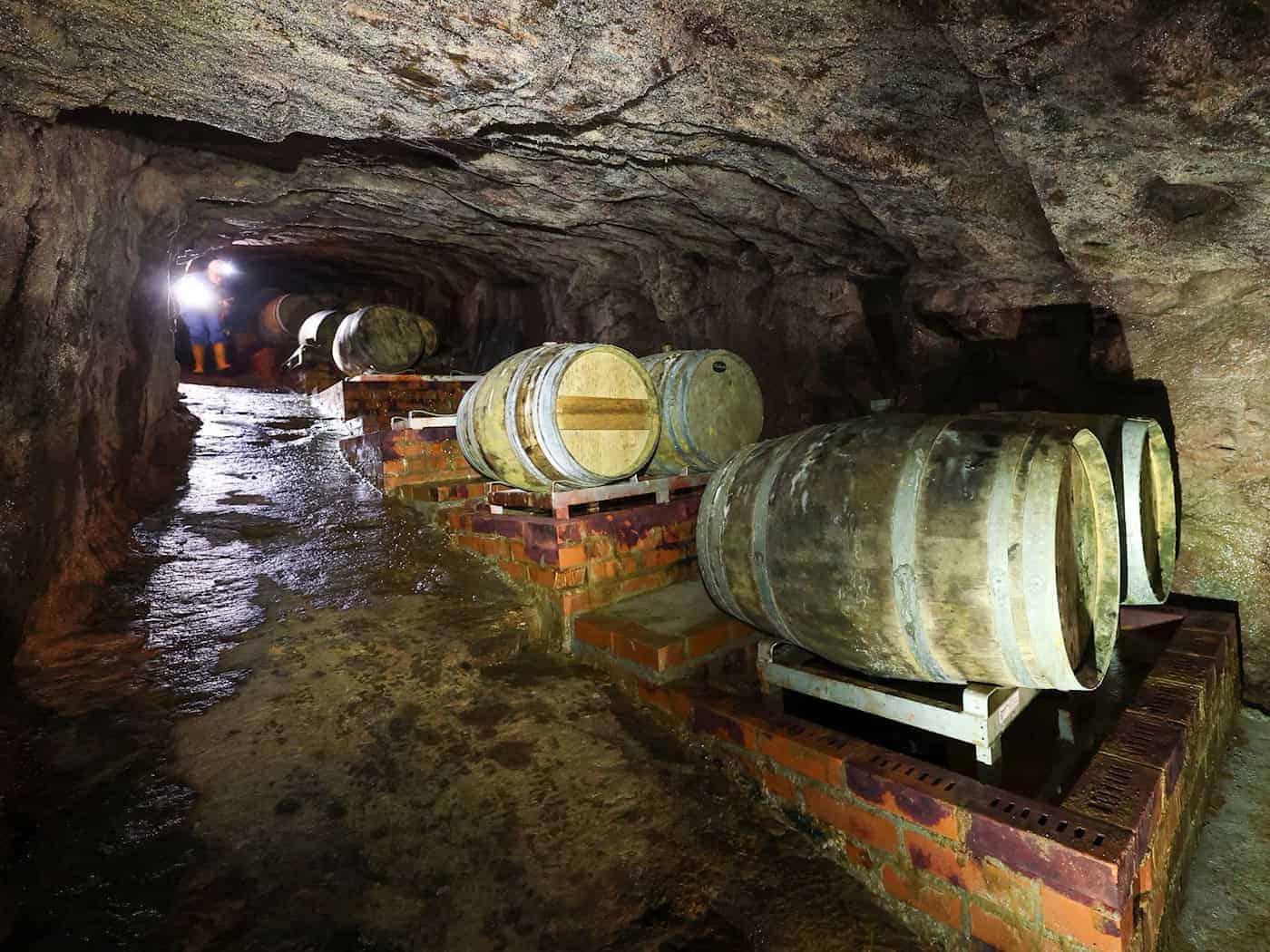
Whisky is stored in an old silver mine in Freiberg / Photo: Jennifer Brückner/dpa
From: DieSachsen News
Whisky matures in oak barrels in an old silver mine in Freiberg. Why the underground storage location is exciting for researchers and connoisseurs alike.

The way to whisky in Freiberg is via a pit cage. The metal cage rushes 147 meters down to the 1st level of the former "Reiche Zeche" silver mine. A few hundred meters below ground, you walk along a dimly lit horizontal corridor until you reach a red door with the sign "Sprengmittellager". Shortly behind it, an old tunnel branches off, in which 16 barrels of whisky are maturing. It is both a business and a research project.

The spirit comes from the Freiberg Whisky Manufactory. The company was founded ten years ago by 13 partners around Prof. Hans-Michael Eßlinger (70). The graduate engineer in brewing and beverage technology was head of the Freiberg brewery for many years and has now switched from beer to whisky for the connoisseur project.

More from this category

Beer's big brother

"Whisky is beer's big brother. It's the same raw materials, just without the hops. And the distillation is one step more than with beer," explains Eßlinger. The whisky matures particularly quickly in the mine. "We don't yet know exactly why that is. We just know that something good comes out of it," he says.

Overground, the conditions are constant - 12 degrees, 98 percent relative humidity and a stable breeze. Above ground, where most whiskies usually mature, the conditions are much more changeable. This causes the liquid level in the oak barrels in the mine to rise through diffusion, whereas it falls during conventional storage.

Research project on flavor formation

Eßlinger reports that scientific research is being carried out into what actually happens to the whisky in the old tunnel. The deposit is located in the TU Freiberg test mine. Two research projects are underway at the university, one on underground microbiology and another on flavor formation.

According to the Federal Association of the German Spirits Industry, whisky is one of the more popular spirits in Germany. In 2024, it accounted for 12.4 percent of the overall market - behind liqueur, vodka and grain, but ahead of drinks such as rum, fruit brandies and gin. Around six million people regularly treat themselves to a glass.

Scotch and bourbon dominate the trade

Whisky "Made in Germany" is an absolute niche. Scotch whisky was sold most frequently in 2024 with 19.3 million bottles, followed by 18.7 million bottles of bourbon or American whiskey and 7.8 million bottles of Irish whiskey. Of "other whisky", which also includes German production, 0.7 million bottles were sold.

The Freiberg-based company is a long way from such large figures - and doesn't even want to get there, as Eßlinger says. The manufactory sells around 1,000 bottles a year. In the old tunnel in the mine, where you can only stand bent over, there is barely enough room for more than 16 barrels.

The Freiberger Manufaktur, like the entire beer, wine and spirits industry, is also noticing that the desire for alcohol in Germany is declining. According to the association, turnover and sales of spirits fell by four and three percent respectively last year. "It's not so easy to say, "We're stepping on the gas a bit"," says Eßlinger.

Instead of focusing on quantity, the Freiberg-based company is working on quality: the first whisky will soon be matured at a depth of 147 meters for five years instead of the previous three.

Copyright 2026, dpa (www.dpa.de). All rights reserved

The translations are automated with the help of AI. We look forward to your feedback and your help in improving our multilingual service. Write to us at: language@diesachsen.com.
Sachsen News
Article from

Sachsen News

Sachsen News is responsible for the content itself. The platform's code of conduct applies. The platform checks and treats content in accordance with the legal requirements, in particular the NetzDG.

Social Media