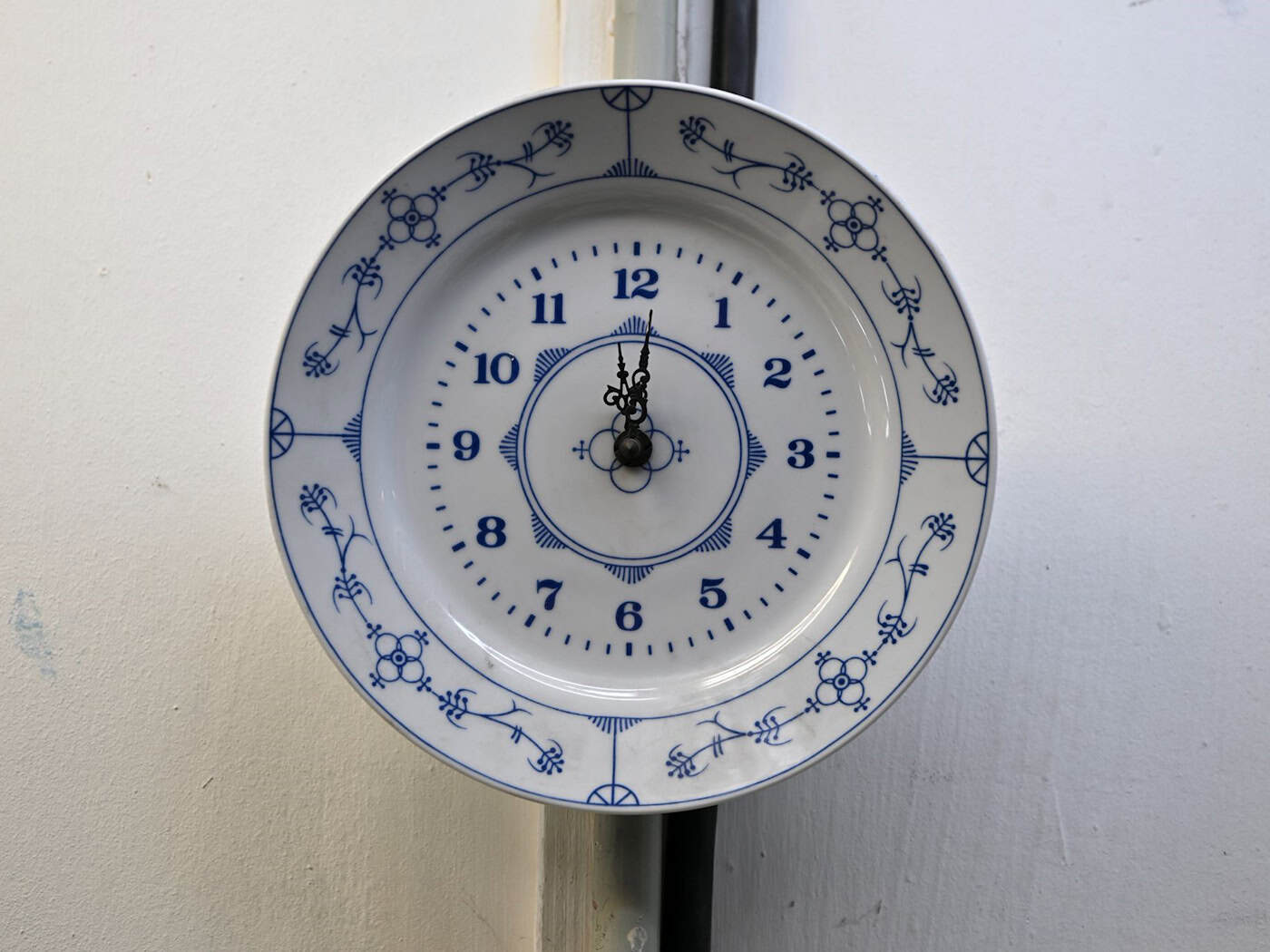
A loud hum can be heard constantly in the factory hall. “I’m actually going to miss the noise from the kiln,” says Nicole Roth, smiling and swallowing at the same time. “I actually thought I’d be here until retirement.” Roth, in her mid-40s, is the head of the decoration department at Kahla Porzellan GmbH. She smiles as she talks about the situation at the historic but insolvent company, where she completed her apprenticeship as a glass and porcelain painter. Sometimes, however, her eyes well up with tears. For exactly 182 years to the day after porcelain was first fired in Kahla, the large kiln there is now being shut down. In the presence of the staff and guests, the gas valves are being turned off for good. “It will take several hours for the kiln to cool down completely,” says production manager Frank Meinhardt-Ruppin. The kiln could be heated to 1,400 degrees to fire cups, plates, pitchers, and other pre-formed and pre-fired porcelain pieces, sometimes for hours at a time. Theoretically, 50,000 pieces could be fired per day in the 70-meter-long facility. “The more pieces that were fired, the more cost-effective the kiln’s operation was,” explains Christoph Schwieter. He was brought to Kahla a few months ago by insolvency administrator Rolf Rombach to serve as interim manager. Recently, however, the kiln had not been operating at sufficient capacity to run it effectively, adds Meinhardt-Ruppin. According to Schwieter, energy costs—which continued to rise even during bankruptcy—were the final straw for the plant. Gas prices on the exchange alone had risen sharply. The company’s energy costs had recently amounted to around 200,000 euros per month. However, the cost of gas alone would not have led to the insolvency proceedings initiated this spring. At the time, the company attributed its financial difficulties to a weak order book, consumer reluctance in the restaurant industry, and high energy costs. Schwieter, meanwhile, points out that investments had also been neglected in the past. Nevertheless, the machinery is technologically up to date. The large kiln will be sold. “To countries outside Europe,” Schwieter emphasizes. The number of porcelain manufacturers has now become manageable—and not just in Germany. Yet for a long time, eastern Germany in particular was known for industrial porcelain production—a sector that, at least within Europe, had its historical origins in Meissen porcelain. According to the state’s Ministry of Economic Affairs, the industry was booming in what is now Thuringia, and Kahla also became a well-known production site. As early as 1844, the famous blue strawflower pattern was being hand-painted onto cups and other items there. Eventually, during the GDR era, the city became the headquarters of the State-Owned Enterprise (VEB) Feinkeramik, which comprised 17 facilities with approximately 18,000 employees. About 2,300 of them worked in Kahla. After reunification, Kahla also faced privatization and its first bankruptcy. In 1994, Kahla/Thüringen Porzellan GmbH was reestablished. In 2020, the company filed for bankruptcy after a major contract fell through and was subsequently taken over by its most recent managing director, Daniel Jeschonowski. Before the bankruptcy six years ago, about 250 people were still working at the factory. In May, there was talk of 120 employees working at the company. That number has since dropped to around 100, and once porcelain production itself ends, it will be about 70. The company has received numerous design awards. Schwieter speaks of “innovative ideas” that were conceived and implemented in Kahla, citing, for example, dishwasher-safe felt decorations. According to Schwieter, the company thus responded to changes in customer buying behavior. A typical starter set of a full dinner service has long since ceased to be the norm. That is why Kahla has also focused on restaurants and hotels as customers. The production of promotional items—such as mugs with company logos and similar items—has also been an important area recently. In the decoration department, for example, mugs are currently being decorated for a café in Paris. “We’ve supplied them several times before,” recalls Roth. Although insolvency administrator Rombach had worked to find an investor after all, and the state of Thuringia had also been involved in the efforts; at the end of September, the announcement came that there was no economic basis for the long-term continuation of operations. Decoration manager Roth still remembers well the day she learned of her employer’s closure: “I cried—I cried a lot.” The mood among the staff is now mixed. Some say there’s nothing that can be done about it, while others still hold out hope that things will somehow continue. “And the majority of the staff is still here—I can count on them,” Roth emphasizes. The mood is particularly evident in the case of Heike Schache. Like many of her colleagues in the white goods production department, she had her last full day of work on Thursday. “I’ve been here for five years. It’s not pleasant,” she says. The 61-year-old doesn’t yet know what the future holds for her career. “That’s just how it is now… But maybe a miracle will still happen—you never know.” Meanwhile, Benedikt Bernshausen is really working up a sweat. As manager of the factory outlet, the 38-year-old has been running around nonstop for days. Ever since the news of Kahla’s closure broke, the rush at the factory outlet has been enormous. In some cases, cars are already backing up at the exit. “We’re now seeing 1,500 to 2,000 customers a day,” says Bernshausen. Normally, several hundred shoppers would come each day. These days have been an “emotional roller coaster,” says Bernshausen, who, although he has only been working at Kahla for a little over six years, knows the company’s history better than almost anyone else. Customers often feel the need to talk about their own connections to Kahla and the tableware, sharing anecdotes and taking a personal interest in the fate of the company and its employees. “We laugh together, but sometimes you also feel a lump in your throat. “The wave of empathy is huge,” says Bernshausen. Christian Koseck is one such customer at the factory outlet. “This is probably the last time we’ll be able to buy anything here,” he explains. He traveled all the way from Leipzig with his family, including two small children. Kahla tableware is part of the family’s everyday life. “Now we want to pick up what we’re missing—or what’s already broken.” For the native of Thuringia himself, however, the connection to Kahla porcelain has always been there: “I grew up with this tableware and had plates with beautiful children’s designs.” The factory outlet is set to remain open into next year, as long as possible. Nicole Roth’s decorative line has also been granted a grace period; there are still orders to be fulfilled there. But there’s also a glimmer of hope: Insolvency administrator Rombach says they’re working “flat out” to find at least a “small solution” in Kahla. The goal is to preserve the brand and the decorative division. Roth beams at the thought: “I’m hopeful and would love to see this continue.” Copyright 2026, dpa (www.dpa.de). All rights reservedHigh energy costs, weak order book
Once 18,000 Employees at VEB Feinkeramik
It’s been clear since the end of September: “I cried a lot”
Huge crowds at the factory outlet: “a massive wave of empathy”
Tableware that’s been a part of his life since childhood