

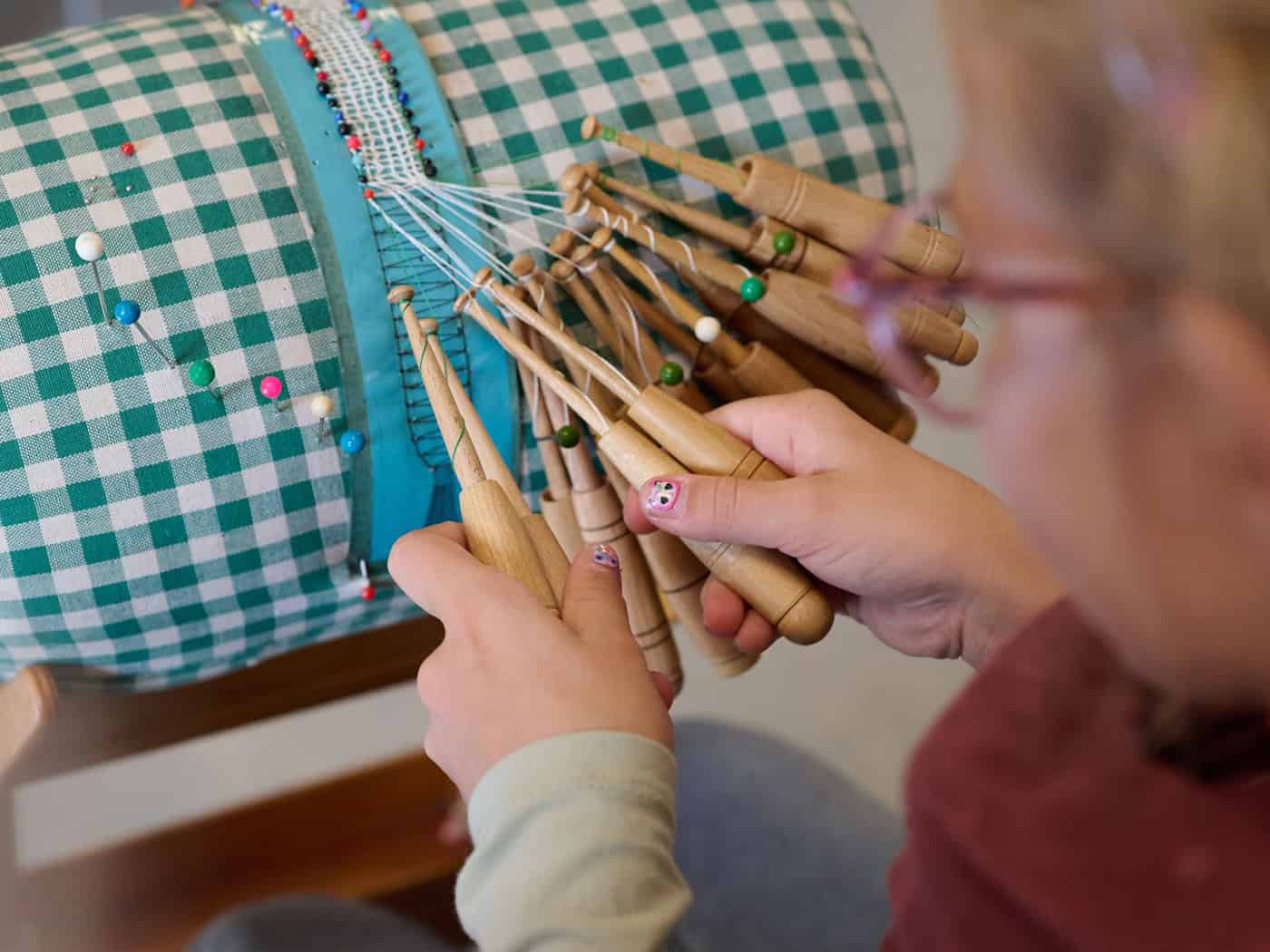
“Clack, clack, clack”—The entire room at the bobbin lace school in Annaberg-Buchholz is filled with the clattering of wooden bobbins. It’s a sound typical of the Ore Mountains. Hands big and small twist and cross threads on their colorful bobbin bags. Every now and then, they stick numerous pins into the bags to secure the work in progress or to hang unused bobbins to the side. Any of the students who aren’t fully focused chat with the girl next to them, while a jellyfish, a rooster, or a fox takes shape in the colorful threads. “Manu, can you help me?” is a phrase heard again and again when one of the students has “lost her way,” as bobbin lace teacher Manuela Fischer calls it. Now Fischer hurries over to Maja. The nine-year-old has only recently started taking bobbin lace classes. Nevertheless, she’s already working away nimbly—though sometimes a little too fast. Then teacher Manu steps in to help, twisting and turning the threads until they’re back in the right place. Bobbin lace-making is a craft technique that consists of just two movements: twisting and crossing, as Manuela Fischer explains. “Bobbin lace-making is a kind of braiding,” she adds. Maja listens attentively, nods, and then takes the threads back into her own hands. “Well, I’ve been here with my class before, and that’s when I realized I really enjoy it, which is why I’m here now,” says the nine-year-old, who is currently making a bird with her bobbins. She likes coming here “because it calms my nerves,” Maja says cheerfully. Alongside the girls, three older women are also working on their projects at the bobbin lace school—one of them because of her granddaughter. “That was at the beginning of the year. Emilia came over and asked, ‘Grandma, are you coming with me?’ I said, ‘Yes, that sounds great, because I used to do bobbin lace myself when I was a teenager,’” says 69-year-old Karin Schwabe. But the most important thing about this shared hobby, she explains, is “spending time together with the kids—that’s wonderful.” Her granddaughter Emilia feels the same way. She does bobbin lace because “it helps you wind down a bit after a stressful day at school.” And just as important, she says, is “simply being together with others.” Bobbin lace-making is closely intertwined with the Ore Mountains—and has been for more than 450 years, according to records. The bobbin lacemaker is depicted alongside a woodcarver and two miners in the traditional “Schwibbogen” motif. Barbara Uthmann became particularly well-known for this; in the 16th century, she is said to have employed up to 900 borte weavers and played a key role in spreading bobbin lace-making throughout the Ore Mountains. The bobbin lace school in Annaberg-Buchholz is named after her. After mining dried up here, bobbin lace-making became the region’s main source of income, explains Manuela Fischer. And even today, people in the Ore Mountains still practice this handicraft, albeit primarily as a hobby. Emilia feels that it somehow connects her to her homeland. “It’s just kind of part of who we are,” says Kimberly, another bobbin lace student, “because my older sister did it, my mom did it, and my two younger siblings do it, too.” Bobbin lace-making also brings joy to the younger generation—you can really feel it in the room. Unfortunately, many people still think of grandma’s doilies when they hear “bobbin lace,” says Steffi Schneider, a bobbin lace expert and director of the Schwarzenberg Adult Education Center. But bobbin lace-making has really changed since then; nowadays, people make jewelry with it or create three-dimensional pieces using wire. “Well, you have to be a little modern to attract people,” agrees Manuela Fischer. She provides the children with a full range of colors and also works with glitter and beads. While there are no figures on how many children and young people in Saxony are actively doing bobbin lace or know how to do it, But it’s still very much alive in the Ore Mountains, says Schneider. “We’re not worried about the next generation,” she adds. The Saxon-Ore Mountains Bobbin Lace Association (SEKV) also estimates that the number of course participants has remained constant in recent years. What’s missing, however, explains Manuela Fischer, is the middle age group. “People between 20 and 40—that’s what we’re missing,” says Fischer. A glance around her classroom confirms this—elementary schoolgirls, teenagers, and older women are seated here at their bobbin lace bags. Equally absent: boys and men. They are in the minority when it comes to this hobby. Yet in the Ore Mountains, men also used to sit at the bobbin lace bags, especially when the region depended on bobbin lace-making for its livelihood, as Fischer explains. According to Fischer, however, men do occasionally show up in her classes. “We always had a boy here, right in this group—unfortunately, he doesn’t come anymore,” says Fischer. Many other children in Manuela Fischer’s classes, on the other hand, would like to keep bobbin lace-making as a hobby—as Emilia and 13-year-old Kimberly, for example, report. Some are even passing it on themselves. One of Fischer’s former students moved to Halle for college and now leads a children’s bobbin lace group there, as the instructor explains. “It’s always a joy to run into kids from back then and see that they’re still making bobbin lace.” In this case, even beyond the Ore Mountains. Copyright 2026, dpa (www.dpa.de). All rights reservedA Shared Experience to Combat Stress
Tradition in the Ore Mountains
More than just Grandma’s lace doilies?
Plenty of young people, hardly any men
A lifelong connection


