

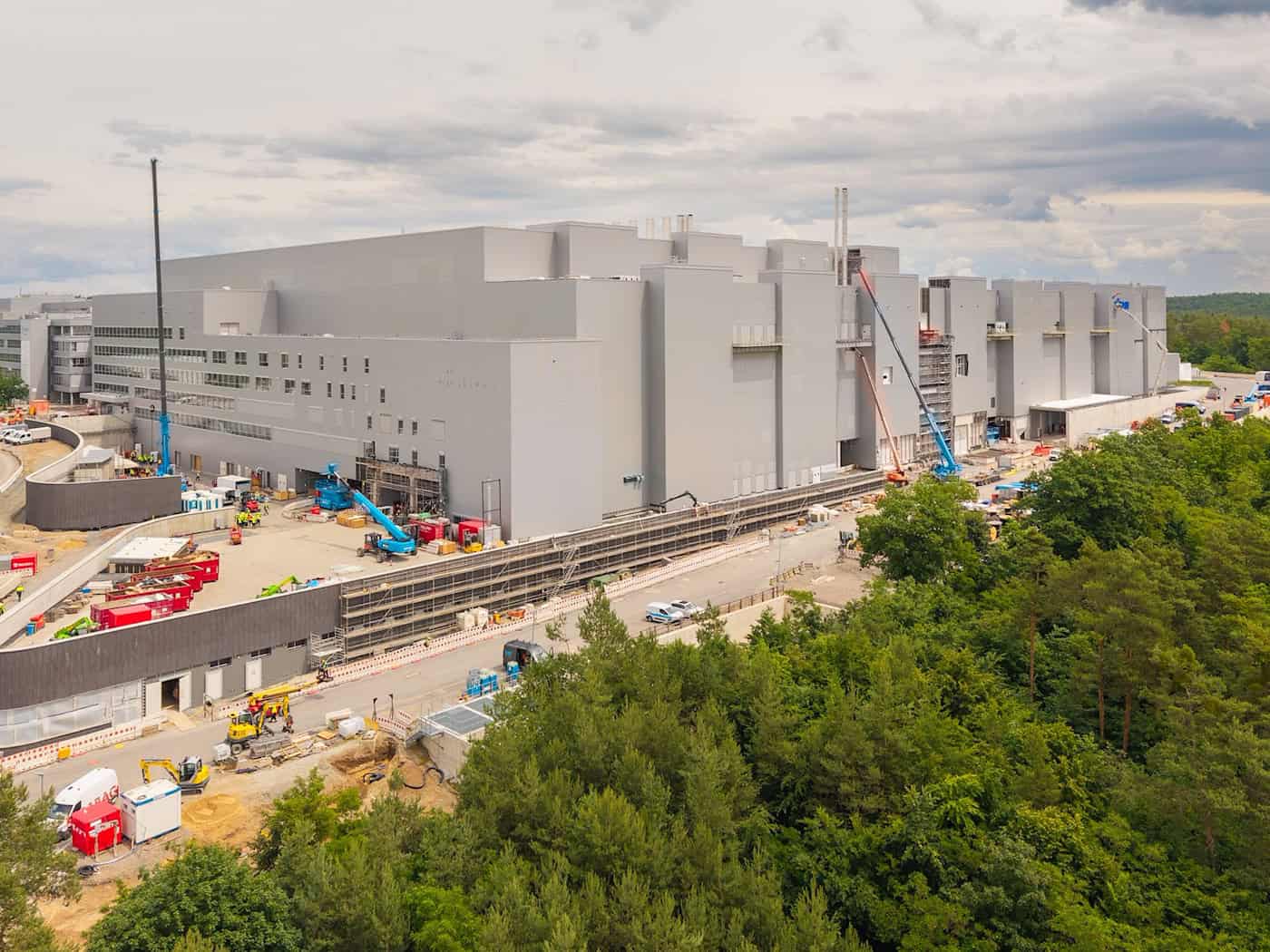
Chip manufacturer Infineon plans to double its production capacity in Dresden. When the new plant officially begins operations on July 2, the company’s largest investment at this location will be completed ahead of schedule. About three months earlier than planned, chips are set to be produced here on 300-millimeter wafers. This will create around 1,000 additional jobs. Just three years have passed since the groundbreaking in early May 2023 until completion—a rare occurrence in Germany. The rapid pace prompted Saxony’s Minister President Michael Kretschmer (CDU) to jokingly ask during a site visit whether Infineon might not also want to build a replacement for Dresden’s collapsed Carolabrücke. The construction facts are impressive. Around 450,000 cubic meters of earth were excavated for the new plant—Infineon compares this volume to the capacity of 180 Olympic-sized swimming pools. A total of 35,000 tons of steel were used—according to the company, that’s equivalent to five Eiffel Towers—and 150,000 cubic meters of concrete. A truck drove onto the construction site every two minutes, where up to 2,400 people were employed at peak times. The transport operations left a lot of mud on the access road, especially in the fall and winter. Infineon made amends to affected residents by offering free car washes. The factory building rises over 40 meters high and extends 22 meters deep. The cleanroom covers an area of about three soccer fields across two floors. Production takes place under yellow light. Its wavelength protects the sensitive photoresists needed to structure the microchips. The temperature is a constant 22 degrees, and the humidity is 41 percent. The heart of the Smart Power Fab is the cleanroom. At full capacity, approximately 1,000 high-tech systems manufacture highly complex semiconductors in hundreds of production steps. Below the cleanroom, electricity, water, and technical gases are treated and then routed to the systems. The flawless production of the microscopic chip structures requires a dust-free environment. In the cleanroom, there may be a maximum of one dust particle larger than 0.5 micrometers in ten liters of air. By comparison: a sheet of printer paper is 250 times thicker. Special clothing and strict rules of conduct are designed to prevent employees from introducing particles into the production halls. That is why a strict dress code applies. Makeup and jewelry are prohibited in the cleanroom. Smoking before work is also strictly forbidden. Staff are required to move slowly and deliberately. There should be no rushing here. A wafer transport system is designed to ensure smooth operations. It moves the wafers fully automatically from machine to machine—like a monorail with vehicles traveling on ceiling rails at a speed of 3.5 meters per second. Central software tracks the location of each wafer and determines which production station it needs to go to next. The factory is powered 100 percent by green electricity. “We completely avoid using natural gas. We use industrial water instead of drinking water,” says Chief Production Officer Alexander Gorski. The goal is a recycling rate of 45 percent. The aim is to return 90 percent of the water withdrawn to the water cycle with the same quality as when it was taken. Gorski is not shy about using superlatives elsewhere either, referring to a “flagship project” for Europe, Germany, and the Dresden region. “The flagship project stands for innovation, technological sovereignty, and scale.” Dresden has the largest factory for smart power semiconductors in Europe and one of the largest worldwide. They are “ready.” The plant cost around five billion euros, with just under a billion of that contributed by the public sector. The new fab in Dresden is also expected to contribute five billion euros in revenue growth. Infineon currently generates global revenue of around 16 billion euros. The new plant in Kulim (Malaysia) is expected to generate an additional five billion euros in revenue. Gorski does assume that the semiconductor industry will continue to be shaped by economic cycles in the future. But for now, he sees only signs of growth. He believes that the long-term growth drivers—decarbonization and digitalization—remain intact, says the executive, pointing to the boom in AI data centers. “This year alone, more than 700 billion U.S. dollars will be invested in the major hyperscalers. We’re seeing customer orders coming in. You can see that artificial intelligence is increasingly finding its way into private life, but of course also into business operations,” says Gorski, explaining his optimism. The Chief Production Officer is also looking beyond Infineon’s immediate scope. “We are helping to significantly strengthen Europe’s role as a semiconductor hub (...). The AI data centers currently being built and planned around the world would consume twice as much electricity in 2030 as they do today—a total equivalent to that of the entire Federal Republic of Germany. Gorski does not see a competitive disadvantage compared to Asian manufacturers. Energy in Germany is indeed expensive by international standards. “That is an important cost factor, but it is not the decisive cost factor.” The energy cost disadvantage can definitely be offset by economies of scale, automation, and wafer diameter. Added to this is a quality argument. “We have failure rates of just a few units per billion products shipped. Our customers worldwide, including in China, value this quality,” emphasizes Gorski. In the automotive sector, Infineon is number one—because, on the one hand, it is a technological leader, but also because it can offer much more in terms of quality. With Infineon’s investment, Silicon Saxony—Europe’s largest semiconductor cluster—continues to grow. With ESCM, led by Taiwanese industry giant TSMC, the next chip factory is already rising in the north of Dresden. Infineon is a partner here alongside Bosch and NXP. ESMC (European Semiconductor Manufacturing Company) is scheduled to be completed in 2027. For Thomas Richter, Managing Director of Infineon in Dresden, this concentration is no coincidence. He sees a major “gravitational pull” here. It is not just industry that makes the area attractive, but also science, with a high concentration of universities, colleges, and research institutes. The region is now home to the largest cluster in the industry in Europe and the fifth-largest worldwide. Already today, one in three chips produced in Europe comes from Dresden. Copyright 2026, dpa (www.dpa.de). All rights reservedHuge excavation pit for Infineon’s largest investment in Dresden
Cleanroom as large as three soccer fields
Strict regulations for the cleanroom
Plant is powered 100 percent by green electricity
Investment of five billion euros
AI investments are boosting business
Energy prices not the decisive cost factor
Next chip factory already visible on the Dresden horizon


