

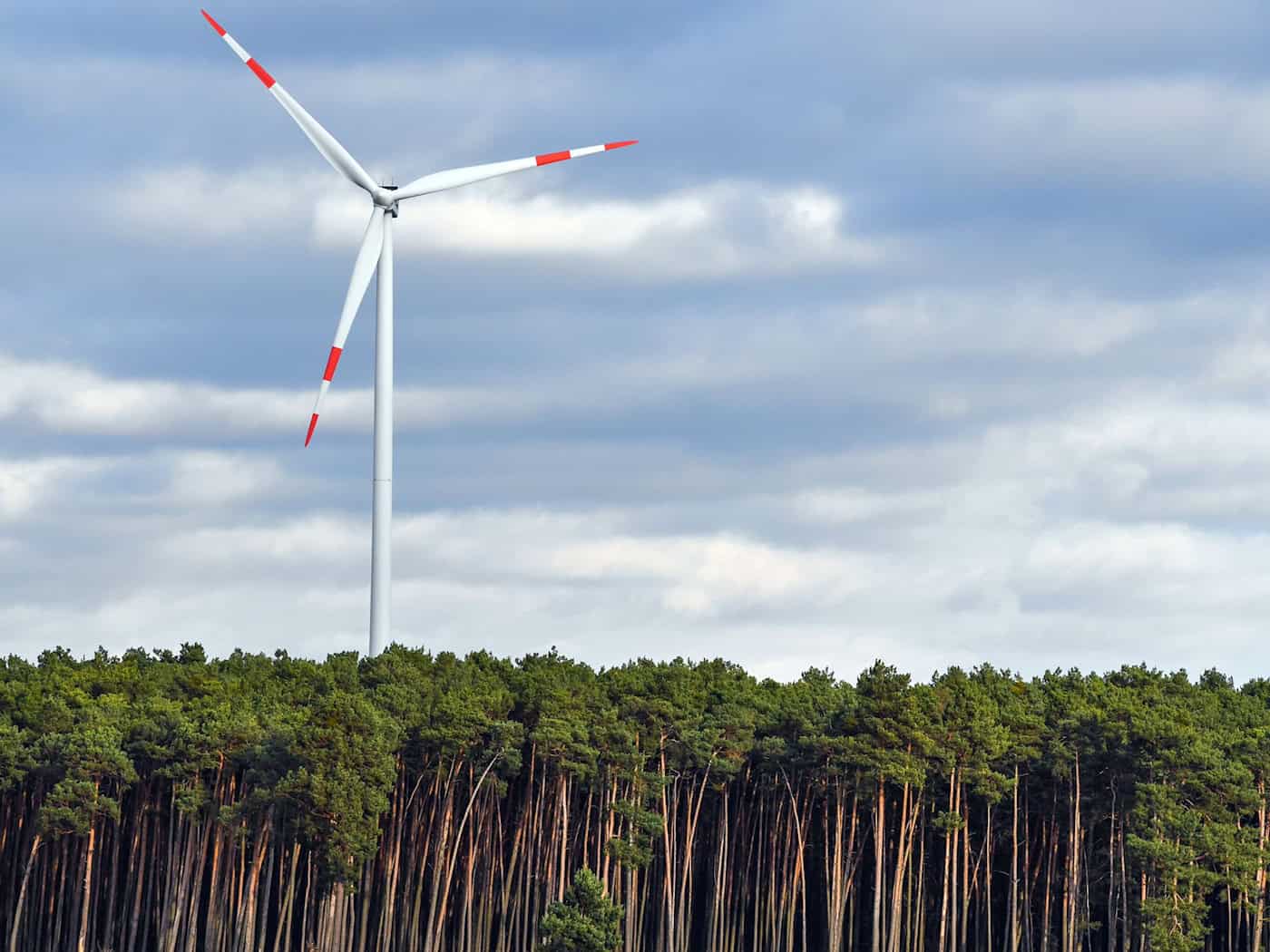
The Nature and Biodiversity Conservation Union of Germany (NABU) in Saxony generally opposes wind turbines in forests and calls for the expansion of renewable energy in a way that is compatible with nature. This stance stems from the fact that the Free State of Saxony is currently revising its regional plans to meet the legally mandated land allocation target of two percent of the state’s total area for wind energy. “NABU Saxony has reviewed all draft plans and has concluded that, in numerous cases, important requirements for nature and species conservation have not been sufficiently taken into account,” the association stated. Too many priority areas are located in forested areas. As an example, NABU cited the Upper Lusatia-Lower Silesia planning region. Here, 17 planned priority areas are located in forests. This makes the region the most severely affected of all four planning regions (Leipzig-Western Saxony, Chemnitz Region, and Upper Elbe Valley/Eastern Ore Mountains). According to federal guidelines, counties must designate at least 1.3 percent of their area as sites for wind turbines by the end of 2027, and two percent by 2032. NABU criticizes the fact that the expansion of renewable energy currently places a burden primarily on rural areas, while existing potential in cities often remains untapped. According to a parliamentary inquiry in the state legislature, Saxony had fewer than 100 photovoltaic (PV) systems installed on state-owned roofs in 2025, three PV systems on building facades, and not a single one installed over parking lots or other impervious surfaces. “The expansion of renewable energy is essential. However, it must be carried out in an environmentally sustainable manner and distribute the burdens between urban and rural areas as evenly as possible. Nature, the population, and climate protection must not be pitted against one another,” explained Nabu Chairwoman Maria Vlaic. The Nature Conservation Union pointed out that forests are among the most important natural climate protectors. “They store carbon, cool their surroundings, regulate the water cycle, and mitigate the effects of heat, heavy rain, and flooding. At the same time, they are indispensable habitats for numerous animal and plant species.” According to the current plans, however, forest areas are also to be used for wind energy. NABU argues that the construction of a wind turbine requires permanent use of land, including for foundations, crane sites, and access roads. For each turbine, approximately one hectare of forest must be cleared, and 0.5 hectares must be kept permanently free of trees. This would result in the loss of valuable forest areas and weaken the forest’s ecological functions. Vogtland District Administrator Thomas Hennig (CDU) is also highly critical of wind turbines in forests. The draft plan for the Vogtland district currently designates 34 wind energy zones. Seventy-five percent of this area is located above the forest. “Assuming an average of five to ten wind turbines per area, that would mean, purely mathematically, that up to 340 new wind turbines could be built in the Vogtland district. Three-quarters of them in the forest.” That is irresponsible. Copyright 2026, dpa (www.dpa.de). All rights reservedThe Upper Lusatia-Lower Silesia planning region is particularly affected
At 16 sites, there is a risk of a so-called “trap effect” for animals. NABU Sees Untapped Potential in Cities
Forests Protect the Climate and Biodiversity
Two hectares of forest must be cleared to build a wind turbine
The Vogtland District Also Criticizes Wind Power in Forests


