

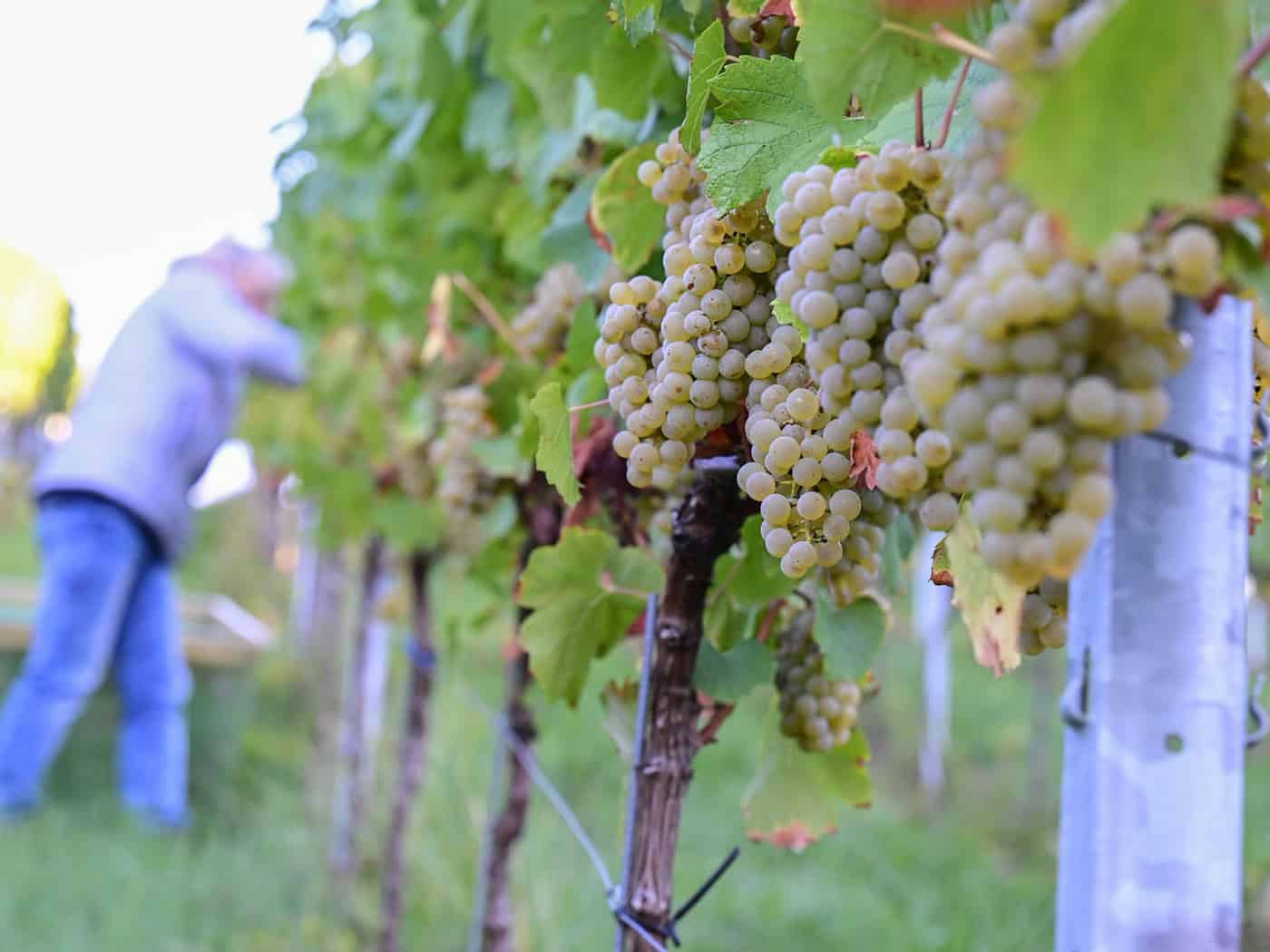
The 2026 grape harvest in Germany will not be quite as meager as feared. According to final estimates by winemakers, the amount of grape must produced will definitely be lower than the average of recent years, but not as low as the German Wine Institute (DWI) had most recently assumed. As the DWI announced in Bodenheim, Rheinhessen, the current projection is 7.7 million liters. That would be on par with last year’s level and ten percent below the average for the past ten years. Recently, the institute had forecast a volume 20 percent below the ten-year average of 8.7 million hectoliters. That would have resulted in the smallest harvest in 16 years. The Federal Statistical Office had projected a harvest four percent lower than the average for the years 2020 through 2025, at 8.0 million hectoliters. The latest survey showed slightly higher yields in some growing regions, explained DWI spokesperson Ernst Büscher. As in previous years, the Wine Institute reports significant regional differences, which are attributed to varying amounts of precipitation and the differing water-retention capacity of the soils. In the three largest wine-growing regions, the drought did not have as severe an impact as feared. In Rheinhessen, the yield is reportedly 2.3 billion hectoliters, on par with the previous year. The Palatinate is projected to produce 2.1 million hectoliters—12 percent more than in 2025, but still 5 percent below the ten-year average. The picture is similar in Baden: Here, the yield is estimated at around 1.0 million hectoliters, three percent above the previous year and 12 percent below the long-term average. According to the DWI, winemakers on the Moselle expect only 610,000 hectoliters, a full 13 percent below the ten-year average. Württemberg remains a full 21 percent below this average, with an estimated 700,000 hectoliters. The situation is different again in Hesse: The Rheingau, with 200,000 liters, is 18 percent above the previous year and 6 percent below the average, while the Hessian Bergstraße region shows an increase in both figures and expects 32,000 hectoliters. The Saale-Unstrut and Saxony regions, which were blessed with unusually large harvests last year, are slightly above the long-term average at 45,000 and 25,000 hectoliters, respectively, but at 24 percent and 14 percent, respectively, they are very significantly below the 2025 volume. According to the DWI, all 13 wine-growing regions report exceptionally high grape ripeness this year and first-class health. Very aromatic white wines, concentrated red wines, and first-class sweet wines are expected. Copyright 2026, dpa (www.dpa.de). All rights reservedSignificant Regional Differences
Increase in Hesse, low volume on the Moselle


