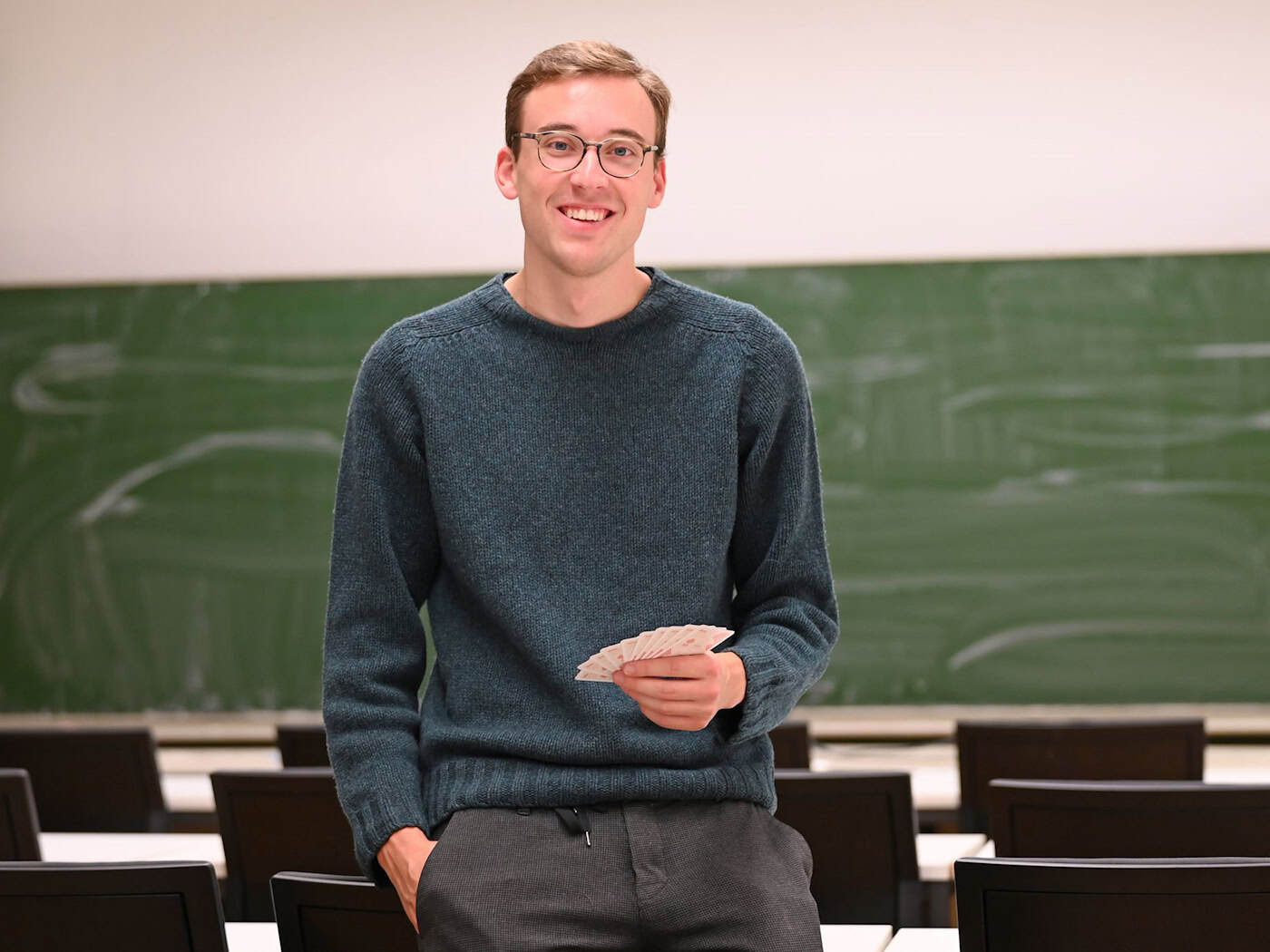
With a good deal of gusto, Marten Fiedler slams his Skat card down on the table. The ten of hearts now lies on top of his opponent’s queen of clubs. So he’s “played it” in the hope of scoring as many points as possible. Marten’s brother Lukas keeps a straight face. He has no clubs, but he’s also out of trumps; so he has to discard a card and thereby concede the next trick. About halfway through this game of Skat, things aren’t looking good at all for Lukas Fiedler. And in the end, he actually loses the Grand—that is, the game in which only the four jacks may be used as trumps. The suits were too unfavorably distributed for a win. But there’s hardly any time to dwell on it this Thursday evening in Leipzig. Because before Lukas can get upset about the loss or his older brother Marten can celebrate the victory, Florian Pieper steps in. Pieper, 39 years old with gray hair, actually works as a financial advisor. On this October evening, however, he’s out and about as a Skat instructor. Together with Theodor Liebing, he was crowned online world champion this year; since April, the two have also been hosting a weekly card game at the University of Applied Sciences for Economics, Technology, and Culture. The event is open not only to students at Leipzig’s universities but also to participants from outside the university. The only requirement is a basic knowledge of Skat. Seven young people—five men and two women—attended the first session of the semester. They’re seated at two tables—one for beginners and one for advanced players. On the other side of the seminar room stretches a large green chalkboard covered in smudged chalk drawings. The black chairs at the white tables are neatly lined up. Nothing here gives the impression of a rough pub game dominated by old men. Instead, concentration and mutual support prevail. Pieper and Liebing are thus giving this more than 200-year-old card game an academic twist. One of the participants this evening is Julia Andrae from Weimar. The 22-year-old was introduced to Skat by classmates in high school and often played cards with them during breaks. Today, Andrae is in her seventh semester studying to become an elementary school teacher. She last played about three years ago because she hasn’t found any fellow players in Leipzig yet, as she explains. And because the learning curve for Skat is linear at the beginning, as expert Pieper says, Andrae can hope to quickly brush up on the skills she learned in high school. Not everyone in the group that evening learned Skat exclusively in school. Lukas and Marten Fiedler, for example, were taught the card game by their families. Lukas says he was introduced to Skat by his older brother. The 27-year-old is now more advanced than Marten. Lukas was already there half a year ago when Pieper and Liebing first offered Skat through the university sports program. He has since even competed in the Young People’s Cup, a tournament for up-and-coming players. At 27, Fiedler is among the younger players in the scene. Online, the average age is 45, says Joachim Schreiner. For 20 years, he has been chairman of the German Online Skat Association in Zweibrücken, which he founded shortly before with a team. There are about 25,000 active players on the association’s server, as Schreiner reports. He estimates that only about 500 to 600 people are under 30. Skat has been losing popularity for a long time. Even online, it’s hard to compensate for its dwindling popularity because, unlike poker or chess, skat missed the boat when it came to digitization. Timo Strömel of the German Skat Association—the long-established governing body of the sport of skat, so to speak—also reports a decline in popularity. At the federation, headquartered in Altenburg, Thuringia, Strömel is in charge of youth programs. In 2024, the federation introduced a new age group for championships—22 to 35 years old—to make it easier for young players to compete against the Skat veterans. At least with programs at universities like the one offered by Pieper and Liebing, players can quickly improve their skills. Association representative Strömel estimates that about 15 to 20 university towns offer Skat programs. You need to bring a “healthy dose of ambition” if you want to get good, says world champion Pieper. It also requires patience, logical thinking, and a “feel for probabilities.” “Interpersonal skills” are also important, much like in poker, adds Liebing. So do you have to be a sly fox and bluff in Skat to succeed? Not exactly, because if you have a bad hand, you won’t get very far. But, as world champion Liebing explains, if you can tell from the other two players’ body language that they probably don’t have much in their hands, you might say “18”—that is, call the lowest bid. And then they might find something helpful in the Skat—that’s the name for the two face-down cards that the active player is allowed to pick up. And ultimately, it’s also about speed, as Thursday’s nearly two-hour training session demonstrates. Pieper needs only a quick glance at his hand to determine that the ten cards are suitable for a “zero ouvert” with a “91 percent probability of winning.” This means: If the player lays his cards face up on the table, as is the case with an “ouvert,” he still has a pretty good chance of not taking any tricks. Because that’s the goal in Nullspiel. This way, the otherwise worthless sevens, eights, and nines—in other words, all the low-value cards in a hand—can still be converted into points. A “Null ouvert” is worth 46 points, which is almost as many as a simple “Grand” game, which relies on aces. In general, numbers are a big part of the game when Pieper is at the table. This evening, he’s with the advanced players and regularly darts from one side of the table to the other to explain to everyone, with mathematical precision, how to get the most out of their cards. Meanwhile, fellow world champion Liebing casually strolls around the beginners’ table; he, too, has all the probabilities in his head. The 25-year-old studied applied mathematics at the University of Leipzig, but he didn’t take up Skat just because of the mathematical component. “I like it when chance plays a small role,” says Liebing. So how much luck is involved in Skat? If you play against a world champion for five minutes, you might have a chance. If you play for two hours, however, you hardly stand a chance, explains Pieper. Skat is, therefore, a game of probability. The longer you play, the lower the probability that you’ll get good cards in every round to compensate for a lack of skill. In Leipzig that evening, Pieper and Liebing had already boosted the participants’ knowledge of Skat. Although not all of the registered participants showed up, the duo managed to get at least one participant excited about the sport. At the end of her first Skat evening after a three-year hiatus, student teacher Julia Andrae already has a new goal in mind: “I’m really eager to take part in a tournament sometime.” Copyright 2026, dpa (www.dpa.de). All rights reservedAn academic twist on the roughly 200-year-old pub game
From College Sports to Tournament Play
A New Category to Counter the Downward Trend
Lightning-fast mental calculations
Chance also plays a role